
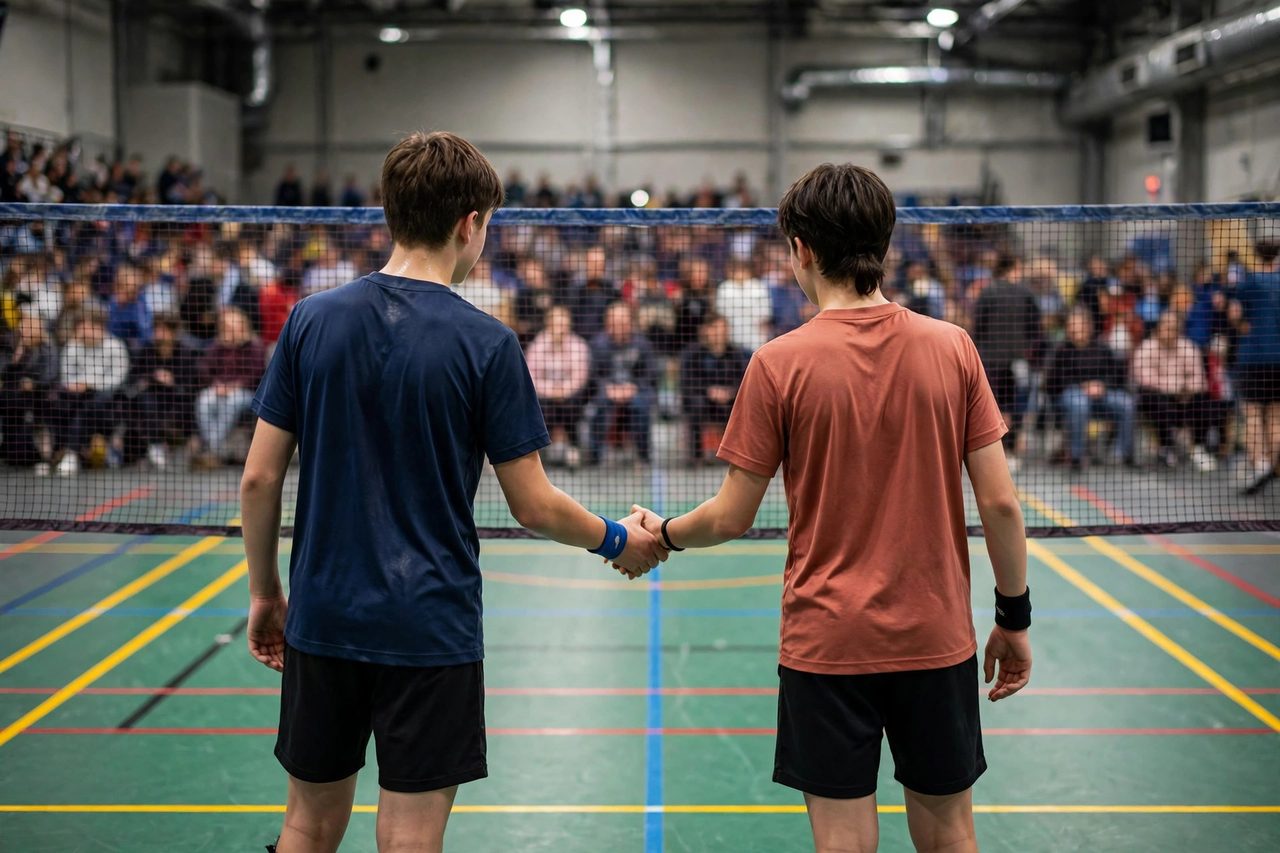
Every great badminton player was once a junior nobody had heard of. The BWF World Junior Championships is where those nobodies introduce themselves to the world. It is the sport’s biggest under-19 event, run every year by the Badminton World Federation, the sport’s world governing body.
If you want to know who will be winning senior titles in five years, this is the tournament to watch.
Two tournaments in one
The championships actually contain two separate competitions, played back to back over about 12 days. Up to 50 national teams and 400 players take part.
First comes the team event, the Suhandinata Cup. It is a mixed team championship, which means each tie — one match between two countries — is made up of boys’ and girls’ singles, doubles, and mixed doubles. Countries play each other as teams, not as individuals, and the whole squad shares the win or the loss.
Then comes the individual event, the Eye Level Cups. Here players compete for themselves in five categories: boys’ singles, girls’ singles, boys’ doubles, girls’ doubles, and mixed doubles. This is the part that produces individual world junior champions.
The team event first, then the individual event: that order matters. Players arrive, get used to the arena and the pressure while playing for their country, and then carry that confidence into their own events.
Who can play
The age limit is the whole point. This is an under-19 championship, so every player is 18 or younger during the event year. That is why the tournament feels so raw. The players have huge talent but not yet the experience, the patience, or the physical strength of senior stars. Matches swing wildly. Leads disappear. Unknown players beat famous juniors.
For many of them, this is the first time they have ever represented their country at a world event. That is a big deal. Wearing your country’s shirt, hearing your anthem, playing with a whole team behind you — it is the closest most teenagers get to the senior game, and it shows who can handle the pressure.
A new team format
Team badminton has traditionally been simple: play five matches, win three, take the tie. The 2025 edition in Guwahati, India, tried something different — a relay-style format.
In the relay format, a tie is best of three sets, and each set is played to 45 points. A set is a chunk of a match, and in this format each set is built from five matches in a row: men’s singles, women’s singles, men’s doubles, women’s doubles, and mixed doubles, with the points adding up as the set goes on. Win two sets, win the tie.
The idea is to make team matches faster, more dramatic, and easier to follow on television. Every point counts toward the same running total, so a match is never dead until the final point. Traditionalists grumbled. Younger fans loved it. Either way, it shows the BWF is willing to experiment with its junior event in ways it would not dare at senior level.
The 2025 championships in Guwahati ran from October 6 to 19, with the team event first and the individual event second. Thirty-six national teams took part in the team competition. The 2026 edition is set for Cairo, Egypt.
Why it matters
The junior worlds have a strong record of spotting future stars. India’s Saina Nehwal won the girls’ singles gold in 2008, when India last hosted the event in Pune, and went on to become world No. 1 and an Olympic medallist. India’s Lakshya Sen won a boys’ singles bronze in 2018 and is now one of the senior game’s leading names.
That pattern repeats across countries. Today’s junior champion is often tomorrow’s senior contender. Coaches and scouts know it, which is why the stands at the junior worlds are full of people taking notes.
But the tournament is not just a scouting exercise. For the players, it is an education. They learn to handle travel, media, pressure, and defeat at world level before the senior tour demands it of them. A player who copes with a junior world semi-final at 17 is better prepared for a senior quarter-final at 22.
A short history
The championships began in Jakarta, Indonesia, in 1992 as an individual event. It became an annual event from 2007, and the team competition grew up alongside it. The team trophy is named after Suhandinata, an Indonesian badminton figure, which is fitting for a sport where Indonesia has always been a powerhouse.
China, Indonesia, Malaysia, Japan, and South Korea have traditionally dominated, but the field keeps widening. France, Denmark, and India have all produced junior medallists in recent years. The gap between the old powers and the rest is shrinking, which makes each edition less predictable than the last.
How to follow it
If you are new to the junior game, start with the team event. National pride makes every point louder, and the relay format means a tie can turn in minutes. Then pick a few individual events to follow. Singles is the easiest way in: two players, one court, nowhere to hide.
Watch for the players who win ugly, not just the ones who hit pretty shots. Juniors who defend well, stay calm when they are losing, and find a way through bad days are the ones who usually make it as seniors. Talent gets you to the junior worlds. Temperament gets you out of them and onto the senior tour.
That is the real prize on offer. Not just a medal, but proof — to yourself, to your federation, and to the watching world — that you belong at the next level.
Related articles
How the Indonesia Open Works
Badminton's loudest week: a simple guide to the Super 1000 in Jakarta, its format, its history and why Istora Senayan matters.
How the Malaysia Open Works
Badminton's season opener in Kuala Lumpur: a simple guide to the Super 1000, its format, its fans and its history.
How the European Badminton Championships Work
Five titles, one week, and the best players in Europe: here is how badminton's biggest continental event works.