
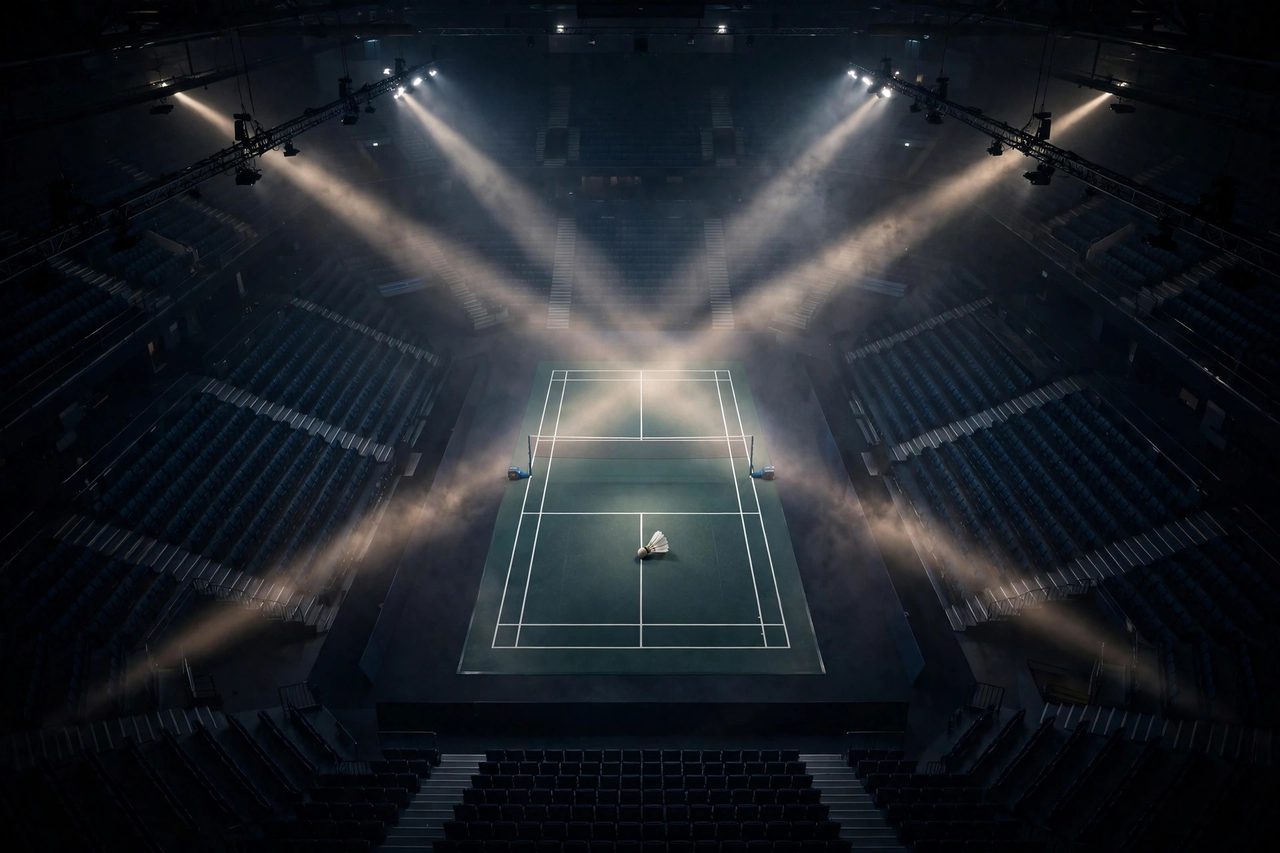
When the French Open is introduced as a “Super 750”, most viewers hear it as marketing. It isn’t. The Super number is the single most important label on the professional badminton calendar: it fixes the prize money, the ranking points, the size of the field and, for the top players, whether they are even allowed to stay home.
The HSBC BWF World Tour, launched in 2018, is a pyramid of five tournament levels. Here is what each one means.
The pyramid, top to bottom
Super 1000 — The majors of the weekly circuit. Four tournaments through the 2026 season: the Malaysia Open, All England, Indonesia Open and China Open. The winner takes 12,000 ranking points, and each event guarantees at least $1.45 million in prize money. The fields are 32-strong straight knockouts with no qualifying, and the commitment rules are strict: the world’s top 15 singles players and top 10 doubles pairs must enter every Super 1000, barring an official exemption. Miss one without one, and the BWF fines you.
Super 750 — One rung down, still the sport’s flagship tier in Europe. Six events, including the Denmark Open, French Open, Japan Open, China Masters, India Open and Singapore Open. Winners earn 11,000 points; minimum prize money is $950,000. This is the tier where almost every famous European badminton week lives — the Arena Grand Paris is a Super 750 arena this week.
Super 500 — The working heart of the tour. Nine tournaments, from the Arctic Open in Finland to the Korea Open and Hong Kong Open. The winner gets 9,200 points and a cut of at least $500,000. For players ranked 20–40, the Super 500s are the battleground where careers are made or stall: good enough fields to move the needle, accessible enough to actually win matches.
Super 300 — The tour’s grassroots elite. Eleven events — the Swiss Open, German Open, US Open, Thailand Masters, Orléans Masters and others — worth 7,000 points to the winner and at least $250,000 overall. This is where rising juniors get their first taste of senior finals and where veterans rebuild rankings after injury.
Super 100 — The entry level, offering 5,500 points and at least $120,000. Formally associated with the tour rather than fully part of it — until now.
What the points are for
BWF rankings run on a rolling 52-week window: your best results count, old ones expire. That is why a player who stops competing slides fast — and why the protected ranking that Shi Yu Qi has just applied for exists at all.
There is also a second, separate race running all year: the World Tour standings, which count only points earned at World Tour events in the current season. The top eight in each discipline qualify for the season-ending World Tour Finals, a $3.5 million shootout where the winner banks another 12,000 points. (For how that finale works, see our piece on the World Tour Finals format.)
Note what is not on the tour: the BWF World Championships and the Olympics. They award the most points of all — 13,000 to the winner — but they sit outside the pyramid, won by qualification rather than by tour standing.
The 2027 overhaul
Everything above is about to change. In February 2026 the BWF announced a sweeping revamp from 2027: 36 tournaments across six levels, with the Super 100 folded fully into the circuit for the first time. The five Super 1000s — with the Denmark Open joining Malaysia, England, Indonesia and China — will each offer at least $2 million, stretch to 11 days across two weekends, and play singles through a 48-player group stage before the knockouts. Super 750s rise to $1.1 million minimums. Total annual prize money across the tour climbs to roughly $26.9 million.
The aim, in BWF president Patama Leeswadtrakul’s words, is “a sport that speaks to the next generation.” For fans, the translation is simpler: more events that matter, bigger stakes, and no more ambiguity about what a Super number means.
Related articles
How the Indonesia Open Works
Badminton's loudest week: a simple guide to the Super 1000 in Jakarta, its format, its history and why Istora Senayan matters.
How the Malaysia Open Works
Badminton's season opener in Kuala Lumpur: a simple guide to the Super 1000, its format, its fans and its history.
How the European Badminton Championships Work
Five titles, one week, and the best players in Europe: here is how badminton's biggest continental event works.