
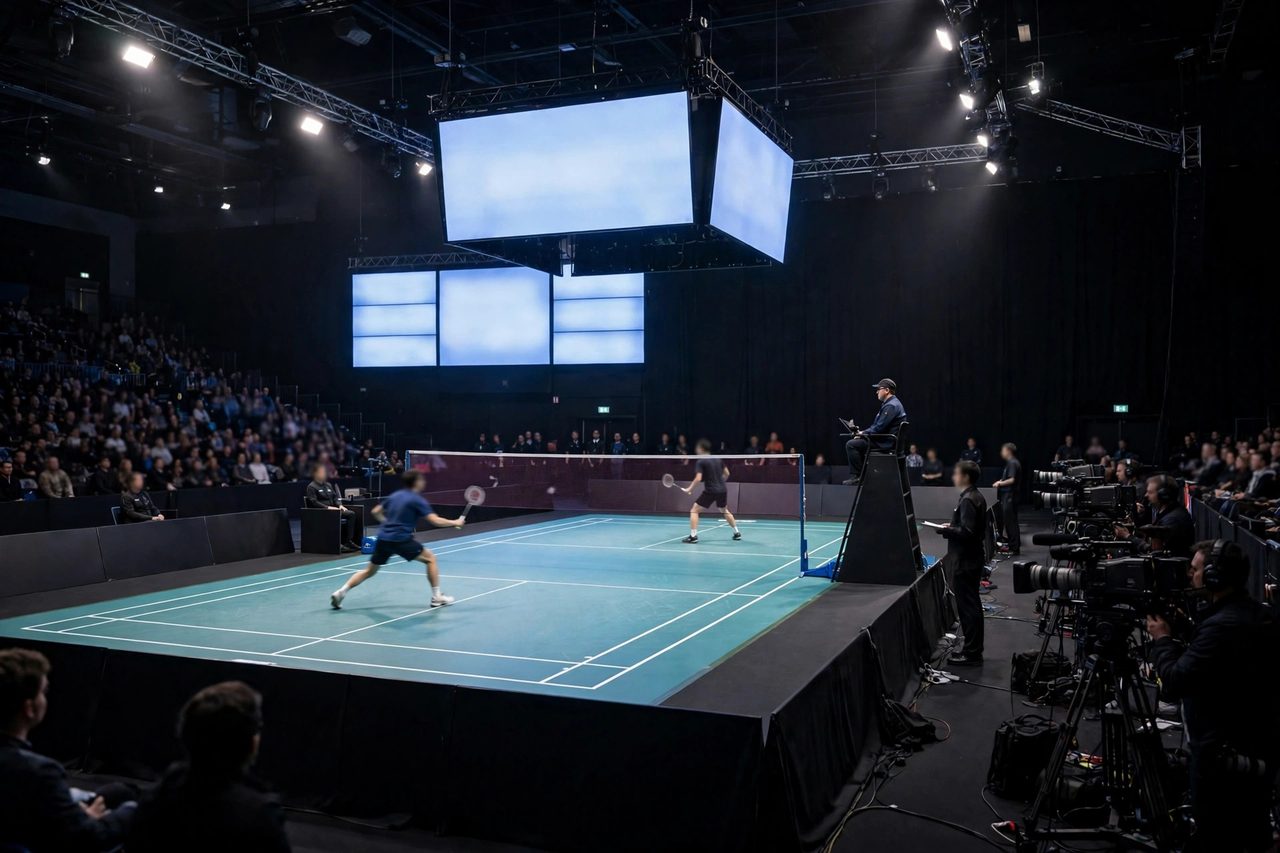
Every Thursday, the Badminton World Federation — the sport’s global governing body, known as the BWF — publishes a new set of world rankings. Those lists decide who gets into tournaments, who is seeded, and who qualifies for the Olympics. But how do they actually work? The answer is simpler than it looks, and stranger than you might expect.
The basic idea
Players earn ranking points by playing in tournaments that the BWF grades. A graded tournament is an official event on the BWF calendar, with a set level that decides how many points are on offer.
The higher the level of the tournament, the more points you can win. The Super 1000 events — the top tier of the World Tour — offer the most. Below them come the Super 750s, Super 500s, Super 300s and Super 100s. Above them all sit the World Championships, the Olympic Games and the season-ending World Tour Finals, which offer the biggest hauls of all.
The further you go in a tournament, the more points you get. Winning earns more than reaching the final, which earns more than a semi-final, and so on. Even losing in the first round usually earns a few points, as long as you played.
There is one ranking list for each of the five disciplines: men’s singles, women’s singles, men’s doubles, women’s doubles and mixed doubles. Mixed doubles is the event where each pair is made up of one man and one woman.
The best 10 rule
Here is the part that surprises most fans. Your ranking is not based on every tournament you play. It is based on your best 10 results in the last 52 weeks — one year.
If you play 10 or fewer graded tournaments in the last year, all of your points count. If you play 11 or more, only your 10 highest-scoring results count, and the rest are ignored.
That means playing more tournaments does not automatically mean a higher ranking. Once you have 10 good results, an 11th tournament only helps you if it scores more than your worst result so far. If it scores less, it changes nothing.
This is why top players pick their schedules carefully. Playing every week sounds like a good idea, but it brings tiredness and injury risk for no ranking gain. Playing fewer, bigger events — and doing well in them — is often the smarter route to the top.
The 52-week window
Points do not last forever. Every point you earn stays on your ranking for exactly 52 weeks, and then it drops off.
That creates a constant pressure that fans sometimes miss. A player is not just trying to win new points. They are also trying to defend the points they won last year. If you won a big title last October, those points vanish this October unless you do well in the same event again.
This is why rankings can fall even when a player is not playing badly. If last year’s points expire and this year’s results are only slightly worse, the total goes down. A three-month injury break can cost a player 20 or 30 ranking places, because several big results expire while they are out.
It also explains why comebacks take time. A player returning from injury cannot jump straight back to the top with one good week. They have to rebuild their best 10, tournament by tournament, while old points keep dropping away.
What the ranking decides
The ranking is not just a list for fans to argue about. It runs the sport.
First, seedings. A seed is a ranking-based spot in the draw that keeps the best players apart in the early rounds. Tournament seedings are based on the world ranking, so the No. 1 seed and the No. 2 seed cannot meet until the final.
Second, entry. Most big tournaments have limited places. The ranking decides who gets in directly and who has to play qualifying rounds first. A qualifier is a player who has to win a small pre-tournament event just to reach the main draw.
Third, Olympic qualification. The Olympic Games and World Championships qualification systems are based on the world ranking. If you are not ranked high enough when the qualification window closes, you do not go — no matter how famous you are.
Fourth, the World Tour Finals. The season-ending event for the year’s best players uses a separate but related list — the Race to the Finals, which counts only results from the current calendar year. The top eight in each discipline qualify. The world ranking still matters here, because it decides who gets into the tournaments where Race points are won.
The quirks
The system has a few quirks worth knowing.
Ties are broken in a specific way. If two players have exactly the same points, the one who has played in more tournaments ranks higher. If they have played the same number of tournaments too, they are ranked equal — so you can sometimes see two players both listed at No. 6, with the next player at No. 9.
The ranking is also a lagging measure, not a form guide. Because it looks back over a full year, it can rank a player highly even if they are out of form right now, and it can underrate a young player who has only just started winning. The Race to the Finals, which counts only this year’s results, is a better guide to who is hot right now.
And the ranking can be frozen. During the pandemic, when tournaments were cancelled in large numbers, the BWF froze the rankings so players would not lose points through no fault of their own. It was a reminder that the ranking is a set of rules made by people, not a law of nature — and it can be changed when the sport needs it.
Why it matters this week
Look at the Hylo Open draw and you can see the system at work. PV Sindhu is ranked world No. 11 but seeded second in Saarbrücken, because several higher-ranked players are absent. Christo Popov became world No. 1 this week because his French Open title gave him enough points to pass everyone else. Lakshya Sen’s ranking has slid because his early exits this year have not replaced the points he earned in better seasons.
Every match this week will move points around. Some players will defend last year’s points and stay where they are. Some will gain, some will lose. And next Thursday, when the new list comes out, the whole sport will shift slightly — one tournament at a time.
Related articles
How the Indonesia Open Works
Badminton's loudest week: a simple guide to the Super 1000 in Jakarta, its format, its history and why Istora Senayan matters.
How the Malaysia Open Works
Badminton's season opener in Kuala Lumpur: a simple guide to the Super 1000, its format, its fans and its history.
How the European Badminton Championships Work
Five titles, one week, and the best players in Europe: here is how badminton's biggest continental event works.