
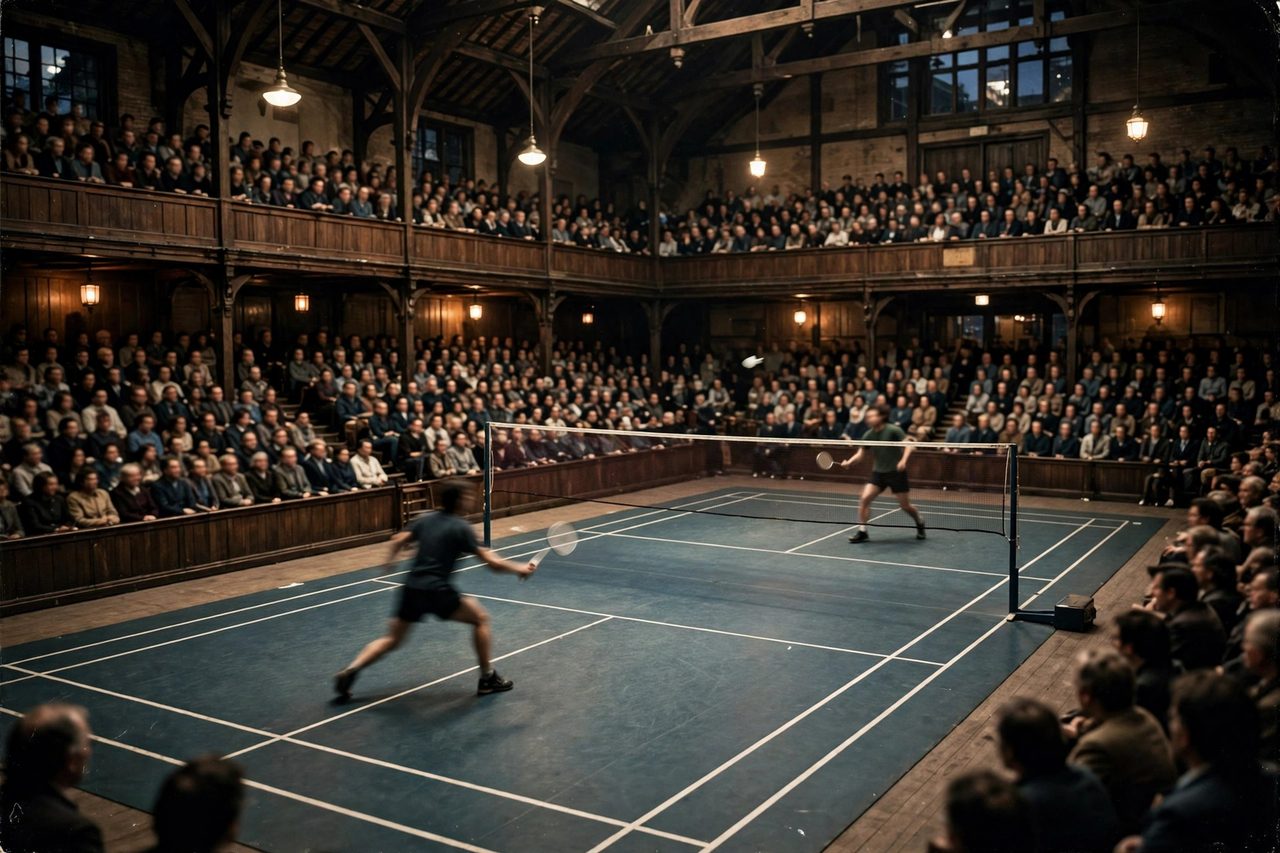
Every sport has a tournament that means more than the rest. In tennis, it is Wimbledon. In badminton, it is the All England Open.
First played in 1899, the All England is the oldest badminton tournament in the world. Winning it puts your name on a list that goes back more than 125 years. For players, it is the title every great wants on their record.
Here is how it works, and why it still matters so much.
The oldest tournament in the sport
The story starts in Guildford, England, in 1898. A small open tournament there worked so well that organisers staged a bigger one the next year at London’s Horticultural Halls. That was the first All England, in 1899.
The first edition featured only doubles. Doubles means two players on each side of the net, as opposed to singles, where it is one against one. Singles were added the following year, in 1900.
For decades, the All England was the unofficial world championship of badminton. There was no official World Championships until 1977, so if you won the All England, you were the best in the world as far as everyone was concerned.
The tournament has only ever stopped twice, both times because of world wars: from 1915 to 1919 during World War I, and from 1940 to 1946 during World War II. Every other year, it has gone ahead.
A Super 1000 event
Today the All England is one of just four Super 1000 tournaments on the BWF World Tour. The BWF is badminton’s world governing body, and the World Tour is its season-long circuit of tournaments. Super 1000 is the top tier, below only the World Championships and the Olympic Games.
The other three Super 1000s are in China, Malaysia and Indonesia. The All England is the only one in Europe.
Super 1000 status means three things: the best players in the world all show up, the ranking points are massive, and the prize money is among the highest in the sport. The 2026 edition carried a total prize pool of $1,450,000.
The tournament is held every March at the Utilita Arena in Birmingham, England. It runs for six days, usually from Tuesday to Sunday.
The format: six rounds, no second chances
The All England is a knockout tournament. Knockout means if you lose a match, you are out. There is no second chance, no group stage, no safety net.
There are five events: men’s singles, women’s singles, men’s doubles, women’s doubles and mixed doubles. Mixed doubles is one man and one woman on each side.
Each event starts with a main draw of 32. The main draw is the main tournament bracket, as opposed to the qualifying rounds, where lower-ranked players fight for the last few spots. From there it is six rounds in some events counting qualifying, but in the main draw it goes: last 32, last 16, quarterfinals, semifinals and final.
Matches are best of three games. Each game goes to 21 points, and you must win by two points. The semifinals are played on Saturday and the finals on Sunday, in front of a packed arena and a huge television audience.
The draw is seeded. Seeding means the top-ranked players are spread across the bracket so they cannot meet each other in the early rounds.
Why it matters more than other tournaments
Plenty of tournaments offer big prize money and ranking points. The All England offers something extra: history.
Every great player has a relationship with this tournament. Denmark’s Viktor Axelsen, Malaysia’s Lee Chong Wei, China’s Lin Dan — all of them measured themselves here. Winning the All England is how you join the sport’s royal family.
The record books are full of legends. George Alan Thomas, the man the Thomas Cup is named after, won 21 All England titles across singles, doubles and mixed doubles. That record will never be broken.
England itself has not won a title since 2005, when Nathan Robertson and Gail Emms won the mixed doubles. That drought is part of the story now.
India has won the All England twice in singles: Prakash Padukone in 1980 and Pullela Gopichand in 2001. Both wins are national sporting landmarks. Padukone’s win announced India on the world badminton stage. Gopichand’s win inspired a generation, including PV Sindhu.
What it takes to win
Winning the All England takes more than talent. You need to win five or six matches in six days, often against the best players in the world, in front of a loud and knowledgeable crowd.
The arena is big and the atmosphere is intense. The drift — the way air currents in a large hall affect the shuttle’s flight — can be tricky. The shuttle is the feathered object players hit. In a big arena, it can behave differently than in a small hall, and the best players adjust fast.
You also need to handle the occasion. The All England final is one of the most watched matches in badminton. Some players rise to it. Others tighten up. The champions are the ones who treat it like any other match, even though it is not.
The 2026 edition and beyond
The 116th edition took place in March 2026 at the Utilita Arena Birmingham, and it delivered the usual drama. The All England never really disappoints, because the format guarantees it: the best players, a knockout draw, one trophy, and 127 years of history watching.
If you are new to badminton, the All England is the perfect place to start. Watch the finals on Sunday. You will see the fastest sport in the world played at its highest level, in the tournament that started it all.
And if you ever get the chance to go, take it. Six days in Birmingham in March, watching the best players on earth fight for the oldest trophy in the sport — there is nothing else in badminton quite like it.
Related articles

How the Indonesia Open Works
Badminton's loudest week: a simple guide to the Super 1000 in Jakarta, its format, its history and why Istora Senayan matters.
How the Malaysia Open Works
Badminton's season opener in Kuala Lumpur: a simple guide to the Super 1000, its format, its fans and its history.
How the European Badminton Championships Work
Five titles, one week, and the best players in Europe: here is how badminton's biggest continental event works.