
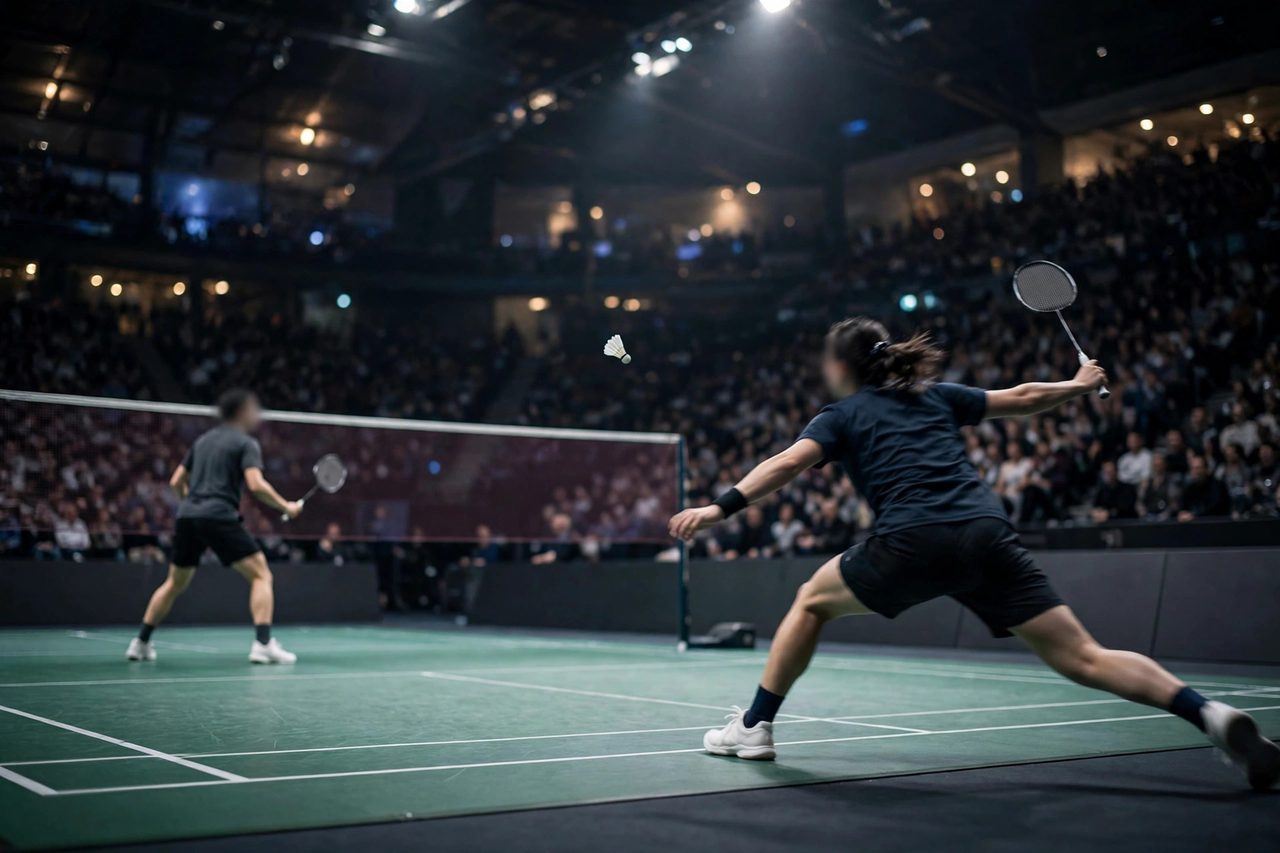
Every spring, the best badminton players in Europe meet in one city to decide who is the champion of the continent. That event is the European Badminton Championships. It is run by Badminton Europe, the sport’s governing body on the continent, and the winners go home with the title of European champion.
Five events, five champions
The championships crown a winner in five events:
- Men’s singles: one man against one man.
- Women’s singles: one woman against one woman.
- Men’s doubles: two men playing as a pair.
- Women’s doubles: two women playing as a pair.
- Mixed doubles: one man and one woman playing as a pair.
Every event is a tournament of its own. A player can enter more than one event, so the same name can show up twice in a week. In 2025, for example, France’s Toma Junior Popov reached the men’s singles final and won the men’s doubles title with his brother Christo.
How a match works
The format is a knockout. That means you lose once and you are out. There is no second chance, and there is no group stage to hide in.
Before play starts, the entries are placed into a draw. A draw is the bracket that decides who plays whom, and in which order. The strongest players are kept apart in the early rounds through seeding. A seed is a ranking spot in the draw, given to the top players so that the favourites do not meet each other on day one.
Each singles draw holds around 64 players. Each doubles draw holds around 32 pairs. The tournament lasts about a week, from the first round through to the finals on the last weekend.
Matches use rally scoring. That means every rally scores a point, no matter who served. A game goes to the first player or pair to reach 21 points, and a match is best of three games. Win two games and you take the match.
There is no match for third place. Both losing semi-finalists go home with a bronze medal.
How players get in
There is no open sign-up. Most players qualify through the world rankings, with the highest-ranked Europeans getting in first. Each country can only send a few players per event, usually up to four in singles and two or three pairs in doubles, picked by its national federation. That mix keeps the event both elite and open: the world’s best Europeans are there, but so are young players from smaller badminton nations, getting their first taste of a major championship.
How often it happens
Since 2017, the individual championships have been held every year. Before that, they took place every two years.
There is one exception. In a year when the European Games are held, the badminton event at the Games doubles as that year’s European Championships. That happened most recently in 2023, when the Games were held in Poland and the badminton was played in Tarnów. Denmark’s Viktor Axelsen and Spain’s Carolina Marín won the singles titles there.
Do not confuse this event with the team championships. Those are separate. The European Mixed Team Championships are held every two years, most recently in Baku, Azerbaijan, in February 2025, when Denmark beat France 3-0 in the final for their 20th title. In even years, the men and women play separate team championships instead.
A short history
The first European Championships were held in 1968, in Bochum, in what was then West Germany. For decades the event ran every two years, growing from a small gathering into the continent’s biggest badminton week. The 2020 edition, planned for Kyiv, was cancelled because of the Covid-19 pandemic. Kyiv hosted the event a year later instead, in 2021.
Moments to know
No player owns this event quite like Carolina Marín. The Spaniard won the women’s singles title seven times, in 2014, 2016, 2017, 2018, 2021, 2022 and 2024, and added the European Games gold in 2023. She announced her retirement in April 2026, during the championships in her home city of Huelva.
The 2025 edition, in Horsens, Denmark, produced a record of its own. France’s Alex Lanier won the men’s singles at 20 years and 77 days old, the youngest men’s singles champion in the event’s history. He beat his compatriot Toma Junior Popov 21-17, 21-18 in an all-French final, and France finished top of the medal table with eight medals.
A year later, Scotland’s Kirsty Gilmour finally got her title. She had lost five European finals before. At the sixth attempt, in Huelva in 2026, she beat Denmark’s Line Kjærsfeldt 21-17, 21-15 to win Scotland’s first ever European Championships gold. Marín herself handed her the trophy.
The latest champions
The most recent edition was the 32nd, held in Huelva, Spain, from 6 to 12 April 2026. The five champions were:
- Men’s singles: Christo Popov (France), who beat Denmark’s Anders Antonsen 21-12, 21-19.
- Women’s singles: Kirsty Gilmour (Scotland).
- Men’s doubles: Ben Lane and Sean Vendy (England), who beat the Popov brothers 21-15, 21-16. It was England’s first men’s doubles gold in 28 years.
- Women’s doubles: Gabriela Stoeva and Stefani Stoeva (Bulgaria), who defended their title.
- Mixed doubles: Mathias Christiansen and Alexandra Bøje (Denmark).
Five events, five different nations on top. That is the modern European Championships in one line: Denmark still matters, but the crown is now up for grabs.
Why it matters
For European players, this is the biggest title they can win on home soil. A world title and an Olympic medal sit above it, but neither of those is a European contest. The championships are where a young player announces themselves, where a veteran defends a legacy, and where a smaller badminton nation gets its moment.
Related articles
How the Indonesia Open Works
Badminton's loudest week: a simple guide to the Super 1000 in Jakarta, its format, its history and why Istora Senayan matters.
How the Malaysia Open Works
Badminton's season opener in Kuala Lumpur: a simple guide to the Super 1000, its format, its fans and its history.
How the BWF Junior World Championships Work: Where Tomorrow's Stars Are Found
Two tournaments in one, the world's best under-19 players, and a team trophy named after a badminton legend. Here is how the junior worlds work — and why scouts watch them so closely.