
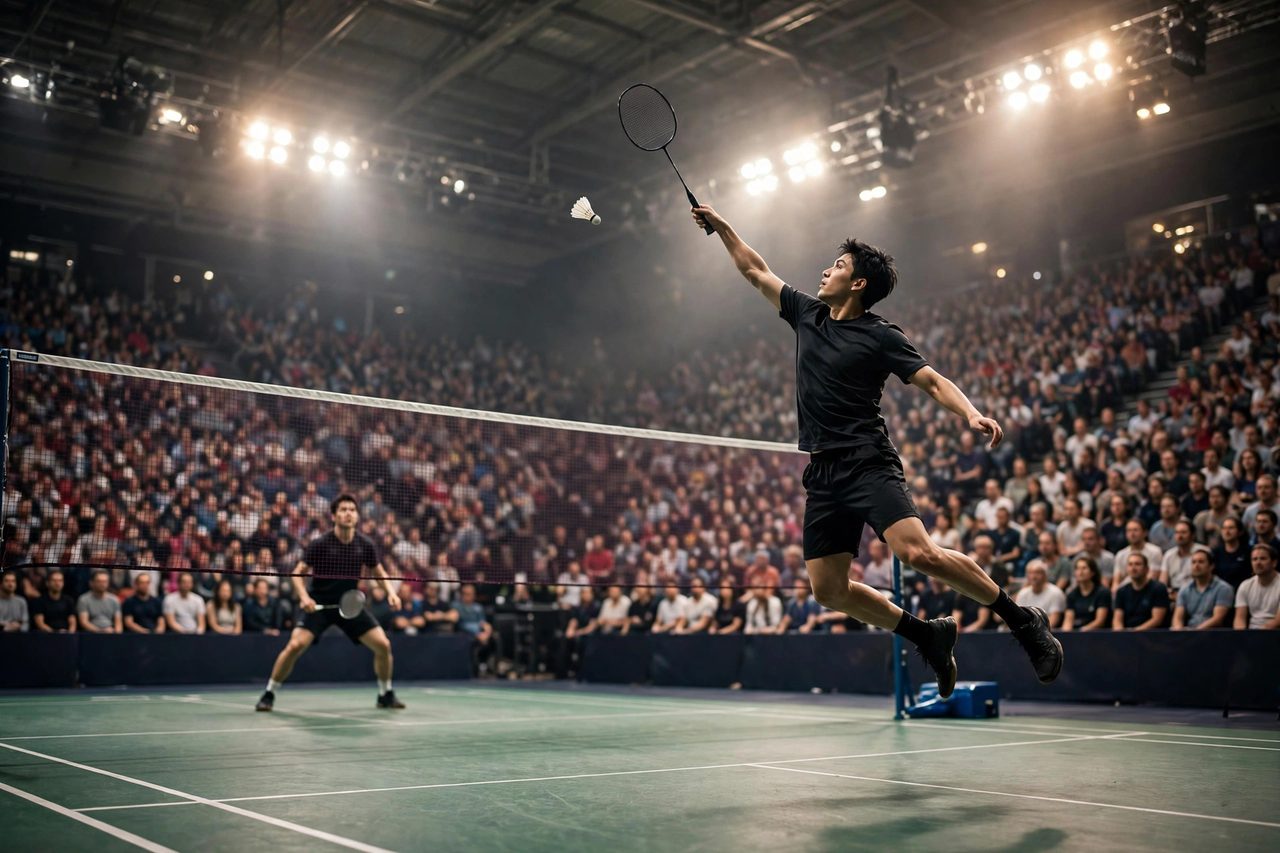
Every June, badminton gets loud. Really loud. The Indonesia Open takes over Jakarta, and the crowd inside Istora Senayan turns a badminton match into something closer to a football derby. If you want to understand top-level badminton, this is the tournament to start with.
What is a Super 1000?
The BWF World Tour is the main circuit of professional badminton. BWF stands for the Badminton World Federation, the sport’s world governing body. The tour is split into levels, and the Super 1000 is the top level. A Super 1000 is the biggest type of regular tour event, just below the season-ending World Tour Finals.
There are only four Super 1000 events each year: the Malaysia Open, the All England Open, the Indonesia Open and the China Open. Every top player shows up, and the points and prize money are the largest of any regular event.
When and where it is played
The Indonesia Open takes place in June. The 2026 edition ran from 2 to 7 June, the 14th tournament of the 2026 BWF World Tour season.
The venue is the Istora Gelora Bung Karno in Jakarta, usually just called Istora Senayan. It sits in the Gelora Bung Karno sports complex in central Jakarta and has hosted the tournament in most years since it began.
The format, in plain words
There are five events at the Indonesia Open: men’s singles, women’s singles, men’s doubles, women’s doubles and mixed doubles. Mixed doubles means one man and one woman play together as a pair.
Each event has a draw of 32 players or pairs. A draw is the list that shows who plays whom, round by round. With 32 entries, a player needs five wins in a row to take the title. There is no qualifying round: only the world’s best get in.
Matches are best of three games. A game is one part of a match, and the first player or pair to win two games wins the match. Each game goes to 21 points, and a player must win by at least two. If the score reaches 20–20, play goes on until someone leads by two — but a game can never go past 30 points. At 29–29, the next point wins it.
The top players in the draw are called seeds. A seed is a player ranked high enough to get a protected spot in the draw, so the best players do not meet each other in the first round. In 2026 the seeds had a rough week: top seed Shi Yuqi lost in the second round, and second seed Kunlavut Vitidsarn and third seed Anders Antonsen both lost their openers.
The 2026 event also trialled the BWF’s Time Clock. Once the umpire updated the score, players had 25 seconds to be ready to serve or receive, to keep matches moving and cut down on long pauses between rallies. A rally is one exchange of shots between the two sides.
The money and the points
In 2026 the total prize money was US$1,450,000. The singles winners each took home US$101,500, and the winning doubles pairs shared US$107,300.
Ranking points matter just as much as money. The winner of each event earns 12,000 ranking points. The runner-up gets 10,200, losing semi-finalists get 8,400, and even a first-round exit is worth 3,000 points. A big week in Jakarta can lift a player several places in the world rankings and helps in the race to qualify for the World Tour Finals at the end of the year.
Why Istora Senayan matters
Badminton is huge in Indonesia. It is the country’s most-loved sport, and the Istora crowd is famous across the world for its noise. Thousands of fans fill the arena, wave flags and react to every shot. For the home players, that support is a gift and a weight at the same time.
That pressure shows in the history books. Indonesia is the only nation ever to win all five titles at its home event, and it has done it four times: in 1983, 1996, 1997 and 2001. But the home crowd has waited a long time in some events. No Indonesian man has won the singles title since Simon Santoso in 2012. In 2026, Jonatan Christie reached the final in front of his own fans — but Canada’s Victor Lai beat him 21–19, 21–8.
A tournament with real history
The Indonesia Open was first held in 1982. It is run by the Badminton Association of Indonesia, known as PBSI. It joined the BWF Super Series in 2007, earned Super Series Premier status in 2011, and became a Super 1000 event in 2018, when the BWF World Tour began.
Three names stand above the rest in men’s singles. Indonesia’s Taufik Hidayat won six titles, in 1999, 2000, 2002, 2003, 2004 and 2006. Before him, Ardy Wiranata of Indonesia also won six, in 1990, 1991, 1992, 1994, 1995 and 1997. Malaysia’s Lee Chong Wei matched them with six of his own, in 2007, 2009, 2010, 2011, 2013 and 2016.
The 2026 champions
The 2026 edition was the 44th Indonesia Open, and it produced one of the biggest surprises of the season. Victor Lai’s win over Jonatan Christie made him the first Canadian ever to win a Super 1000 title.
South Korea’s An Se-young beat Japan’s Akane Yamaguchi 23–21, 21–12 to win the women’s singles. Malaysia’s Goh Sze Fei and Nur Izzuddin came back to beat Indonesians Raymond Indra and Nikolaus Joaquin 13–21, 21–18, 21–10 in the men’s doubles. The women’s doubles went to Japan’s Yuki Fukushima and Mayu Matsumoto, and the mixed doubles to Denmark’s Mathias Christiansen and Alexandra Bøje.
Why it matters
The Indonesia Open matters because it is the loudest test in badminton. The level is the highest there is on the regular tour, the points are the biggest, and the crowd is the most intense. A player who wins in Jakarta has beaten the best players in the world in the hardest atmosphere in the sport.
Related articles
How the Malaysia Open Works
Badminton's season opener in Kuala Lumpur: a simple guide to the Super 1000, its format, its fans and its history.
How the European Badminton Championships Work
Five titles, one week, and the best players in Europe: here is how badminton's biggest continental event works.
How the BWF Junior World Championships Work: Where Tomorrow's Stars Are Found
Two tournaments in one, the world's best under-19 players, and a team trophy named after a badminton legend. Here is how the junior worlds work — and why scouts watch them so closely.