
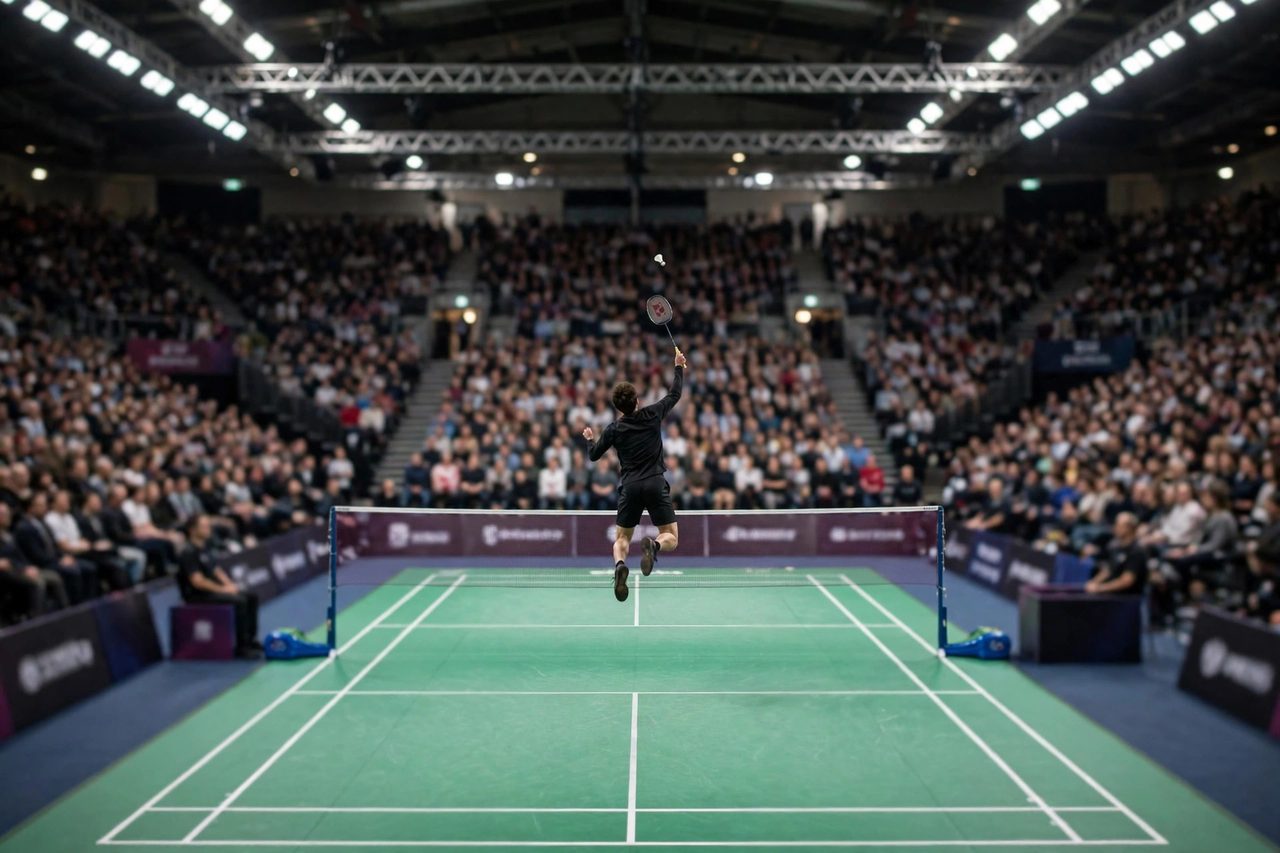
Every badminton season starts in the same place: Kuala Lumpur, Malaysia. The Malaysia Open is the first big event of the year, and it is one of the biggest events in the whole sport. If you are new to badminton, this is the perfect tournament to learn how the top level works.
What is a Super 1000?
The BWF World Tour is the main circuit of professional badminton. BWF stands for the Badminton World Federation, the sport’s world governing body. The tour is split into levels, and the Super 1000 is the top level. A Super 1000 is the biggest type of regular tour event, just below the season-ending World Tour Finals.
There are only four Super 1000 events each year: the Malaysia Open, the All England Open, the Indonesia Open and the China Open. Every top player shows up, and the points and prize money are the largest of any regular event.
When and where it is played
The Malaysia Open takes place in January, usually in the first or second week of the year. The 2026 edition ran from 6 to 11 January. It is the first tournament of the BWF World Tour season, so it sets the tone for everything that follows.
The venue is the Axiata Arena in Bukit Jalil, a sports district in Kuala Lumpur. It can hold up to 16,000 fans, which makes it Malaysia’s largest indoor venue. Built for the 1998 Commonwealth Games, when it was called the Putra Indoor Stadium, it has hosted the Malaysia Open for most years since 2008.
The format, in plain words
There are five events at the Malaysia Open: men’s singles, women’s singles, men’s doubles, women’s doubles and mixed doubles. Mixed doubles means one man and one woman play together as a pair.
Each event has a draw of 32 players or pairs. A draw is the list that shows who plays whom, round by round. With 32 entries, a player needs five wins in a row to take the title.
Matches are best of three games. A game is one part of a match, and the first player or pair to win two games wins the match. Each game goes to 21 points, and a player must win by at least two. If the score reaches 20–20, play goes on until someone leads by two — but a game can never go past 30 points. At 29–29, the next point wins it.
The top players in the draw are called seeds. A seed is a player ranked high enough to get a protected spot in the draw, so the best players do not meet each other in the first round.
The money and the points
In 2026 the total prize money was US$1,450,000. The singles winners each took home US$101,500, and the winning doubles pairs shared US$107,300.
Ranking points matter just as much as money. The winner of each event earns 12,000 ranking points. The runner-up gets 10,200, losing semi-finalists get 8,400, and even a first-round exit is worth 3,000 points. Because this is the first event of the season, a strong week in Kuala Lumpur gives a player a head start in the race to qualify for the World Tour Finals at the end of the year.
Why the fans make it special
Malaysian badminton fans are famous, and the Axiata Arena is one of the loudest rooms in the sport. Badminton is close to a national sport in Malaysia. Fans arrive early, fill the stands in the national colours, and stay loud from the first rally to the last. A rally is one exchange of shots between the two sides, and in Kuala Lumpur the crowd reacts to every single one.
Home players feel that support more than anyone. In the 2026 men’s doubles final, Malaysians Aaron Chia and Soh Wooi Yik came within one game of winning the title in front of their own fans, losing a tight three-game battle to South Korea’s Kim Won-ho and Seo Seung-jae, 21–15, 12–21, 21–18.
A tournament with real history
The Malaysia Open is one of the oldest badminton tournaments in the world. It was first held in 1937, when the first men’s singles champion was A. S. Samuel and the first women’s singles champion was Alice Pennefather. The event has been interrupted only three times: during the Second World War, from 1942 to 1946; from 1969 to 1982; and during the Covid-19 pandemic, in 2020 and 2021.
It became a Super 1000 event in 2023, when the BWF raised it to the top tier of the tour.
No name is linked to this tournament more than Lee Chong Wei. The Malaysian star won the men’s singles title a record 12 times, including seven in a row from 2008 to 2014. His last win, in 2018, was the last time a Malaysian player won a singles title at home. Since he retired in 2019, no local player has reached a final at the event.
The 2026 champions
The most recent edition, in January 2026, was the 69th Malaysia Open. Thailand’s Kunlavut Vitidsarn won the men’s singles title after China’s Shi Yuqi had to stop during the final. It was the first Super 1000 title of Kunlavut’s career, and he became the first Thai man to win the singles title in 64 years.
South Korea’s An Se-young won the women’s singles, beating China’s Wang Zhiyi 21–15, 24–22 in the final. It was her third Malaysia Open title in a row. The doubles titles went to Kim Won-ho and Seo Seung-jae of South Korea in men’s doubles, Liu Shengshu and Tan Ning of China in women’s doubles, and Feng Yanzhe and Huang Dongping of China in mixed doubles.
Why it matters
The Malaysia Open matters because it is first. After a short break, every top player returns in January, and this is where we find out who has improved, who is fit, and who is ready to lead the season. A win here does not guarantee a great year, but it sets the story for the months ahead.
Few tournaments mix this much history, this much prize money and this much noise. For a new fan, there is no better place to start. Watch the first week of January, listen to the crowd in Kuala Lumpur, and you will understand what top-level badminton feels like.
Related articles
How the Indonesia Open Works
Badminton's loudest week: a simple guide to the Super 1000 in Jakarta, its format, its history and why Istora Senayan matters.
How the European Badminton Championships Work
Five titles, one week, and the best players in Europe: here is how badminton's biggest continental event works.
How the BWF Junior World Championships Work: Where Tomorrow's Stars Are Found
Two tournaments in one, the world's best under-19 players, and a team trophy named after a badminton legend. Here is how the junior worlds work — and why scouts watch them so closely.