
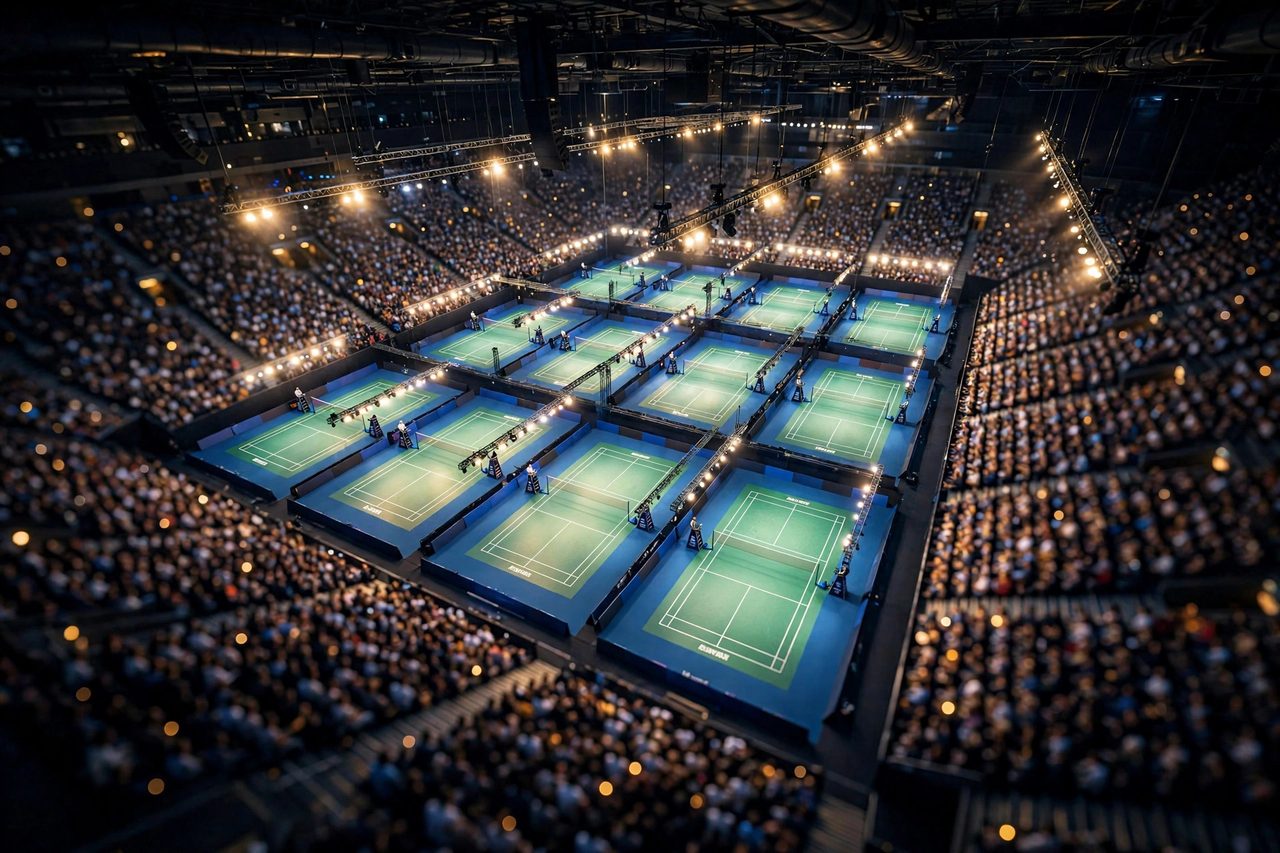
Every sport has one tournament where the title matters more than the money. In badminton, that is the BWF World Championships: the standalone individual world championship, where five new world champions are crowned — men’s singles, women’s singles, men’s doubles, women’s doubles and mixed doubles — and the medal is the prize.
The format: brutally simple
Forget round-robin groups and second chances. The World Championships are played as a straight single-elimination draw. Lose once, go home.
Draws are large: at the 2026 edition in New Delhi, the men’s singles field had 64 players from 38 nations, and the women’s singles the same size. Every match is best of three games to 21 points, rally scoring — the same format used across professional badminton. Doubles draws follow the same knockout structure.
Seeding comes from the world rankings. For the 2026 championships, the seeding list was set from the rankings of 31 July 2026, and the draw ceremony took place on 5 August — roughly two weeks before the first serve. That gap matters: it means late-season form can matter more than the seeding number next to your name.
How players qualify
There is no separate qualifying tournament. Entry is based on the BWF world rankings, with each member association allowed a limited number of players or pairs per discipline. The top-ranked players are seeded so they cannot meet each other until the later rounds — in 2026, for example, An Se-young went in as the women’s singles top seed and Shi Yuqi as the men’s No. 1 seed.
The result is a field that is deep rather than merely top-heavy: with 64 singles players in the draw, a champion has to win six matches in seven days. There is nowhere to hide, and an early upset — like world No. 1 seeds falling in round one — reshapes the entire draw.
What is at stake
This is what sets the World Championships apart from the World Tour. There is no prize purse: unlike a Super 1000 or Super 750 event, the championships offer ranking points and medals, not money. The title itself is the currency — and in badminton-mad nations, a world championship gold can define a career.
The 2026 edition showed why. Played 17–23 August at the Indira Gandhi Arena in New Delhi, it produced one of the most historic weeks the sport has seen.
New Delhi 2026: the edition that made history
France arrived in India as a rising power and left as a badminton nation transformed. Two French players became world champions on the same day — the first French world titles in history:
- Men’s singles: Alex Lanier (seeded 9th) beat Japan’s Kodai Naraoka 21–11, 21–11 in a one-sided final, becoming the first Frenchman to win a world singles title at just 21.
- Mixed doubles: Thom Gicquel and Delphine Delrue, the bronze medallists from the previous year, beat top seeds Feng Yan Zhe and Huang Dong Ping of China 22–20, 19–21, 21–15 in 78 minutes — the first French pair to become world champions, and the end of a 17-year wait for a European pair to win the mixed doubles title.
Together, the two golds marked the first time since 1983 that Europe won more than one title at a single World Championships.
South Korea also took two titles. World No. 1 An Se-young regained the women’s singles crown, beating defending champion Akane Yamaguchi 21–17, 21–14 for her second world title. And Baek Ha-na and Lee So-hee beat world No. 1 pair Liu Sheng Shu and Tan Ning of China 21–15, 21–15 to end Korea’s 31-year wait for a women’s doubles world title — with the 32-year-old Lee becoming the oldest women’s doubles world champion.
China narrowly avoided a shutout: Liang Wei Keng and Wang Chang beat Malaysia’s Aaron Chia and Soh Wooi Yik in straight games to take the men’s doubles title, preserving China’s remarkable record of winning at least one title at every World Championships since 1983.
The home crowd got its moment too: India’s Treesa Jolly and Gayatri Gopichand took women’s doubles bronze, the country’s only medal of the championships.
Why the Worlds feel different
On the World Tour, players manage their seasons — skipping events, protecting bodies, chasing ranking points across 29 tournaments. At the World Championships, everyone peaks at once. The best-versus-best concentration, the one-loss-and-done pressure, and the fact that the reward is a title rather than a cheque are what make it the tournament players remember longest.
The next edition cannot come soon enough.
Sources: 2026 BWF World Championships – men’s singles · Badminton Europe – French history in New Delhi
Related articles
How the Indonesia Open Works
Badminton's loudest week: a simple guide to the Super 1000 in Jakarta, its format, its history and why Istora Senayan matters.
How the Malaysia Open Works
Badminton's season opener in Kuala Lumpur: a simple guide to the Super 1000, its format, its fans and its history.
How the European Badminton Championships Work
Five titles, one week, and the best players in Europe: here is how badminton's biggest continental event works.