
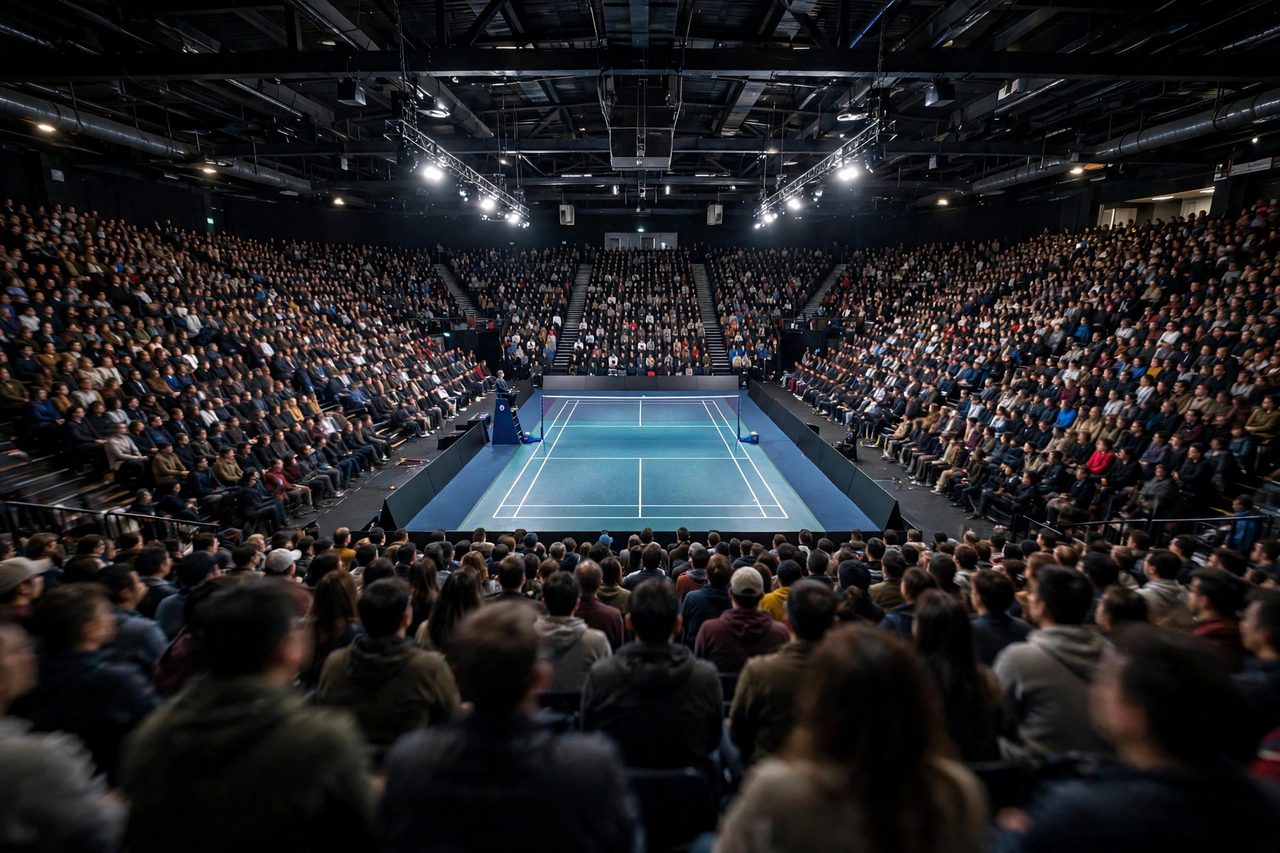
In Europe and America, badminton is often a school gym memory. In much of Asia, it is a national obsession — filling 10,000-seat arenas, dominating television ratings, and producing heroes whose fame transcends sport. Nowhere is the gap between the sport’s two images wider, or more instructive.
Indonesia: the spiritual home
If badminton has a spiritual home, it is Indonesia. The sport arrived with the Dutch in the colonial era and took root so deeply that it became part of the national identity. Indonesia has won Olympic gold in badminton, dominated the Thomas Cup — the men’s world team championship — for decades, and treats its badminton stars as national treasures.
The Istora Senayan arena in Jakarta, during the Indonesia Open, is the loudest venue in the sport: a wall of sound that visiting players describe as the most intimidating atmosphere in badminton. For Indonesians, badminton success is not just sporting pride — it is proof of the nation’s place in the world.
Malaysia: one man’s shoulders
Malaysia’s relationship with badminton can be told through one man: Lee Chong Wei. For over a decade, the Malaysian carried his nation’s hopes alone at the top of the men’s game — three Olympic silver medals, years at world No. 1, and a rivalry with China’s Lin Dan that defined an era.
The affection Malaysians hold for Lee goes beyond results. In a multi-ethnic nation, he became a unifying figure — proof that excellence belongs to everyone. When he retired, the country mourned like it had lost a head of state.
China: the machine
China’s approach to badminton mirrors its approach to table tennis: systematic, state-backed, and ruthlessly effective. A vast network of sports schools identifies talent early, and the internal competition is so fierce that making the Chinese national team is arguably harder than winning some international titles.
The result has been decades of dominance, particularly in women’s singles and doubles. Chinese players set the technical standard the rest of the world chases — and the depth means that when one champion fades, another is already waiting.
India: the awakening
India is badminton’s great growth story. Long a cricket monoculture, the country embraced badminton in the 2010s as stars emerged on the world stage and a professional league brought the sport to television audiences. Academies multiplied, participation soared, and India became a genuine power — particularly in men’s singles.
The Indian story matters because it shows the sport’s formula still works: heroes plus visibility plus infrastructure equals a badminton nation in a single generation.
Denmark: the European exception
No account of badminton culture is complete without Denmark — the one European nation that treats the sport as a major one. Danish clubs, coaching and competitive depth have produced world champions and Olympic medalists for decades, proving that badminton’s Asian dominance is about culture and systems, not geography.
More than a sport
What unites these stories is that badminton, in Asia, carries meaning beyond entertainment. It is national pride in Indonesia, unity in Malaysia, systemic excellence in China, aspiration in India. The shuttlecock weighs five grams. In much of the world, it carries the weight of nations.
Related articles
Badminton: The World's Most Played Racquet Sport — and Most People Don't Even Know It
More than 300 million people play badminton. It is an Olympic sport, it has the fastest shot in racquet sports, and it fills huge arenas in Asia. So why does so much of the West still think of it as a garden game?

From Wood to Carbon: How the Badminton Racquet Changed the Game
A badminton racquet used to weigh as much as a small hammer. Today it weighs less than a phone. Here is how wood, steel and carbon fibre turned badminton into the fastest racquet sport on earth.
Lin Dan vs Lee Chong Wei: The Rivalry That Made Badminton
For more than a decade, China's Lin Dan and Malaysia's Lee Chong Wei played the matches that turned badminton into must-watch sport.