
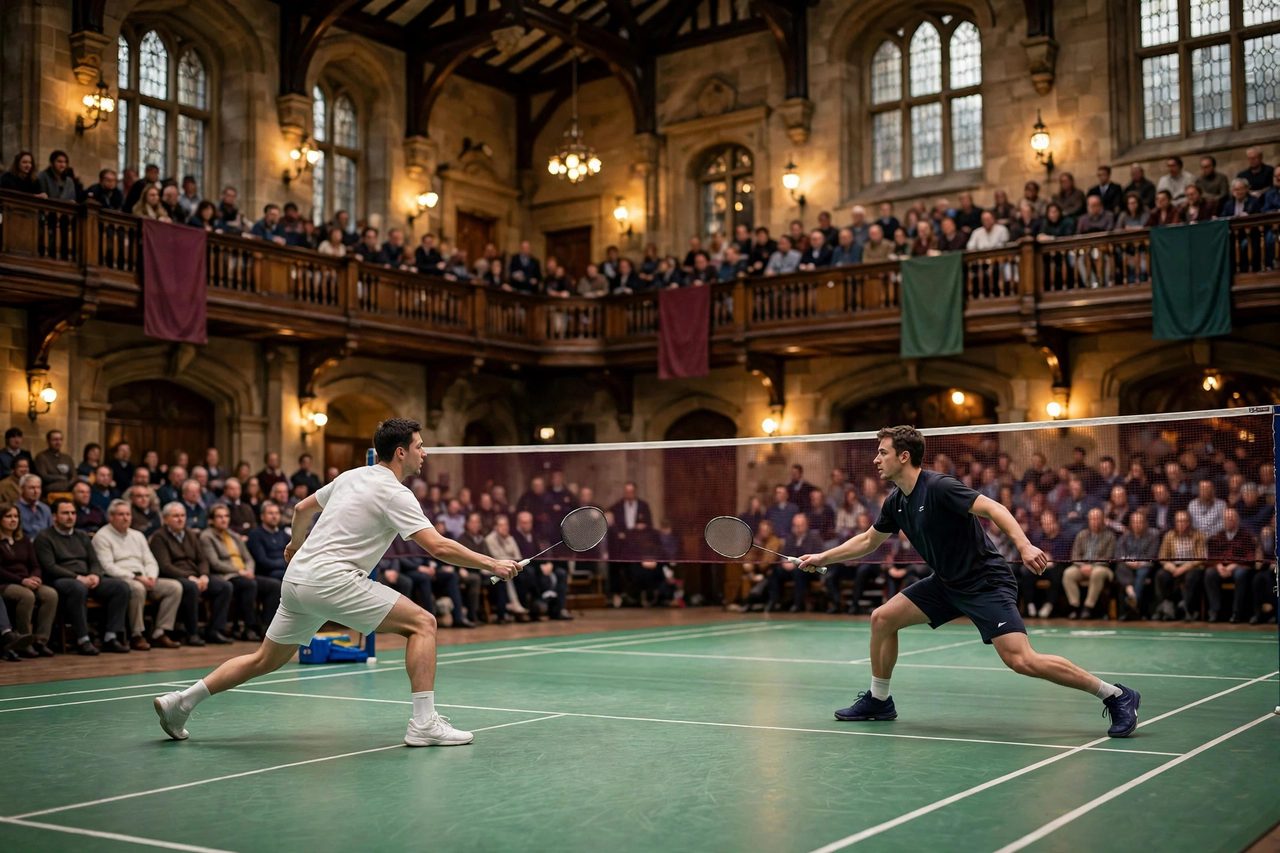
Every sport has a birthplace. Football has its English public schools. Tennis has Wimbledon. Badminton has a country house in Gloucestershire, a duke, and a game that British soldiers brought home from India.
The strange thing is that badminton is now one of the biggest sports on earth — huge in China, Indonesia, Malaysia, India, Denmark and South Korea — but it started as an after-dinner party game for the English upper class. This is the story of how that happened.
A game from India
The roots of badminton go back to India in the 1800s, where British army officers stationed in the garrison town of Poona — now called Pune — played a game with racquets, a net and a feathered shuttle. The shuttle is the small feathered projectile that players hit back and forth. Because it was popular in Poona, the game became known as Poona.
It was not yet the sport we know today. The rules were loose, the courts were improvised, and the game was mostly a social pastime for soldiers and their families. But the basic idea was already there: hit a light, feathered object over a net, and do not let it touch the ground on your side.
When the officers returned to England, they brought the game with them. And in 1873, it got its big break.
The party at Badminton House
In 1873, the Duke of Beaufort hosted guests at his country estate in Gloucestershire, a county in south-west England. The estate was called Badminton House. At a lawn party there, the guests played the game the duke had encountered in India, and it was a hit.
The game took the name of the house. From then on, it was called badminton. The name stuck, and it has stuck for 150 years.
It is a strange name for a global sport. Nobody calls a sport after a house any more. But in Victorian England, that was how things worked — a game played at a grand house took the house’s name, and the name travelled with it.
Rules, clubs and a national association
A party game needs rules if it is going to become a sport, and badminton got them quickly.
In 1877, the Bath Badminton Club — a club in the city of Bath, not far from Badminton House — drew up the first set of written rules. Ten years later, in 1887, those rules were revised and standardised by J. H. E. Hart, a member of the club.
Then, in 1893, the Badminton Association of England was founded. This was the sport’s first national governing body, and it published the first official rulebook. From that point on, badminton was no longer just something you played at a party. It had a structure, a set of laws, and an organisation to run it.
The first recorded open tournament had already happened a few years earlier, in Guildford in 1898. Its success showed there was an appetite for competitive badminton, and it set the stage for the event that would define the sport.
The All England: the oldest tournament in the sport
In 1899, the Badminton Association of England organised the first All England Championships, held at London’s Horticultural Halls. The first edition featured only doubles events — men’s doubles, women’s doubles and mixed doubles, where each pair is one man and one woman. Singles events were added from the second edition onward.
The All England is still going today, and it is the oldest badminton tournament in the world. For most of the 20th century it was, in effect, the unofficial world championship of the sport. The official World Championships did not begin until 1977, so for nearly 80 years, winning the All England was the closest thing to being crowned the world’s best.
The tournament was interrupted only twice: from 1915 to 1919 during the First World War, and from 1940 to 1946 during the Second World War. Every other year, it has been played.
Today the All England is a Super 1000 event — the top tier of the BWF World Tour — and it is still one of the most prestigious titles in the sport. Players who win it join a list that stretches back to 1899, and that history is part of what makes it special.
Going global
Badminton’s international story began early. The first international match was played between England and Ireland in 1903, and England won 5–2. In 1934, the International Badminton Federation — now called the Badminton World Federation, or BWF — was founded by nine countries: Canada, Denmark, England, France, the Netherlands, Ireland, New Zealand, Scotland and Wales. India joined in 1936.
The sport’s first great team events came after the Second World War. The Thomas Cup, the men’s world team championship, began in 1949. The Uber Cup, the women’s equivalent, followed in 1957. These events turned badminton into a national contest, and they are still among the biggest prizes in the sport.
But the real explosion came in Asia. Badminton became a national obsession in Indonesia, Malaysia and China, where it is now one of the most popular sports in the country. Denmark, almost alone in Europe, kept pace with the Asian powers — a story we told in an earlier piece about the little country that refuses to leave badminton’s top table.
Badminton became an Olympic sport at the Barcelona Games in 1992. Since then, it has grown into a truly global game, with professional tours, million-dollar prize funds and players who are household names in countries of hundreds of millions of people.
Why the English beginning still matters
It is easy to forget, watching a packed arena in Jakarta or Kuala Lumpur, that this sport began as a garden game at an English country house. But the English beginning still shapes the sport in small ways.
The All England is still the tournament every player wants to win. The language of the sport — the terms, the scoring, the rulebook — was written in England. And the sport’s governing body, though now based in Kuala Lumpur, Malaysia, still carries the initials of the International Badminton Federation in its history.
More than that, the story is a reminder of how sports travel. A game played by soldiers in Poona became a party game in Gloucestershire, then a national sport in England, then a global obsession in Asia. Sports do not belong to the place where they started. They belong to whoever loves them most.
Badminton started in an English garden. It now belongs to the world.
Related articles
Badminton: The World's Most Played Racquet Sport — and Most People Don't Even Know It
More than 300 million people play badminton. It is an Olympic sport, it has the fastest shot in racquet sports, and it fills huge arenas in Asia. So why does so much of the West still think of it as a garden game?

From Wood to Carbon: How the Badminton Racquet Changed the Game
A badminton racquet used to weigh as much as a small hammer. Today it weighs less than a phone. Here is how wood, steel and carbon fibre turned badminton into the fastest racquet sport on earth.
Lin Dan vs Lee Chong Wei: The Rivalry That Made Badminton
For more than a decade, China's Lin Dan and Malaysia's Lee Chong Wei played the matches that turned badminton into must-watch sport.