
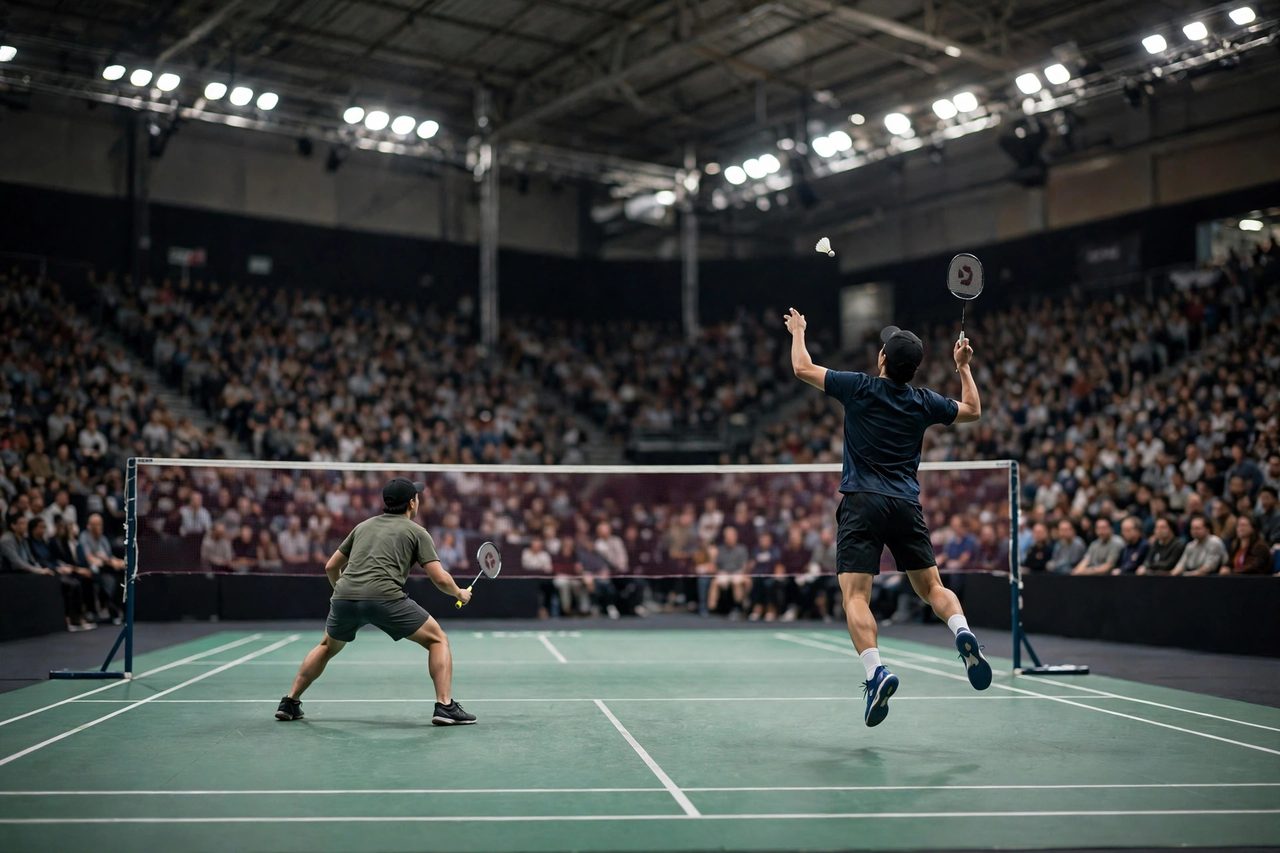
Here is a number that sounds wrong until you check it: more than 300 million people play badminton around the world. That is the figure from the Badminton World Federation, the sport’s global governing body. By its count, only soccer has more players, and badminton has more than 700 million fans worldwide. And yet, if you live in the United States or much of Europe, you could go weeks without hearing the sport mentioned once.
Badminton is the biggest racquet sport on the planet — and, in the West, nearly invisible. How does that happen?
The number that stops you
Think about tennis, the racquet sport the West talks about most. It has far fewer regular players, yet its stars are household names everywhere. Badminton has more players and less fame.
Most of those 300 million are not professionals. They play once or twice a week after work or school, in a hall near home, with friends. That is what makes the number so big: badminton is cheap to start, easy to learn and hard to master.
Where the game actually lives
Almost all of badminton’s weight sits in Asia. China comes first by a huge margin: a 2023 national survey there put recreational players at about 250 million, making badminton the most played sport in the country. In China, it is a daily sight — in parks, offices and school halls.
Indonesia treats the sport as part of its national identity. It has won the Thomas Cup — the men’s world team championship — 14 times, more than any other country, and its first Olympic gold medals ever, in any sport, came from badminton at Barcelona 1992.
Malaysia’s love for the game can be told through one player: Lee Chong Wei, years at world No. 1 and winner of three Olympic silver medals. India is the growth story — once a cricket-only country, it has built academies, a professional league and a generation of stars, and participation has followed.
Europe has one real exception: Denmark, whose clubs and coaching have produced world champions and Olympic winners for decades. Everywhere else in Europe, badminton is a school subject first and a spectator sport a distant second.
The fastest thing in racquet sports
Here is the part that surprises people most. Badminton is the fastest racquet sport in the world — not by a little, by a lot.
A shuttlecock is the feathered projectile players hit back and forth. A smash is the hard, steep shot hit downwards at the other side of the court, and it defines the sport’s speed. The fastest badminton hit ever recorded reached 565 km/h (351 mph), set by India’s Satwiksairaj Rankireddy in a controlled test in Japan on 14 April 2023 and certified by Guinness World Records.
The fastest hit recorded in a real match is 426 km/h (265 mph), by Denmark’s Mads Pieler Kolding in Bangalore in 2017. The fastest tennis serve ever recorded is around 253 km/h. A badminton smash leaves the racquet more than twice as fast.
There is an honest catch: a shuttlecock slows down very fast, because its feathers create huge air resistance. But the first split second is real, and it is why a top-level rally — the back-and-forth exchange of shots — looks almost too fast to follow.
An Olympic sport for more than 30 years
Badminton has been a full Olympic medal sport since Barcelona 1992. It appeared as a demonstration sport as far back as Munich in 1972, but it took another 20 years to win a permanent place.
Today there are five Olympic events: men’s and women’s singles, men’s and women’s doubles, and mixed doubles — one man and one woman per team — which joined the programme at Atlanta in 1996.
China has dominated the Olympic medals more than any other country, winning 22 of the 44 gold medals awarded in the sport. None of this is new. Badminton is not a young sport waiting for its moment. It has had its moment for decades — just not in the West.
So why haven’t you heard of it?
The first reason is the backyard problem. In the US and much of Europe, most people’s first memory of badminton is a garden game at a family barbecue, with a sagging net and a plastic shuttlecock that would not fly straight. That image sticks. It is hard to watch a professional smash at 400 km/h and connect it to the game you played in flip-flops.
The second reason is television. Badminton’s biggest events — the Super 1000s, the top stops on the world tour — fill arenas in Jakarta, Kuala Lumpur and Tokyo, but barely register on Western sports channels, where the calendar is already full of football, basketball, tennis and golf. No coverage means no stars, and no stars means no coverage.
The third reason is results. The United States has never won an Olympic badminton medal, and only about 1.3 million Americans play even once a year, according to one estimate. Countries follow their winners, and America has never had a badminton winner to follow.
None of these reasons is about the sport itself. They are about where it is shown, who wins it, and what people remember from childhood.
What the West is missing
Watch one top-level match and the backyard image falls apart. The rallies are long, the movement is extraordinary, and the tactics are subtle — players build a point slowly, then finish it in a blink. It is chess at sprint speed.
The good news is that badminton is the easiest of the racquet sports to try. A racquet and a tube of shuttlecocks cost less than a night out, most towns have a hall with courts, and you can have a real rally within an hour of picking it up.
The world’s most played racquet sport has been hiding in plain sight. It was never small. We were just looking the wrong way.
Related articles
From Wood to Carbon: How the Badminton Racquet Changed the Game
A badminton racquet used to weigh as much as a small hammer. Today it weighs less than a phone. Here is how wood, steel and carbon fibre turned badminton into the fastest racquet sport on earth.
Lin Dan vs Lee Chong Wei: The Rivalry That Made Badminton
For more than a decade, China's Lin Dan and Malaysia's Lee Chong Wei played the matches that turned badminton into must-watch sport.
The Shuttlecock: 16 Feathers and the Weirdest Ball in Sport
No other sport plays with anything like it — a cone of goose feathers that flies faster than a tennis serve, then stops dead in mid-air.