
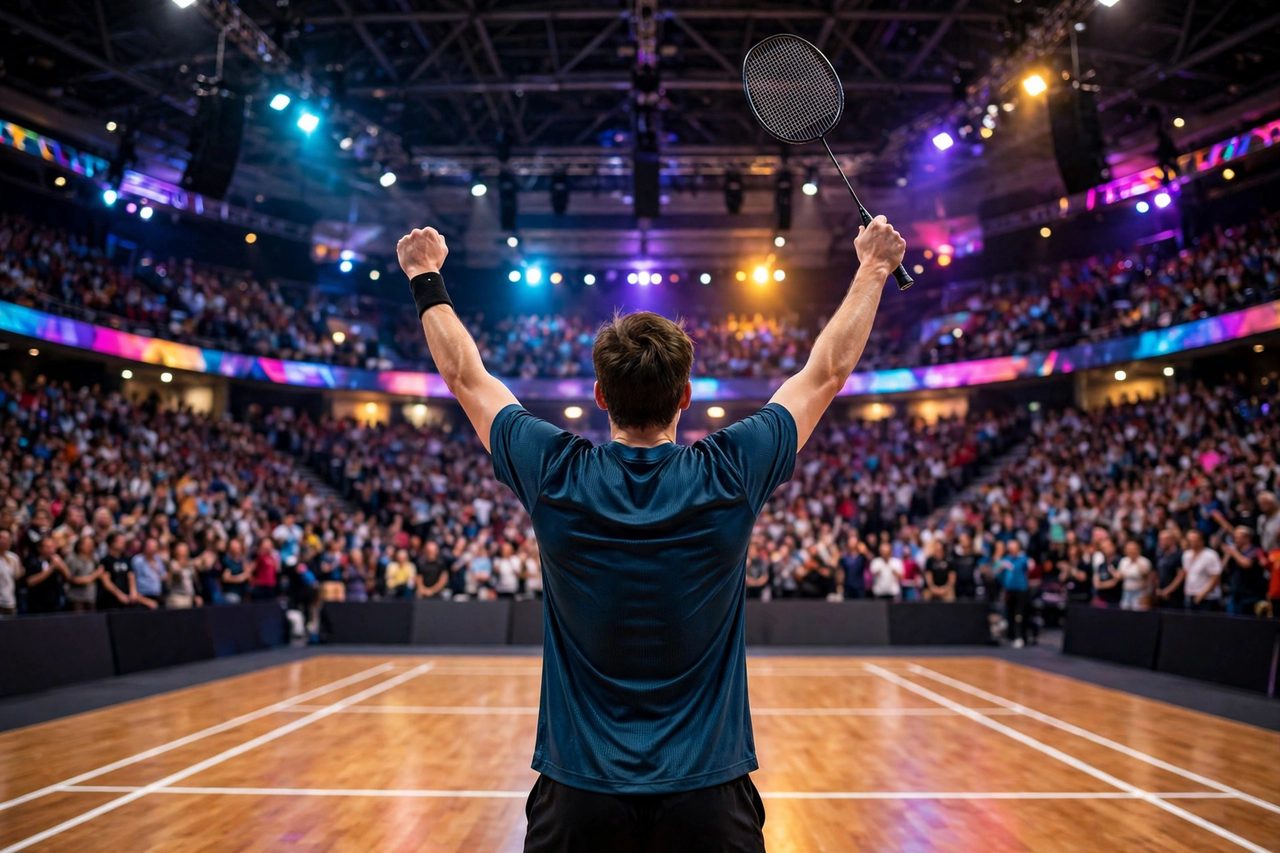
Every four years, the whole world watches the Olympics. For badminton, that spotlight was a long time coming. The sport spent twenty years knocking on the Olympic door before it was finally let in — and when it arrived, it made up for lost time fast.
A demonstration, not yet a medal sport
Badminton first appeared at the Olympic Games in Munich in 1972, but not as a real medal event. It was a demonstration sport. That means it was played to show the sport to the world, but no official Olympic medals were awarded.
Think of it as an audition. The International Olympic Committee, the body that runs the Games, wanted to see whether badminton could work on the Olympic stage. Would crowds come? Would television like it? Would the competition feel like it belonged?
The audition did not lead straight to a medal event. Badminton had to wait another sixteen years for its next Olympic appearance, at the Seoul Games in 1988. This time it was an exhibition sport, a similar showcase role. Again, no medals. Again, a chance to prove the sport deserved a permanent place.
Barcelona 1992: the real debut
The breakthrough finally came at Barcelona 1992. Badminton became a full medal sport, with four events: men’s singles, women’s singles, men’s doubles, and women’s doubles. Singles means one player against one player. Doubles means two players on each side.
Indonesia, the sport’s great early power, won both singles golds. Alan Budikusuma won the men’s title and Susi Susanti won the women’s title, and both became national heroes overnight. For Indonesian fans, those golds confirmed what they already knew: their sport belonged at the very top table.
Barcelona changed everything for badminton. Olympic status brought money, television coverage, and government support in Asia. Countries that had treated badminton as a pastime started treating it as a medal factory. Training centres grew. Professional leagues grew. The sport’s world tour, the BWF World Tour, became the road to the Games.
Atlanta 1996: the fifth event
Four years later, at Atlanta 1996, mixed doubles joined the programme. Mixed doubles is a pair made up of one man and one woman playing together. South Korea won the first mixed doubles gold, and the Olympic badminton programme was complete at five events. It has stayed at five ever since.
That fifth event mattered for more than numbers. Mixed doubles gave smaller badminton nations another route to a medal, and it gave the sport a different kind of drama: two players of different styles and strengths learning to play as one unit.
The Chinese era
From Sydney 2000 onward, one country dominated the Olympic badminton story: China. With a huge player base, state-backed training, and ruthless internal competition, China turned Olympic badminton into something close to a home event every four years.
But the medals were never China’s alone. Indonesia and South Korea kept winning. Denmark, the great European exception, kept producing contenders. Malaysia chased its first badminton gold for decades, collecting silvers and bronzes along the way, including Lee Chong Wei’s three silver medals in men’s singles.
The Olympic format also shaped how the sport is played. Olympic singles draws are small — fewer than forty players — and every match is knockout after the group stage. The group stage is a round-robin, where each player plays everyone else in their small group and only the winner advances. One bad day in the group can end four years of work. That pressure produces extraordinary matches and famous upsets.
Speed becomes the selling point
What the Olympics gave badminton, more than anything, was an audience that had never seen it before. And what that audience saw was astonishing: the fastest racquet sport in the world.
A badminton smash has been recorded at over 400 kilometres per hour in testing, faster than any shot in tennis or squash. Rallies last seconds but contain dozens of shots. Players dive, leap, and change direction at speeds that look impossible on television. For viewers discovering the sport for the first time, it was a revelation.
That speed is now badminton’s calling card at every Games. The finals fill arenas. In Asia, they stop whole countries. When An Se-young of South Korea won the women’s singles gold at Paris 2024, and Viktor Axelsen of Denmark defended his men’s singles title, the matches were watched by tens of millions of people.
Still fighting for the spotlight
Badminton’s Olympic journey is not finished. The sport still fights for prime-time television slots in Europe and America, where it remains a niche sport despite its huge Asian audience. It still argues about scoring formats, service rules, and how to make the game easier for new viewers to follow.
But compare today with 1972. Back then, badminton was a curiosity on the edge of the programme, playing for applause rather than medals. Today it is a core Olympic sport with five medal events, global stars, and finals that pack arenas.
Twenty years of waiting bought badminton a permanent place at the biggest show in sport. The next twenty will decide how big that place becomes.
Related articles
Badminton: The World's Most Played Racquet Sport — and Most People Don't Even Know It
More than 300 million people play badminton. It is an Olympic sport, it has the fastest shot in racquet sports, and it fills huge arenas in Asia. So why does so much of the West still think of it as a garden game?
From Wood to Carbon: How the Badminton Racquet Changed the Game
A badminton racquet used to weigh as much as a small hammer. Today it weighs less than a phone. Here is how wood, steel and carbon fibre turned badminton into the fastest racquet sport on earth.
Lin Dan vs Lee Chong Wei: The Rivalry That Made Badminton
For more than a decade, China's Lin Dan and Malaysia's Lee Chong Wei played the matches that turned badminton into must-watch sport.