
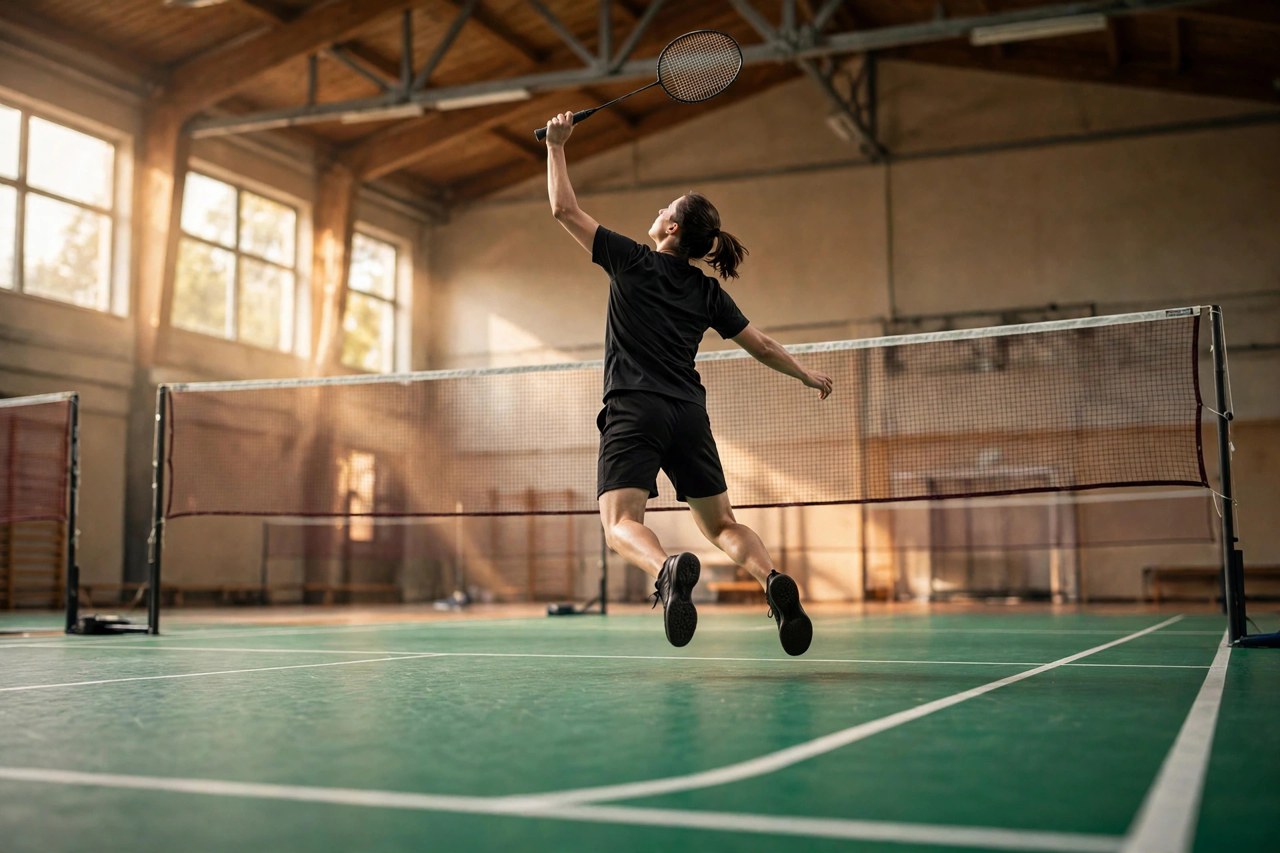
Pick up a modern badminton racquet and it feels almost empty. It weighs about 70 to 85 grams. That is less than a smartphone.
Now imagine playing with one that weighed nearly twice as much. That is what badminton players did for most of the sport’s history. The racquet changed how fast the game was, how hard players could hit, and what shots were even possible.
This is the story of that racquet, from wood to carbon.
The wooden years
Badminton’s first racquets were made of wood, usually ash or maple. They had small oval heads, long handles and strings made from animal gut.
Wooden racquets weighed around 125 to 140 grams. That does not sound like much, but in a sport where you swing hundreds of times in a match, every gram matters. The wood was also stiff in the wrong way. It did not bend and snap back the way modern frames do, so players got less power from the same swing.
The game was slower. Players relied on placement and patience rather than raw power. A rally — a long exchange of shots back and forth over the net — was a battle of control, not speed. The smash, the hard downward shot that is badminton’s most famous weapon, existed, but it was nothing like the weapon it is today. Wooden racquets also broke easily, and damp weather could warp the wood.
Metal arrives
Change came in the 1960s. First came steel shafts, fitted to wooden frames. Then, in the 1970s, the whole frame began to be made from metal: steel or aluminium.
Steel racquets weighed around 120 grams. Aluminium ones were lighter still, at about 100 grams. That drop in weight mattered. Players could swing faster, react quicker, and reach shots they would have missed with a wooden frame.
Metal also solved the durability problem. An aluminium frame did not warp in the rain or crack the way wood did. It was cheaper to make, too, which put a decent racquet in the hands of far more players.
There was one more step in this era. In 1968, the Japanese brand Yonex introduced the T-joint, a small steel piece shaped like the letter T that joined the head of the racquet to the shaft. Before that, the joint was the weak point of every racquet. The T-joint made frames stronger and more stable, and it became a standard part of racquet design.
Metal racquets were a big step forward. But they had a limit. Aluminium is light, but it is also soft. It bends and stays bent. It cannot store and release energy the way the next material could.
The carbon revolution
That material was carbon fibre. It is made of thin strands of carbon, woven together and set in resin. It is light, strong, and it springs back after it bends.
In 1978, Yonex made the first carbon fibre badminton racquet in Japan: the Carbonex 8. It weighed less than 100 grams. Within a few years, top-level racquets weighed between 70 and 80 grams — about half the weight of the old wooden frames.
Carbon changed the game in three ways.
First, it made the smash faster. A lighter racquet moves through the air quicker, so it reaches the shuttle sooner and harder. The shuttlecock — the small feathered object players hit back and forth — is already the fastest projectile in any racquet sport. In a real match, the fastest hit ever recorded in competition is 426 kilometres per hour, by Denmark’s Mads Pieler Kolding in 2017. In a controlled test, India’s Satwiksairaj Rankireddy reached 565 kilometres per hour in 2023. Those speeds would have been unthinkable with a wooden frame.
Second, it changed defence. Defence is the art of getting your racquet to a smash that is flying at you at motorway speeds. With a heavy wooden racquet, you often simply could not move it in time. A light carbon frame lets a player block, lift and counter-attack in a split second, so rallies last longer and the defending player has a real chance.
Third, it opened up the whole court. The jump smash — where a player leaps into the air and hits the shuttle downwards at the highest point — became a standard weapon rather than a rare trick. Fast wrist shots, deceptive flicks and quick drives around the net all became easier when the racquet stopped feeling like a weight in your hand.
What a racquet does today
Modern racquets are all carbon, but they are not all the same. Engineers can tune almost everything.
The balance point matters. A head-heavy racquet carries more weight at the top, which helps power. A head-light racquet feels quicker in the hand, which helps defence and fast exchanges at the net. Players pick one to match their style.
The shaft matters, too. A stiff shaft bends less and gives more control to strong players. A flexible shaft bends more and adds power for players with a slower swing. The frame shape matters as well: a wider head gives a bigger sweet spot, the area of the strings where a hit feels clean and powerful.
The game the old racquets never saw
Watch a top-level match today and you see things the wooden era never produced. Rallies that last 40 or 50 shots, with both players sprinting, diving and jumping. Smashes that arrive before the defender has time to blink. Drop shots — soft shots that fall just over the net — played with a flick of the wrist that a heavy frame could never manage.
The players are fitter and the coaching is smarter, but the tool in their hand is the quiet reason the game looks the way it does.
And here is the strange part: the racquet still looks the same. Put a wooden one from 1920 next to a carbon one from today and you would recognise it in a second.
The shape stayed. The material changed. And the material changed the game.
Related articles
Badminton: The World's Most Played Racquet Sport — and Most People Don't Even Know It
More than 300 million people play badminton. It is an Olympic sport, it has the fastest shot in racquet sports, and it fills huge arenas in Asia. So why does so much of the West still think of it as a garden game?
Lin Dan vs Lee Chong Wei: The Rivalry That Made Badminton
For more than a decade, China's Lin Dan and Malaysia's Lee Chong Wei played the matches that turned badminton into must-watch sport.
The Shuttlecock: 16 Feathers and the Weirdest Ball in Sport
No other sport plays with anything like it — a cone of goose feathers that flies faster than a tennis serve, then stops dead in mid-air.