
No country in badminton history has won like China. More Olympic medals in the sport than any other nation. Thirteen Sudirman Cup team titles. A grip on the world rankings that has lasted for decades. The question every other badminton country asks is simple: how do they keep doing it?
The answer is not one secret. It is a system, built over seventy years, designed to find talented children, train them full-time, and turn the best of them into champions. Other countries have good players. China has a machine.
It starts in school
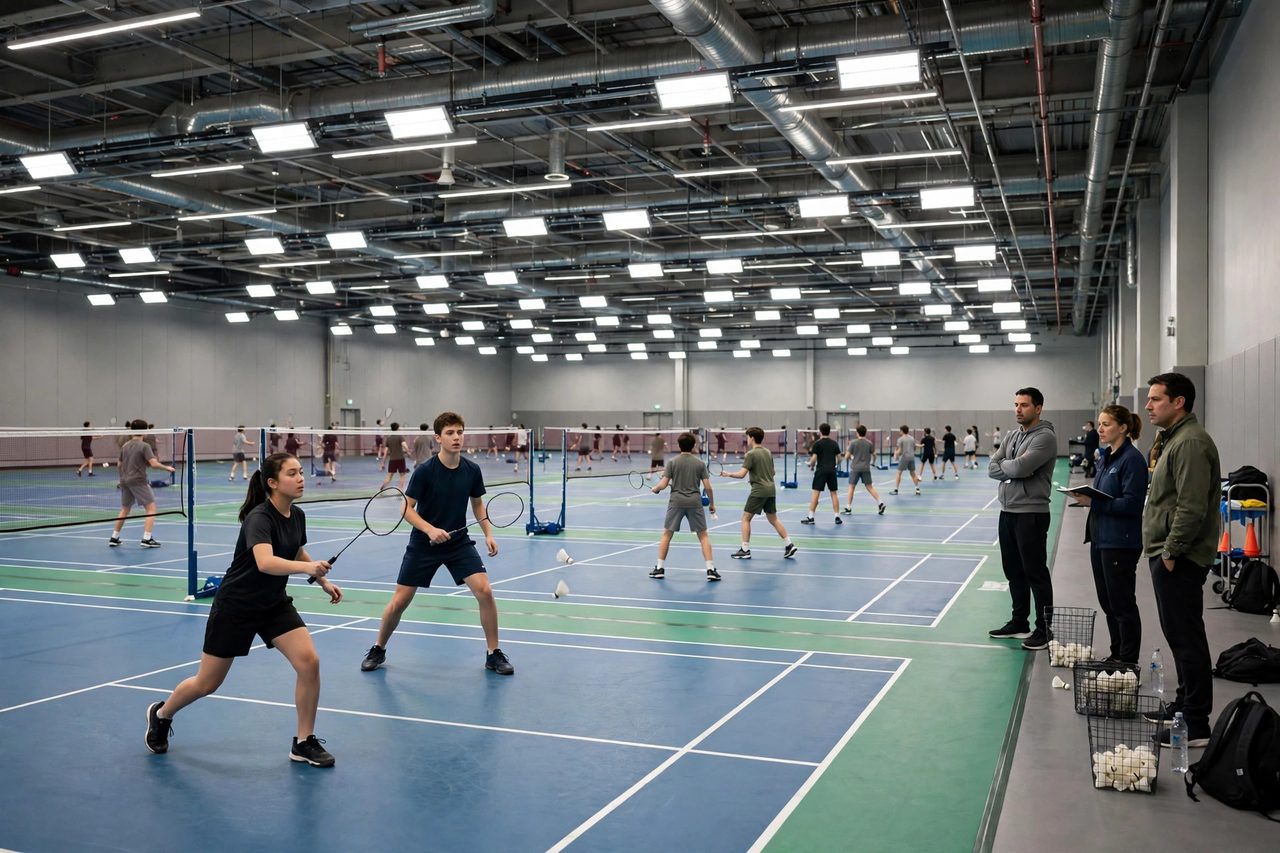
The heart of the system is the sports school. Across China, thousands of these schools combine normal lessons with serious athletic training. Talented children are spotted young — sometimes as young as six or seven — and channelled into badminton programmes. The best move up through city teams, then provincial teams, and finally to the national team in Beijing.
This is a pyramid with a very wide base and a very narrow top. For every player who makes the national team, thousands do not. But the ones who survive that funnel arrive at the top already battle-tested, because they have spent their whole childhood competing against the best players their age in the country.
The national team itself was formed in 1963, and the structure around it grew steadily. China joined the sport’s world governing body, the BWF, in 1978, opening the door to global competition. By 1987, Chinese players had swept every gold medal at the World Championships. The system was working.
The state pays, the players play
The second pillar is funding. The Chinese government funds the national team, covering training, coaching, travel, equipment and living costs. That means a young Chinese player can focus entirely on badminton without worrying about money — a luxury most players elsewhere do not have. In many countries, even top players juggle training with jobs, studies or the search for sponsors. In China, badminton is the job.
The training itself is famously intense: long days of on-court drills, physical conditioning and tactical study, under coaches who are often former world champions themselves. The system also produces depth. China does not just develop one great player at a time; it develops squads. When one star fades, another is already waiting. That is why China can lose a legend and barely miss a beat.
The legends who set the standard
Every system needs heroes, and China has the greatest of them. Lin Dan, nicknamed “Super Dan,” won Olympic gold in 2008 and 2012, five World Championship titles, and completed the “Super Grand Slam” — winning all nine of badminton’s major titles — by the age of 28. No other men’s singles player has ever done it.
Zhang Ning, the greatest women’s singles player of her era, won Olympic gold in 2004 and 2008. Her story shows how brutal the internal competition is: she started professional training at 11, joined the national team at 16, and yet had to wait until she was 29 to become Olympic champion, fighting through years of competition against her own teammates. At 26, she even asked her coach if she could retire. She stayed, and became a legend.
Chen Long carried the torch next, winning Olympic gold in Rio in 2016. And the production line has not stopped: the current generation, led by players like Shi Yu Qi, grew up inside the same system, in the same sports schools, under the same demanding coaches.
Can anyone catch up?
Other countries have tried to copy parts of the model. Japan, South Korea and Indonesia all run strong national programmes. Denmark produces world-class players from a tiny population through excellent club coaching. But nobody has matched China’s combination of scale, funding and depth all at once.
That does not mean China is unbeatable. The rest of the world has closed the gap in recent years — South Korea’s An Se-young is the dominant women’s player of this era, and European stars like Viktor Axelsen and France’s Christo Popov have reached world No. 1. But the factory keeps running. Every year, new children walk into sports schools across China, racquets in hand, dreaming of becoming the next Lin Dan. Most will not make it. A few will. And that is all the system needs.
Related articles
Badminton: The World's Most Played Racquet Sport — and Most People Don't Even Know It
More than 300 million people play badminton. It is an Olympic sport, it has the fastest shot in racquet sports, and it fills huge arenas in Asia. So why does so much of the West still think of it as a garden game?
From Wood to Carbon: How the Badminton Racquet Changed the Game
A badminton racquet used to weigh as much as a small hammer. Today it weighs less than a phone. Here is how wood, steel and carbon fibre turned badminton into the fastest racquet sport on earth.
Lin Dan vs Lee Chong Wei: The Rivalry That Made Badminton
For more than a decade, China's Lin Dan and Malaysia's Lee Chong Wei played the matches that turned badminton into must-watch sport.