
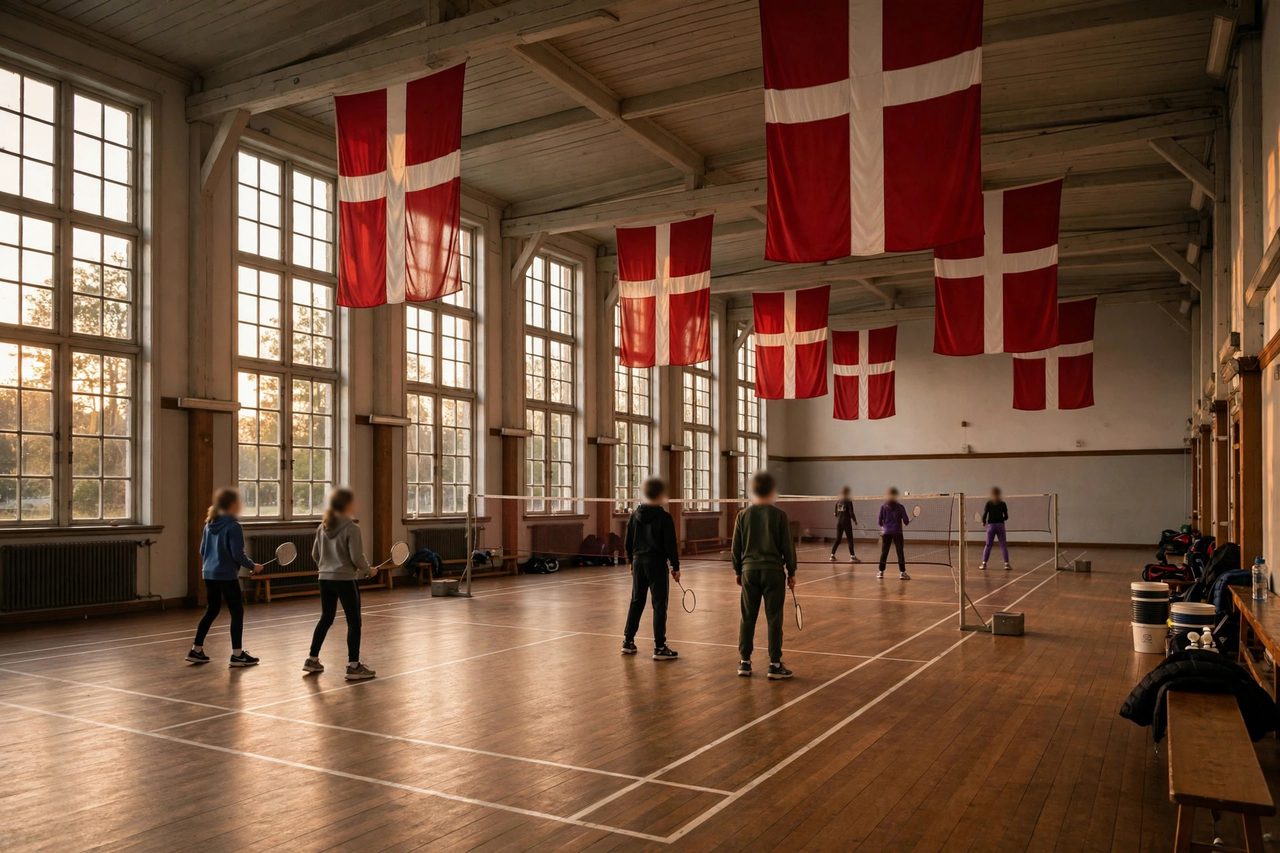
Badminton’s world map is painted in Asian colours — China, Indonesia, Malaysia, Korea, Japan. And then there is a small red-and-white wedge in northern Europe that has spent a century refusing to accept that. Denmark, population 5.9 million, is the only European nation that belongs in every conversation about badminton’s greatest powers. This is how it happened.
An indoor accident, 1925
The story starts with bad weather. Members of a tennis club in Skovshoved, north of Copenhagen, wanted something to play indoors through the Danish winter. Their hall was too small for a tennis court, so they tried an English game they had heard about called badminton. It stuck. By 1930 the Badminton Association of Denmark was formed with just six clubs.
It never stopped growing. Today Denmark has 539 active clubs and over 100,000 registered players — remarkable for a country whose entire population would barely fill the top ten cities of China.
The club system: the real machine
Ask Viktor Axelsen where Danish champions come from and he will not point to a centralised academy. He will point to the clubs. Denmark’s system is built on volunteer-run clubs that organise their own revenue, run adult and youth leagues, and feed talent upward through the association’s age-group squads (under-13 to under-19) and performance centres, including the national junior centre in Aarhus, long managed by the legendary Morten Frost.
The philosophy is deliberately the opposite of the Chinese model: Axelsen himself has said that while Chinese players train five to seven hours a day, “I am more of a fan of the Danish system, where intensity and quality are the most important parts of practice.” The Danish way is deliberate practice in a rich environment — young players training alongside and against much stronger ones, with variety and feedback rather than sheer volume.
When around 200 volunteers from clubs across the country come together every year to run the Denmark Open for nothing, you are looking at the culture that sustains the whole thing.
The lineage of champions
What makes Denmark extraordinary is the unbroken chain. Whenever one legend steps away, another is already there:
- Morten Frost, who won the Denmark Open singles eight times, seven of them in a row from 1980 to 1986;
- Poul-Erik Høyer Larsen, Olympic champion at Atlanta 1996 — Denmark’s first Olympic badminton gold;
- Peter Gade and Camilla Martin, who carried Danish badminton through the late 1990s and 2000s;
- Viktor Axelsen, the multi-time Olympic and world champion of the modern era;
- Anders Antonsen, the defending French Open champion and world No. 2, with Rasmus Gemke right behind him — Gemke beat world No. 1 Kunlavut Vitidsarn at the Denmark Open this very month.
In 2016 Denmark did something no European nation had ever done: it won the Thomas Cup, badminton’s men’s world team championship, beating Indonesia 3–2 in the final. Eight decades of All England titles — 88 across the disciplines — tell the same story.
Why it matters
There is a psychological effect the Danes call their own: success breeds success. When a kid in Odense turns on the television, she does not see a distant foreign sport — she sees people from her own neighbourhood winning Olympic medals. Greatness feels achievable, because it is local.
That is the real secret of the Danish machine. Not money, not population, not a system anyone could copy at scale — just a hundred years of clubs, volunteers, and the quiet belief, passed from Frost to Gade to Axelsen, that a small country can play anyone’s game and win it.
Related articles
Badminton: The World's Most Played Racquet Sport — and Most People Don't Even Know It
More than 300 million people play badminton. It is an Olympic sport, it has the fastest shot in racquet sports, and it fills huge arenas in Asia. So why does so much of the West still think of it as a garden game?
From Wood to Carbon: How the Badminton Racquet Changed the Game
A badminton racquet used to weigh as much as a small hammer. Today it weighs less than a phone. Here is how wood, steel and carbon fibre turned badminton into the fastest racquet sport on earth.
Lin Dan vs Lee Chong Wei: The Rivalry That Made Badminton
For more than a decade, China's Lin Dan and Malaysia's Lee Chong Wei played the matches that turned badminton into must-watch sport.