
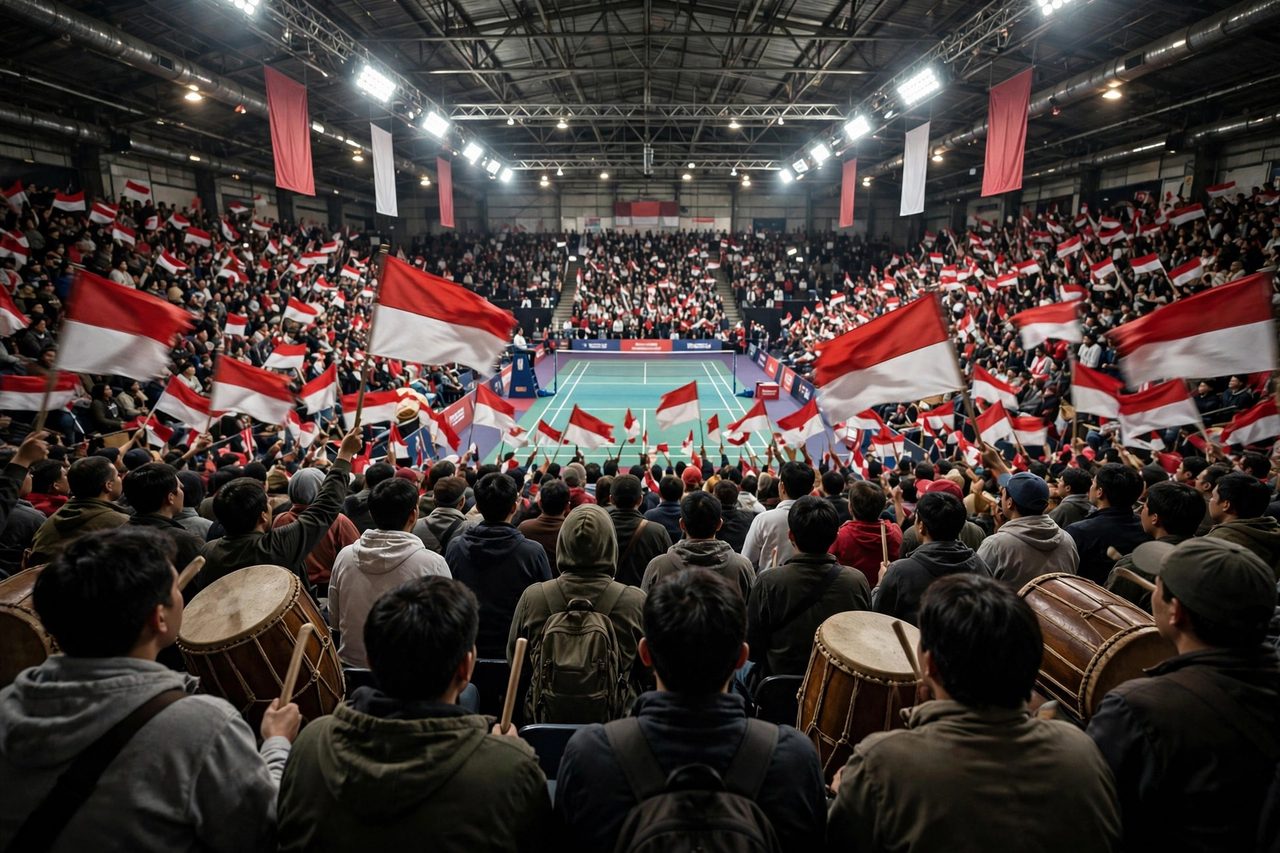
In most countries, badminton is a nice sport. In Indonesia, it is something else entirely. It is the sport that made the country famous. It is the game kids play in every alley and village. It is the reason millions of people stop what they are doing and crowd around a television.
People say badminton is a religion in Indonesia. They are only half joking.
A sport that built a nation’s pride
Indonesia is a huge country of more than 270 million people, spread across thousands of islands. It has many cultures, many languages and many sports. But one sport unites them all: badminton.
The reason is history. Indonesia has won the Thomas Cup 14 times. The Thomas Cup is the world men’s team championship, first played in 1949, and no country has won it more often. Indonesia’s first win came in 1958, and the golden years followed: five straight titles between 1994 and 2002, a run no other country has matched.
Those wins mattered far beyond sport. Indonesia became independent in 1945, and in the decades after, badminton gave the young nation heroes and victories on the world stage. When the Indonesian team won, the whole country felt it.
The Olympic story is just as powerful. Badminton became an Olympic sport at Barcelona 1992, and Indonesia’s first ever Olympic gold medals came there, in badminton: Susi Susanti won the women’s singles and Alan Budikusuma won the men’s singles. Before the Paris 2024 Games, every single Olympic gold medal Indonesia had ever won came from badminton. The sport did not just represent Indonesia. For a long time, it was Indonesia’s only route to the top of the Olympic podium.
Heroes everyone knows
Ask an Indonesian to name a sporting hero and the answer will almost always be a badminton player.
Rudy Hartono is the greatest of them all. He won the All England Open eight times between 1968 and 1976. The All England is badminton’s oldest and most prestigious tournament. Eight titles there is a record that will likely never be broken. Hartono became a national icon, a symbol of Indonesian excellence.
Then came Liem Swie King, with his famous jumping smash. A smash is the hard downward shot that finishes rallies, and King’s version — leaping high and hammering the shuttle down — became legendary.
Later generations had their own heroes. Taufik Hidayat won Olympic gold in Athens in 2004 with a backhand smash so good that fans still talk about it today. The backhand is the shot hit on the opposite side of your body from your racquet hand, and Hidayat’s was a work of art.
In recent years, Jonatan Christie and Anthony Ginting have carried the torch in men’s singles, and the doubles pair known as the Minions — Marcus Fernaldi Gideon and Kevin Sanjaya Sukamuljo — became global stars with their lightning-fast attacking game.
These players are not just athletes in Indonesia. They are celebrities, and children are named after them.
The Istora: badminton’s loudest arena
Every sport has a cathedral. For Indonesian badminton, it is the Istora Senayan in Jakarta.
The Istora is an indoor arena that holds about 7,000 fans, and when it is full for a big Indonesia Open match, it is the loudest place in badminton. The drums never stop. The chanting rolls around the arena like a wave. Visiting players say it is the most intimidating atmosphere in the sport — and the most thrilling.
The Indonesia Open itself is one of the biggest tournaments in the world, a Super 1000 event. Super 1000 is the top tier of the BWF World Tour, the sport’s global circuit. Winning in front of the Istora crowd is a career highlight for any player. Losing there, against an Indonesian, in front of that noise, is one of the hardest experiences in badminton.
A game for everyone
What makes Indonesia different is that badminton is not just for watching. It is for playing, everywhere, by everyone.
You will find courts in villages, schoolyards, office car parks and housing complexes. A net strung between two posts, a cheap racquet, a plastic shuttle — that is all you need. Families play together. Neighbours organise small tournaments. Office workers play after work to unwind.
This is where the champions come from. The Indonesian badminton system scouts talent from local clubs across the country, and the best young players are brought into training centres. It is a pipeline that runs from a village court all the way to the Istora, and it has worked for decades.
This sport is also cheap and accessible in a way that many sports are not. You do not need expensive equipment or a big field. You need a racquet, a shuttle and a flat patch of ground.
The pressure of expectation
There is a flip side to all this love. Indonesian players carry enormous pressure. When they lose, the whole country feels it. Social media erupts. Fans demand answers. Coaches come under fire.
The 2026 Thomas Cup was a painful example. Indonesia, the record champions, went out in the group stage in Horsens, Denmark — a historic early exit for a team used to fighting for the trophy. It was a shock, and it sparked a national debate about the state of the sport.
But that is what happens when a sport matters this much. Nobody debates a sport nobody cares about. The anger after a bad defeat is just the other side of the joy after a great win.
Why it will never fade
Badminton in Indonesia is not a trend. It is woven into the country’s story. It gave Indonesia its first Olympic golds, its most famous sports heroes, and its loudest arena.
Other countries have caught up and passed Indonesia in some areas. China now dominates the women’s game. Denmark, Japan and South Korea all produce champions. But no country loves badminton quite like Indonesia does.
It is not just a game. It is who they are.
Related articles
Badminton: The World's Most Played Racquet Sport — and Most People Don't Even Know It
More than 300 million people play badminton. It is an Olympic sport, it has the fastest shot in racquet sports, and it fills huge arenas in Asia. So why does so much of the West still think of it as a garden game?

From Wood to Carbon: How the Badminton Racquet Changed the Game
A badminton racquet used to weigh as much as a small hammer. Today it weighs less than a phone. Here is how wood, steel and carbon fibre turned badminton into the fastest racquet sport on earth.
Lin Dan vs Lee Chong Wei: The Rivalry That Made Badminton
For more than a decade, China's Lin Dan and Malaysia's Lee Chong Wei played the matches that turned badminton into must-watch sport.