
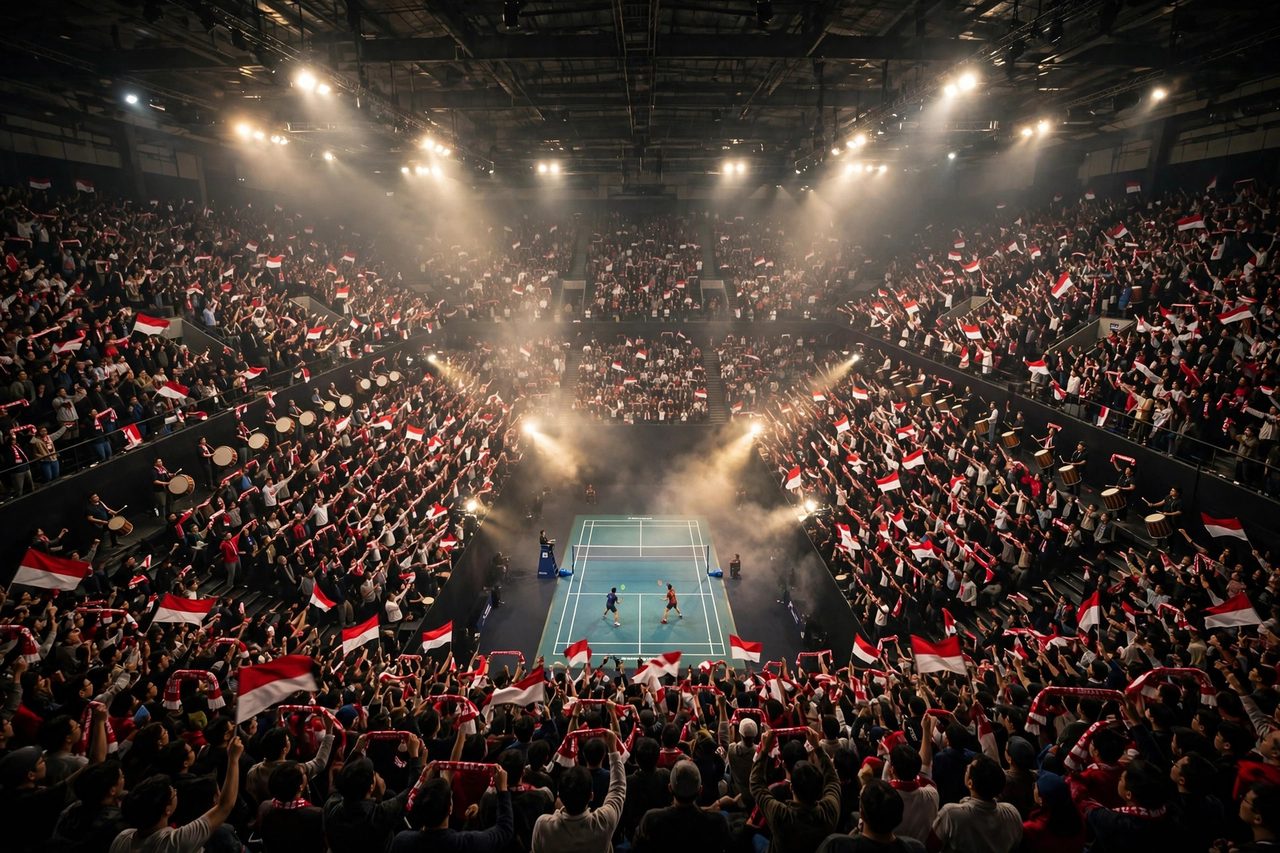
Every sport has a venue where the crowd becomes a weather system. For badminton, it is a 65-year-old concrete bowl in central Jakarta, where the air-conditioning pushes the shuttlecock off course, the drums never stop, and visiting champions walk in knowing the whole building is against them. Its name is Istora Senayan — and there is nowhere else like it.
Built by a president
Istora was born out of national ambition. When Jakarta was awarded the 1962 Asian Games in 1958, President Sukarno — himself a trained architect — ordered a vast sports complex built in the Senayan district. The indoor arena, designed by the architect Friedrich Silaban, opened on 21 May 1961. Its very first event was the 1961 Thomas Cup, the men’s world team championship. An arena that opens its doors with the sport’s greatest team trophy was never going to be a quiet place.
For decades it was the beating heart of Indonesian badminton, the sport the country treats as a religion. The Indonesia Open has lived there since 1982; the Indonesia Masters joined it in 2018 after a major renovation that closed the arena for two years and reduced its capacity to 7,166. The Thomas and Uber Cups have been decided there, world championships too. Generations of Indonesian heroes — from Rudy Hartono to Taufik Hidayat — have had their names roared off these stands.
The wind and the wall of sound
Ask any player about Istora and you will hear two words: drift and noise. The drift is physical. Jakarta is hot and humid, the arena’s air-conditioning runs hard, and the result is swirling air currents that push a feather shuttlecock around like a leaf. Shots that look safe float long; tight spinning net shots die and drop. One end of the court can play fast while the other plays slow, and sideways drift shoves attacking shots wide. Learning to read Istora’s air is a skill in itself — the locals, who train in it, read it best.
The noise is psychological, and it is the arena’s true weapon. Seven thousand Indonesians with drums, trumpets and a complete repertoire of chants produce a sound that players describe as physically overwhelming. When an Indonesian is on court, the roar lifts them and buries their opponent; when a foreigner faces an Indonesian, every rally feels like twenty thousand people are willing the shuttle out. Favourites have melted in Istora for four decades. It is not hostility — Indonesian fans applaud great badminton from anyone — but it is a force field, and everyone who has played there says so.
Why it matters
In an era of identical glass arenas and interchangeable tour stops, Istora is a reminder that badminton venues can have souls. The Super 1000 Indonesia Open, held there each year, remains the tournament players most want to win and most fear to lose — because winning in Istora means you conquered the wind, the noise and the expectation of a nation that treats the sport as its own.
Sixty-five years after Sukarno’s arena opened with a Thomas Cup, it still does what it was built to do: make badminton feel like the biggest thing in the world.
Related articles
Badminton: The World's Most Played Racquet Sport — and Most People Don't Even Know It
More than 300 million people play badminton. It is an Olympic sport, it has the fastest shot in racquet sports, and it fills huge arenas in Asia. So why does so much of the West still think of it as a garden game?

From Wood to Carbon: How the Badminton Racquet Changed the Game
A badminton racquet used to weigh as much as a small hammer. Today it weighs less than a phone. Here is how wood, steel and carbon fibre turned badminton into the fastest racquet sport on earth.
Lin Dan vs Lee Chong Wei: The Rivalry That Made Badminton
For more than a decade, China's Lin Dan and Malaysia's Lee Chong Wei played the matches that turned badminton into must-watch sport.