
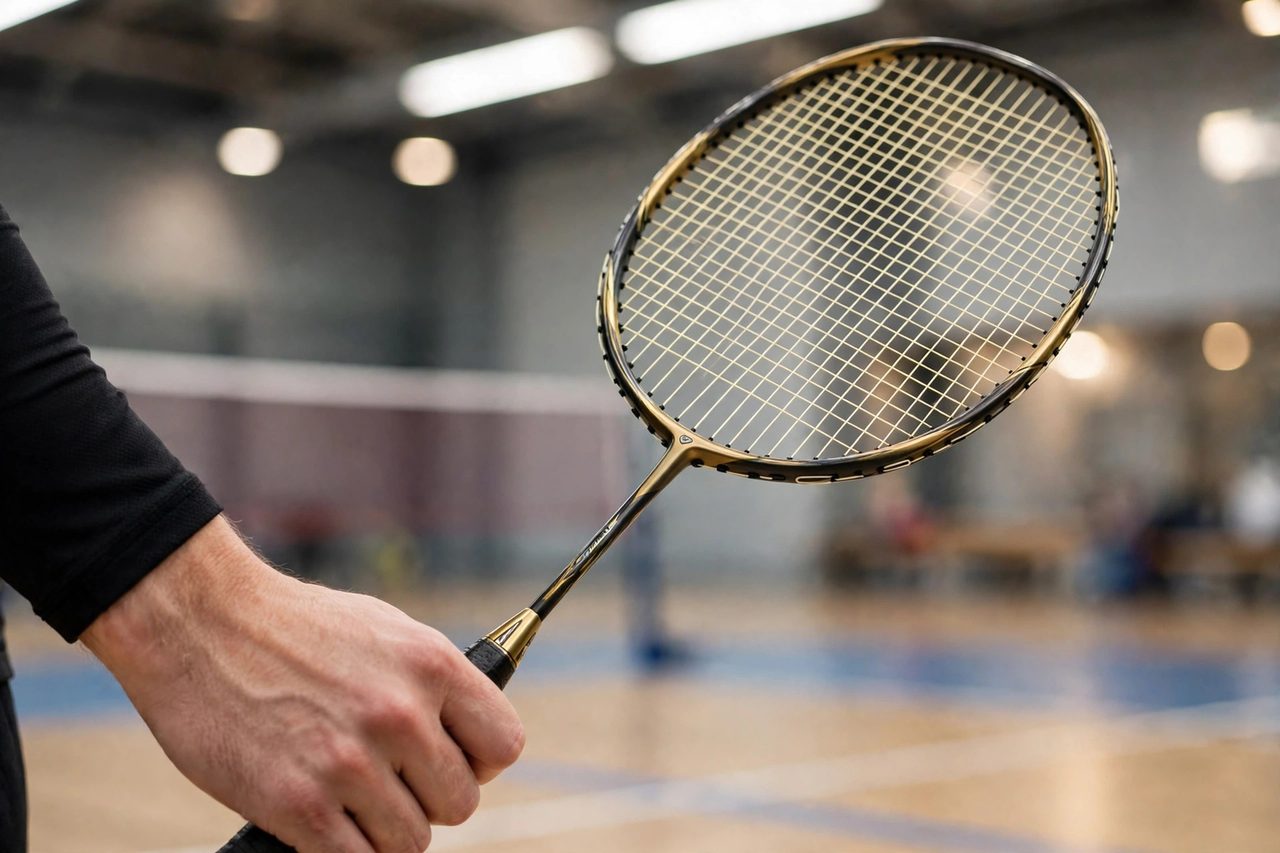
Some racquets help you. Some racquets test you. The Li-Ning Axforce 100 does both, and that is exactly why advanced players love it.
This is Li-Ning’s flagship attacking racquet. Flagship means it is the top model in the range, the one the brand puts its best technology into. It is built for one job: hitting hard, steep and fast, and winning points through attack.
But here is the honest warning up front. This is not a racquet for everyone. If your technique is still developing, it will feel heavy, stiff and tiring. If your technique is already solid, it will feel like a weapon.
What you get
Let us start with the facts. The Axforce 100 comes in two weight classes: 3U (about 87 to 89 grams) and 4U (about 84 to 86 grams). In badminton, U is the weight code. A lower number means a heavier racquet. Most club players pick 4U because it is a little easier to swing fast.
The balance is head-heavy. Balance describes where the weight sits. Head-heavy means more weight sits in the head of the racquet, which adds power to your smashes but makes the racquet slower to move around. The balance point sits at about 306mm from the handle end.
The shaft is stiff, and it is thin — just 6.0mm across. The shaft is the long narrow part between the handle and the head. A stiff shaft bends less when you hit. That gives you more control and a crisper feel, but only if you already swing fast enough to bend it yourself. A flexible shaft helps slower swings. A stiff shaft rewards fast ones.
The frame uses high-grade carbon fibre, including the kind of materials Li-Ning calls M50 and T1100 graphite. You do not need to memorise the codes. What matters is that the frame is light, strong and stable, so it does not twist much on off-centre hits.
It is rated for string tension up to 30 lbs in the 4U version and 31 lbs in 3U. String tension is how tight the strings are pulled. Tighter strings give more control and a sharper feel, but a smaller sweet spot. The sweet spot is the part of the strings that gives the best hit. Most racquets arrive unstrung, so you pick your own string and tension.
The grip size is G5, which is on the smaller side. A smaller grip lets you change your grip quickly between forehand and backhand, which matters in fast doubles exchanges.
On court: the smash
The first thing you notice is the smash. A smash is the hard downward shot you hit from the back of the court, and it is badminton’s most famous weapon. With the Axforce 100, smashes feel heavy. The head-heavy balance loads weight behind the shot, and the stiff shaft sends the power straight into the shuttle. The shuttle is the feathered (or plastic) object you hit back and forth — some people call it a birdie.
Steep smashes are the best kind. Steep means the shuttle dives down sharply, so your opponent has less time to react. This racquet helps you hit steep because the head weight drives the shuttle down, and the stiff shaft keeps the shot accurate.
Clears are good too. A clear is the high, deep shot you hit to the back of the court to buy time or push your opponent back. The Axforce 100 sends clears long without much effort, which is a big help when you are under pressure at the back.
On court: the weaknesses
Now the honest part. Defence is hard work with this racquet. Because the head is heavy, it is slower to lift into place when a smash is flying at you. Quick net play takes effort too. At the net, you need fast, small movements, and a head-heavy racquet resists those little adjustments.
Long matches will tire your arm. If you play three games of fast singles, you will feel this racquet in your shoulder. That is the trade-off for all that power. Players who rely on speed and quick defence will be happier with a head-light or even-balanced racquet, where the weight sits closer to the handle.
The stiff shaft also punishes lazy technique. If your swing is slow or your timing is off, the shuttle will fall short. This racquet does not cover up mistakes. It rewards good habits and exposes bad ones.
Who should buy it
Buy the Axforce 100 if you are an advanced or competitive player who attacks a lot. It suits aggressive singles players, and it suits the back-court hitter in doubles — the player who stays at the back and smashes while their partner covers the net.
Pick the 4U version if you want a little more speed. Pick 3U if you are strong, play mostly singles, and want maximum weight behind your shots.
Do not buy it if you are a beginner or an improving intermediate. You will get more from a lighter, more flexible racquet that helps you generate power while your technique grows. The Axforce 90, a lighter racquet in the same family, is the smarter step for most club players.
The verdict
The Li-Ning Axforce 100 is a brilliant attacking racquet with a clear personality. It gives huge power, sharp control and a rock-solid feel on attacking shots. It asks for strength, speed and good technique in return.
Think of it like a sports car. In the right hands, it is thrilling. In the wrong hands, it is hard work. If your game is built on attack and your technique is ready, this racquet will make your best shots even better. If it is not ready yet, keep building — this racquet will still be here when you are.
Related articles
Yonex Astrox 88S Pro Review: The Front-Court Doubles Racquet Built for Speed and Control
The Yonex Astrox 88S Pro is the third-generation doubles racquet for front-court players: fast, stiff, and 5mm longer than standard. Our review covers the real specs and who it suits.

Yonex Astrox 88D Pro Review: The Doubles Smasher Built for the Back Court
The Yonex Astrox 88D Pro is the third-generation doubles attack racquet for back-court smashers: head-heavy, stiff, and 10mm longer than standard. Our review covers the real specs and who it suits.

Yonex Astrox 99 Pro Review: The Power Racquet for Players Who Live to Smash
The Yonex Astrox 99 Pro is the most head-heavy racquet in Yonex's current lineup: stiff, powerful, and built for advanced attacking players. Our review breaks down the real specs and who it suits.