
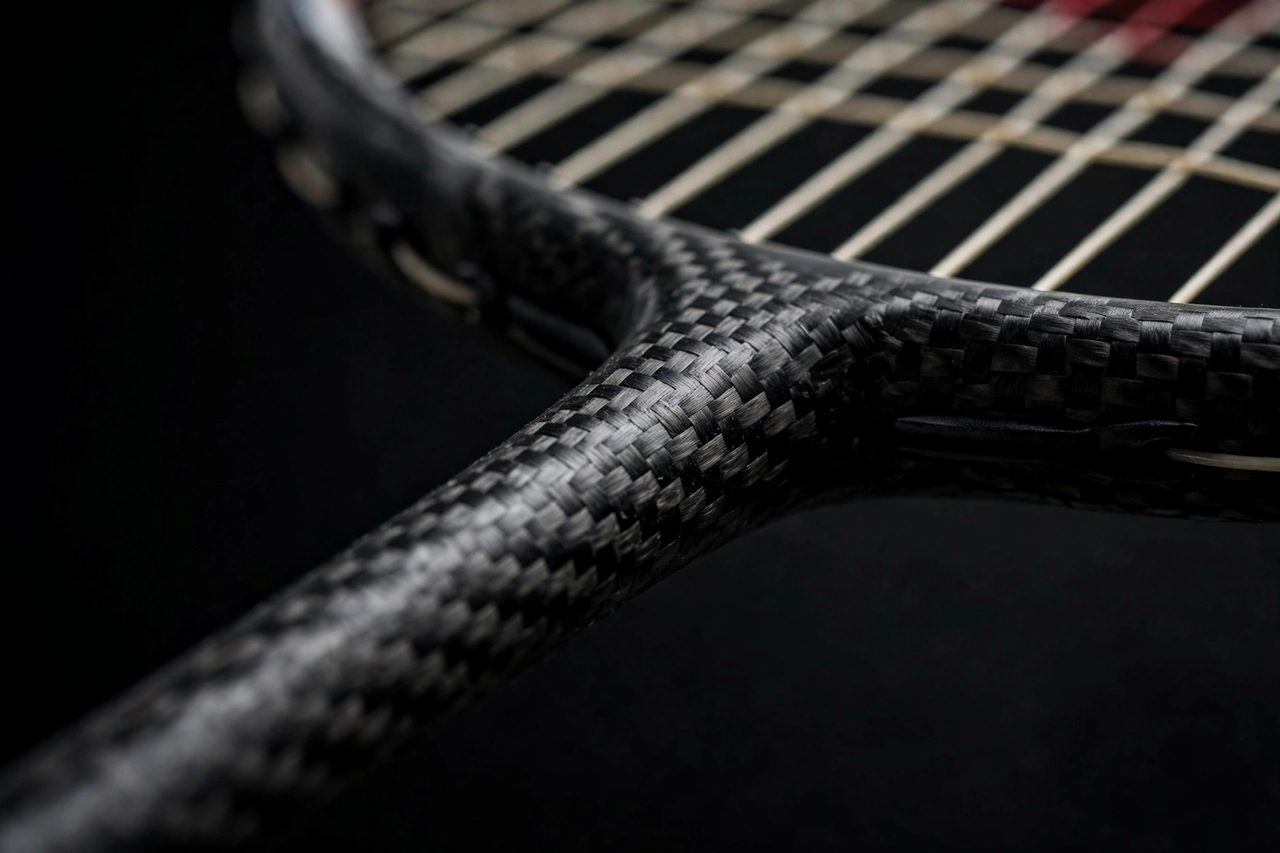
Few racquets carry as much reputation as the Yonex Astrox 100 ZZ. It sits at the top of Yonex’s Astrox line — the attacker’s line — and it is the frame the brand’s marketing puts in the hands of its biggest stars. But reputation is not a specification. Here is what the 100 ZZ (item code AX100ZZ) actually is, spec by spec, so you can decide whether it belongs in your bag.
The headline specs
The numbers below come from the manufacturer’s published spec sheet, as listed by Yonex USA and confirmed across major retailers:
- Flex: Extra Stiff
- Balance: Head-heavy
- Weight / grip: 4U (average 83 g) in G5, G6 — 3U (average 88 g) in G4, G5, G6
- Recommended string tension: 4U: 20–28 lbs · 3U: 21–29 lbs
- Frame: HM Graphite / Namd / Tungsten / Black Micro Core / Nanometric
- Shaft: HM Graphite / Namd (hyper-slim profile)
- Length: 10 mm longer than standard
- Colours: Kurenai (red) and Dark Navy
- Made in: Japan
Yonex USA currently lists the Astrox 100 ZZ at $295.00 (there is also a Viktor Axelsen limited-edition version at a premium).
What those specs mean on court
Extra stiff shaft. This is the most important line on the sheet. A stiff shaft does not bend easily, so it rewards players who can generate their own racquet-head speed: you get more precision and a crisper transfer of power. If your swing is slow or your timing inconsistent, an extra-stiff shaft will feel dead and unforgiving. It is not a beginner’s tool.
Head-heavy balance. Weight sits toward the head of the frame, which adds momentum through the hitting zone. That is why head-heavy racquets are the attacker’s choice: smashes come down steeper and clears travel deeper with less effort. The trade-off is defensive speed — head-heavy frames are slower to whip up for a drive or a fast block at the net.
10 mm longer. The extended length gives extra reach and leverage on the smash, but it also makes the frame slightly slower through the air. Combined with the head-heavy balance, it tells you everything about the design brief: this racquet wants to attack from the back court.
Rotational Generator System. This is Yonex’s name for distributing counter-balanced weight through the grip end, the top of the frame and the joint. The idea is smoother transitions between consecutive shots — useful because a head-heavy racquet can otherwise feel sluggish when you need a second and third attacking shot in a row.
4U or 3U?
This is the question every buyer asks, and the honest answer depends on your build and your game:
- 4U (average 83 g): the lighter option, sold in G5 and G6 grips. Faster handling, easier on the shoulder over a long session, better for doubles or for players who like to mix attack with fast flat exchanges. If you are not sure, start here.
- 3U (average 88 g): the heavier option, available in G4, G5 and G6. More stability on impact, more weight behind the smash, more demanding on the arm. Best for strong singles players with established technique.
Note the tension ranges differ slightly: 4U is strung 20–28 lbs, 3U 21–29 lbs. Yonex recommends Aerobite Boost for control-oriented players and BG66 Force for hard hitters.
The technology stack, decoded
Marketing names aside, here is what the materials actually do:
- Namd: a graphite composite that flexes more and snaps back faster, designed to add power at high swing speeds.
- Tungsten: dense material in the frame that pushes weight toward the head — the source of the head-heavy feel.
- Black Micro Core: a vibration-dampening material in the upper frame for a more solid hit.
- Nanometric: a finer carbon structure in the shaft for strength at a slimmer profile — hence the hyper-slim shaft, one of the thinnest Yonex makes.
- ISOMETRIC head: Yonex’s squarish head shape, which gives a larger sweet spot than a conventional oval frame.
- AERO+BOX frame: an aerodynamic top half for swing speed, a boxy lower half for stability, meeting at a new built-in T-joint.
Who should buy it — and who should not
Buy it if: you are an intermediate to advanced player with a fast, technically sound swing; you play an attacking game built on the smash and the jump smash; you can handle an extra-stiff shaft without losing accuracy; you want the most power-focused frame in Yonex’s current lineup.
Skip it if: you are still developing your swing (a flexible or medium-flex racquet like the Nanoflare or ArcSaber lines will give you more for free); you play a defensive or control-first game; you have shoulder or elbow trouble — head-heavy plus extra stiff is the most demanding combination there is.
The Astrox 100 ZZ is, in short, a specialist: it does one thing — attack — better than almost anything else on the market, and it makes no apologies for the rest. Know your game before you buy.
Specs: Yonex USA – Astrox collection · Astrox 100 ZZ spec sheet
Related articles
Yonex Astrox 88S Pro Review: The Front-Court Doubles Racquet Built for Speed and Control
The Yonex Astrox 88S Pro is the third-generation doubles racquet for front-court players: fast, stiff, and 5mm longer than standard. Our review covers the real specs and who it suits.
Yonex Astrox 88D Pro Review: The Doubles Smasher Built for the Back Court
The Yonex Astrox 88D Pro is the third-generation doubles attack racquet for back-court smashers: head-heavy, stiff, and 10mm longer than standard. Our review covers the real specs and who it suits.
Yonex Astrox 99 Pro Review: The Power Racquet for Players Who Live to Smash
The Yonex Astrox 99 Pro is the most head-heavy racquet in Yonex's current lineup: stiff, powerful, and built for advanced attacking players. Our review breaks down the real specs and who it suits.