
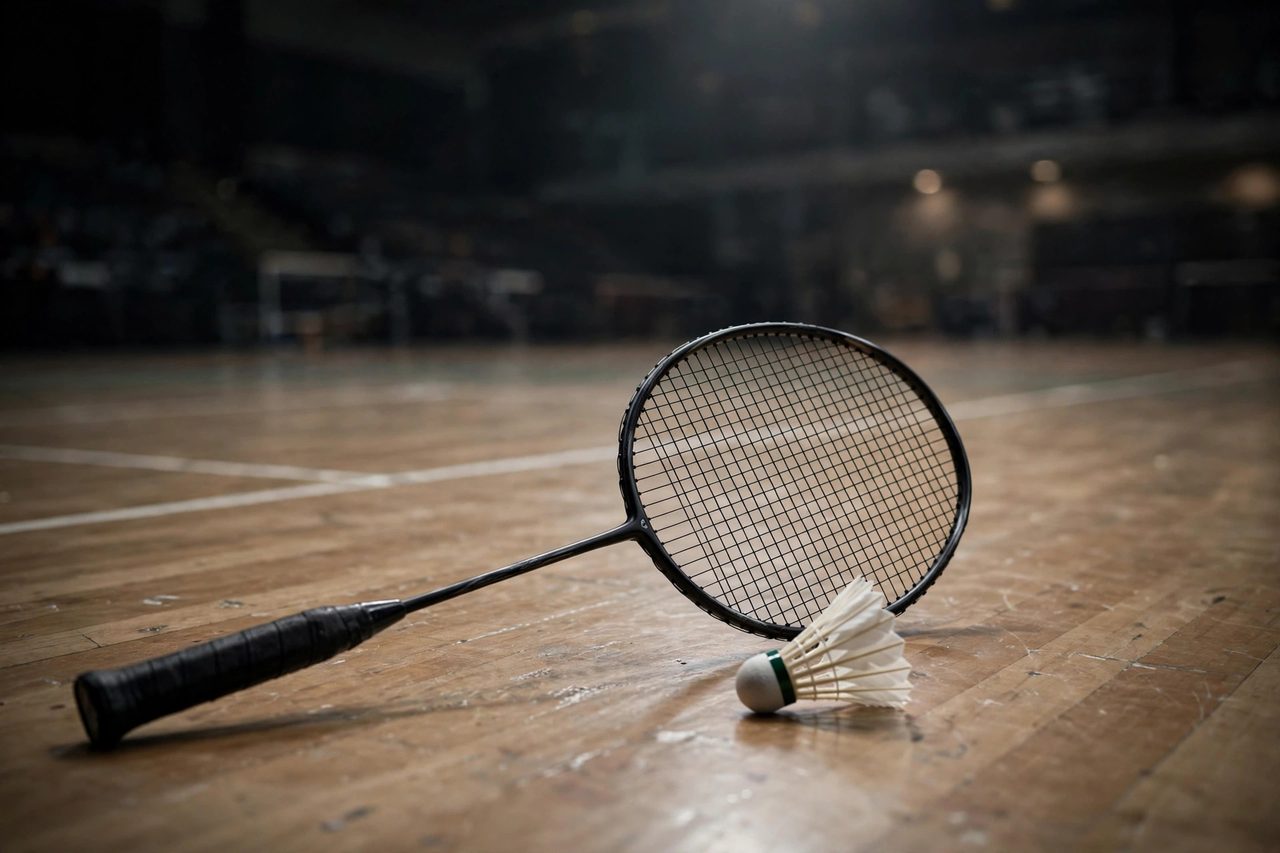
There is a particular kind of badminton player who loves head-heavy racquets and hates what they do to their arm. The Yonex Astrox 77 Pro was built for them. It is the attack racquet in Yonex’s flagship Astrox line that trades a little of the brute force of the 100 ZZ and 88D Pro for something rarer: power you can actually live with over three games.
The spec sheet tells the story plainly. The Astrox 77 Pro (item code AX77-P) comes in 4U (average 83 g) and 3U (average 88 g), with a head-heavy balance, a medium-flex shaft, an isometric head and a frame 10 mm longer than standard. It is made in Japan, strung to 19–27 lbs in 4U and 20–28 lbs in 3U, and finished in the unmistakable High Orange colourway.
The technology, in plain language
Three pieces of Yonex engineering do the heavy lifting. Namd graphite in the shaft — nanomaterial bonded directly to the graphite fibres rather than mixed into the resin — lets the shaft flex deeply and snap back quickly, storing energy on the backswing and releasing it at impact. Flex Fuse, a shock-absorbing resin around the T-joint, softens the feel at contact and damps the vibrations that make stiff racquets punishing. And the Rotational Generator System distributes weight between the grip end, the frame top and the joint, so a head-heavy racquet still recovers quickly between shots instead of lagging behind the rally.
The 10 mm longer frame matters more than it sounds. The extra length gives the shuttle a fraction more dwell time on the strings and a little more leverage on the swing — Yonex’s own framing is that it increases smash power over the previous generation — and it is part of why the 77 Pro feels longer and more whip-like than its weight suggests.
Who actually uses it
The endorsement list is a clue to the racquet’s character. World No. 1 An Se-young plays it, as does Olympic champion Chen Yu Fei, China’s Han Yue, and elite mixed doubles players Feng Yan Zhe and Huang Dong Ping. That is a revealing spread: women’s singles stars and mixed doubles specialists, players who need steep, heavy smashes but also fast hands at the net and a racquet that does not punish them across a long tournament week.
It is rated intermediate to advanced, and that rating is honest. A genuine beginner will find the head-heavy balance tiring and the medium flex harder to time than a flexible, even-balanced frame. But for the ambitious club or league player stepping up from an all-round racquet, the 77 Pro is the gentlest doorway into serious attacking equipment.
On court: what it feels like
The first thing you notice is that it does not feel as heavy as it looks. The 4U version, at around 83 g unstrung, swings lighter than a typical head-heavy frame because the counterbalanced weight distribution keeps the racquet head from dragging on recovery. Smashes come off steep and heavy, clears carry to the back with less effort than a stiff shaft demands, and the medium flex forgives a slightly mistimed swing in a way the 100 ZZ simply does not.
The trade-offs are real but modest. If your game is built on flat, fast doubles drives, a head-light frame like the Nanoflare 1000Z will still beat it for sheer hand speed. And if you want maximum raw power and can handle a stiff shaft, the Astrox 100 ZZ remains the bigger hammer. The 77 Pro sits deliberately between those poles: an attack racquet that lets you play a full match, and then another one.
String it thoughtfully. At the lower end of the recommended tension — around 24–25 lbs in 4U — you get forgiveness and a bigger sweet spot; push higher with a control string like BG66 Ultimax or a power string like NBG99 and the racquet sharpens up considerably. The 22 × 21 string pattern keeps the bed consistent either way.
The verdict
The Astrox 77 Pro is not the most powerful racquet Yonex makes, and it is not trying to be. It is the attack racquet for players who want to smash hard on Saturday and still have a shoulder on Sunday. For intermediate and advanced players moving towards an attacking game — especially singles players and all-court doubles players — it is one of the easiest recommendations in the entire Yonex range: head-heavy punch, medium-flex comfort, and a price that sits well below the flagship Pro models it borrows its technology from.
Buy the 4U if you play doubles or value speed; buy the 3U if you are a singles player who wants the extra plough-through. Either way, you are buying the racquet the world No. 1 trusts — and the one your arm will thank you for.
Related articles
Yonex Astrox 88S Pro Review: The Front-Court Doubles Racquet Built for Speed and Control
The Yonex Astrox 88S Pro is the third-generation doubles racquet for front-court players: fast, stiff, and 5mm longer than standard. Our review covers the real specs and who it suits.
Yonex Astrox 88D Pro Review: The Doubles Smasher Built for the Back Court
The Yonex Astrox 88D Pro is the third-generation doubles attack racquet for back-court smashers: head-heavy, stiff, and 10mm longer than standard. Our review covers the real specs and who it suits.
Yonex Astrox 99 Pro Review: The Power Racquet for Players Who Live to Smash
The Yonex Astrox 99 Pro is the most head-heavy racquet in Yonex's current lineup: stiff, powerful, and built for advanced attacking players. Our review breaks down the real specs and who it suits.