
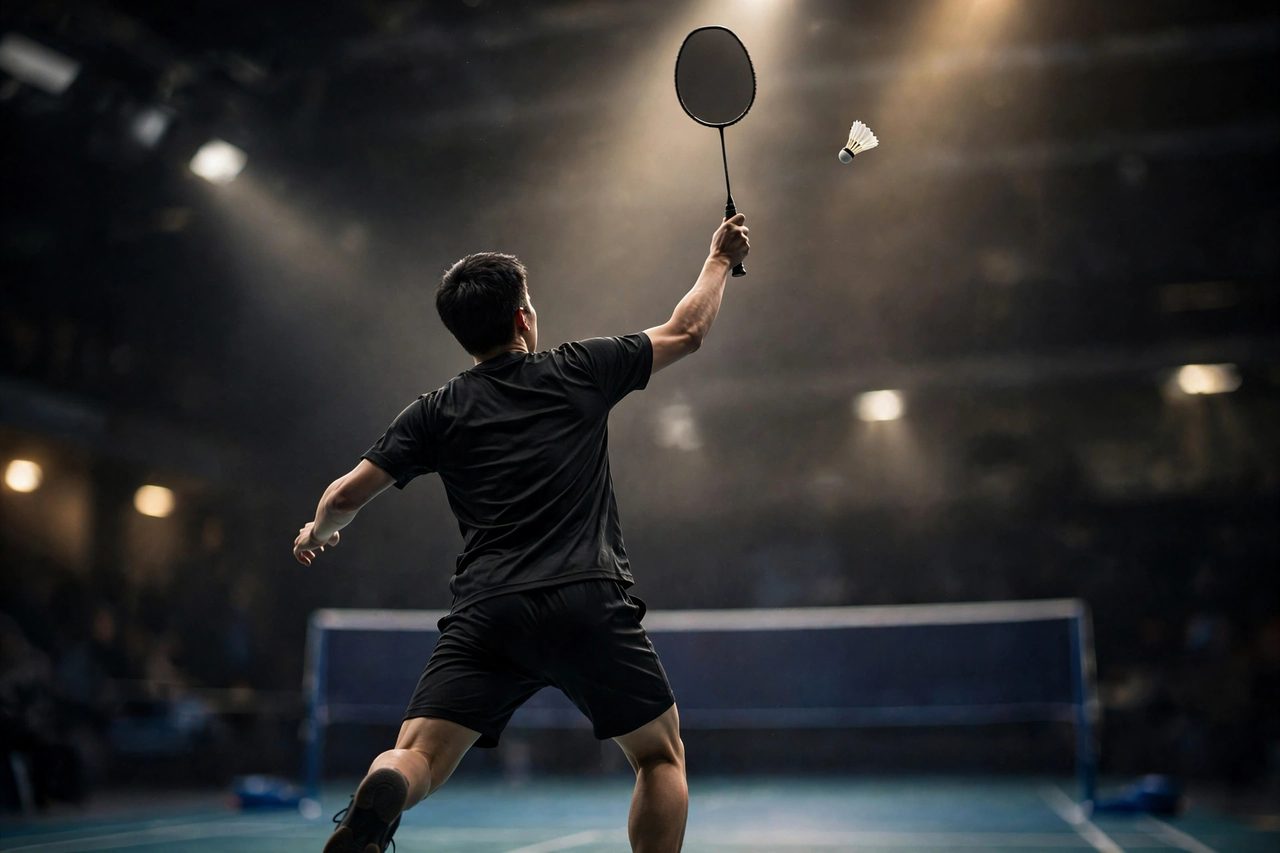
In doubles, the two players split the court: one owns the front, hunting for quick kills at the net, and the other owns the back, smashing again and again until the defence breaks. The Yonex Astrox 88D Pro is built for the player at the back. The D stands for Dominate, and that is exactly what this racquet is for.
This is the third generation of the 88D Pro, launched worldwide on March 22, 2024. Its sibling, the 88S Pro, is the front-court racquet — the S stands for Skill. If you play doubles and you are the one doing most of the smashing, this racquet was made with you in mind.
The specs that matter
The 88D Pro comes in two weight classes: 3U (about 88 grams) and 4U (about 83 grams). In badminton, weight is measured in “U” codes, and a lower number means a heavier racquet. Most club players pick 4U, which is a little easier to swing fast. Stronger players who want more weight behind the shuttle often go 3U.
The balance is head-heavy. Balance describes where the weight sits: head-heavy means more weight sits in the head, which adds power to your smashes but makes the racquet slower to move around. The 88D Pro is clearly head-heavy, though not as extreme as the Astrox 99 Pro, Yonex’s heaviest singles racquet. That middle ground is the point: it hits hard but still moves fast enough for doubles.
The shaft is stiff. The shaft is the long narrow part between the handle and the head. A stiff shaft bends less when you hit, giving more control and a crisper feel — but only if your swing is already fast enough to bend it. A flexible shaft helps slower swings; a stiff one rewards fast ones.
It is also 10mm longer than standard, giving a little more reach on overhead shots. Stringing advice is 20 to 28 lbs for the 4U and 21 to 29 lbs for the 3U. String tension is how tight the strings are pulled: higher tension gives more control but a smaller sweet spot, the area of the strings that gives the cleanest, most powerful hit.
The frame mixes high-modulus graphite, CFR, and tungsten, a very dense metal Yonex uses to add weight exactly where it wants it. The shaft adds 2G-Namd Flex Force, a graphite that flexes and snaps back fast, plus Ultra PE Fiber. It is made in Japan and comes in Black/Silver.
What the technology actually does
The Rotational Generator System spreads weight across the grip end, the top of the frame, and the joint between them — the joint is the T-shaped piece where the shaft meets the head. That balance is meant to make the racquet feel smoother as you move from one big shot to the next. This third generation adds a Power-Assist Bumper, extra weight at the top of the frame that pushes more power into your shots.
Stability Weight Distribution is the other new idea: extra weight along the sides of the frame keeps the racquet face steadier at impact, so less power is lost and the smash comes off stronger.
Two smaller details complete the picture. The head shape is Yonex’s ISOMETRIC design: instead of a round or oval head, the shape is squarer, which gives a larger sweet spot, so off-center hits still feel decent. The AERO+BOX frame mixes a slim, fast shape with a sturdier box shape for speed without losing stability.
On court: heavy smashes, honest trade-offs
On smashes, this racquet is superb. The head-heavy balance, the stiff shaft, and the extra length combine to give heavy, steep smashes that are hard to return. Drives feel strong too: a drive is a fast, flat shot hit across the court, and the 88D Pro keeps them quick and punchy. Clears fly deep with little effort, thanks to the weight in the head. A clear is a high shot sent to the back of the court, the shot that buys you time in a rally.
But power comes with a trade. Defence is harder work: a head-heavy racquet is slower to lift and move, so fast flat exchanges and quick blocks take more effort. If your opponents keep the shuttle low and fast, you will feel the weight. Touch shots at the net are fine, but they need a soft hand.
Who should buy it, and who should not
This racquet is for advanced players with good technique and fast swings. If you are the back-court smasher in a doubles pair, it fits your game.
It is not a beginner racquet: the stiff shaft and head-heavy balance will feel heavy and tiring if your technique is still developing. It is also not the best pick for front-court doubles specialists — if you spend most of your time at the net, look at the 88S Pro instead, the same family built for speed and quick kills up front.
One practical note: this is a premium racquet, and it is priced like one — roughly €180 to €230 in Europe and around $250 to $290 in the US, though prices vary by shop and region. Buy from an authorized dealer, since popular Yonex models are widely copied. The 4U is the safer choice for most players; go 3U only if you are strong and know you like heavier racquets.
The verdict
The Yonex Astrox 88D Pro is one of the best doubles racquets you can buy if your job is to smash from the back. It is honest about what it is: a weapon for attacking players. It will not fix your technique or make defence easy. But if your game is built on breaking down the other pair from the rear court, very few racquets hit this hard while staying this quick.
Who it suits: advanced doubles players, back-court smashers, attacking singles players who want a fast head-heavy racquet. Who should skip it: beginners, front-court doubles players, anyone who wants a light and fast racquet.
Related articles
Yonex Astrox 88S Pro Review: The Front-Court Doubles Racquet Built for Speed and Control
The Yonex Astrox 88S Pro is the third-generation doubles racquet for front-court players: fast, stiff, and 5mm longer than standard. Our review covers the real specs and who it suits.
Yonex Astrox 99 Pro Review: The Power Racquet for Players Who Live to Smash
The Yonex Astrox 99 Pro is the most head-heavy racquet in Yonex's current lineup: stiff, powerful, and built for advanced attacking players. Our review breaks down the real specs and who it suits.
Victor Auraspeed 100X Review: The Speed Racquet That Swings Itself
The Victor Auraspeed 100X is built for fast hands and faster rallies. With a stiff shaft, a light head and a slim 5.8 mm shaft on the Ultra version, it rewards quick players — and punishes lazy ones.