
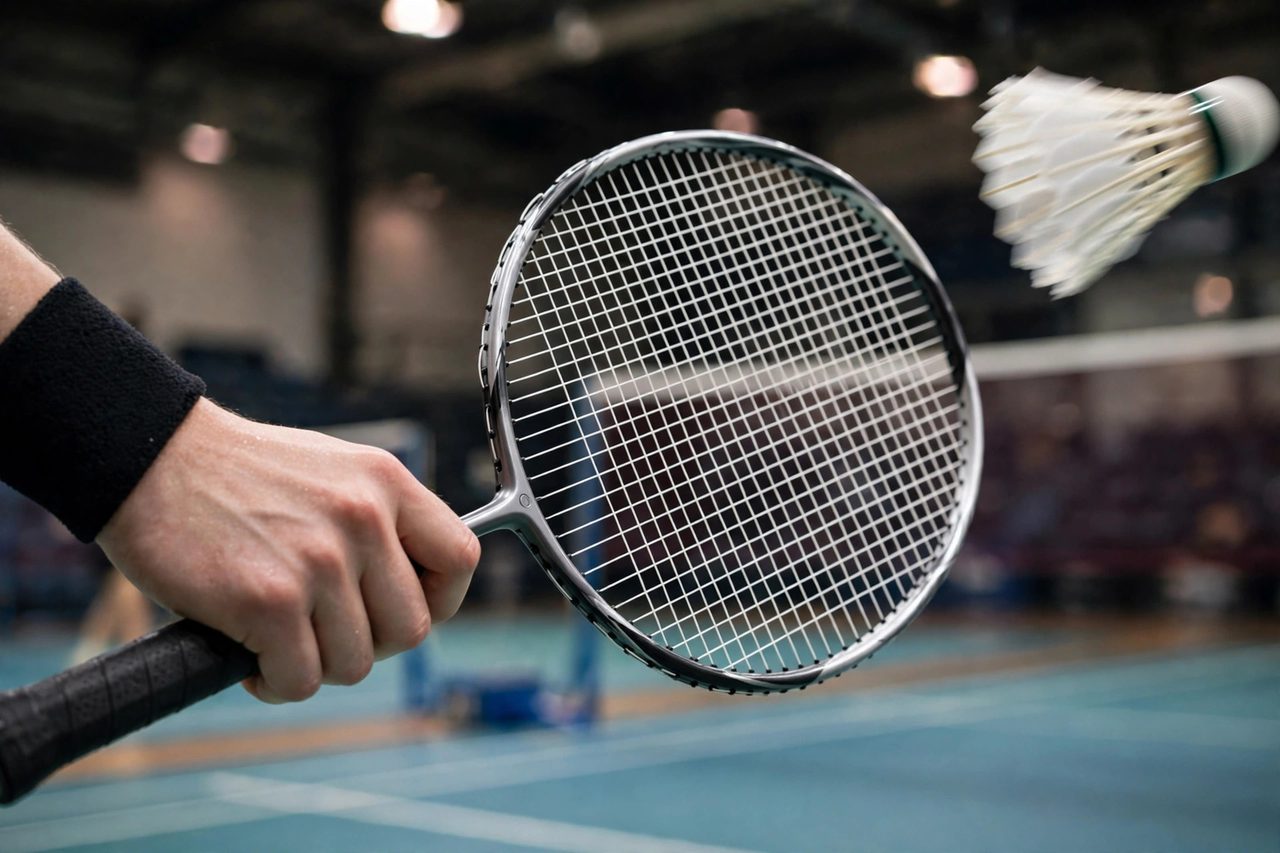
In doubles, the two players split the court: one owns the back, smashing again and again until the defence breaks, and the other owns the front, hunting for quick kills at the net. The Yonex Astrox 88S Pro is built for the player at the front. The S stands for Skill, and that is exactly what this racquet is for.
This is the third generation of the 88S Pro, launched worldwide on March 22, 2024, alongside its sibling, the 88D Pro. The D stands for Dominate and is the back-court smasher; the S is the front-court racquet.
The specs that matter
The 88S Pro comes in two weight classes: 3U (about 88 grams) and 4U (about 83 grams). In badminton, weight is measured in “U” codes, and a lower number means a heavier racquet. Most club players pick 4U, which is a little easier to swing fast. Stronger players who want more weight behind the shuttle often go 3U.
The balance is head-heavy. Balance describes where the weight sits: head-heavy means more weight sits in the head, which adds power to your shots. But the 88S Pro is much less head-heavy than its sibling, the 88D Pro, so it swings lighter and moves faster. That is the whole point of this racquet: it keeps a little of the head weight for punch, but it stays quick enough for the front court.
The shaft is stiff. The shaft is the long narrow part between the handle and the head. A stiff shaft bends less when you hit, giving more control and a crisper feel — but only if your swing is already fast enough to bend it. A flexible shaft helps slower swings; a stiff one rewards fast ones.
It is also 5mm longer than standard, giving a little more reach on overhead shots and at the net. Stringing advice is 20 to 28 lbs for the 4U and 21 to 29 lbs for the 3U. String tension is how tight the strings are pulled: higher tension gives more control but a smaller sweet spot, the area of the strings that gives the cleanest, most powerful hit.
The frame mixes high-modulus graphite, CFR, and tungsten, a very dense metal Yonex uses to add weight exactly where it wants it. The shaft adds 2G-Namd Flex Force, a graphite that flexes and snaps back fast, plus Ultra PE Fiber. It is made in Japan and comes in Silver/Black.
What the technology actually does
The Rotational Generator System spreads weight across the grip end, the top of the frame, and the joint between them — the joint is the T-shaped piece where the shaft meets the head. That balance is meant to make the racquet feel smoother as you move from one quick shot to the next. This third generation adds a Power-Assist Bumper, extra weight at the top of the frame that pushes more power into your shots.
The 88S Pro also gets its own expanded sweet spot. A bigger sweet spot means off-center hits still feel decent, which matters at the front, where you often have to react in a split second.
Two smaller details complete the picture. The head shape is Yonex’s ISOMETRIC design: instead of a round or oval head, the shape is squarer, which gives a larger sweet spot. The AERO+BOX frame mixes a slim, fast shape with a sturdier box shape for speed without losing stability.
On court: quick hands, honest trade-offs
At the net, this racquet is superb. The lighter swing weight and the stiff shaft combine to give fast, sharp kills and tight net shots. Drives feel strong too: a drive is a fast, flat shot hit across the court, and the 88S Pro keeps them quick and punchy. Interceptions — jumping in front of a shot meant for your partner — are where it really shines, because the racquet gets into position so fast.
But speed comes with a trade. Smashes from the back court are fine, but they do not hit as hard as the 88D Pro. If you end up at the back and have to smash again and again, you will feel the missing weight. Clears fly well enough — a clear is a high shot sent to the back of the court, the shot that buys you time in a rally — but they need a bit more effort than with a power racquet.
Who should buy it, and who should not
This racquet is for advanced players with good technique and fast swings. If you are the front-court player in a doubles pair, it fits your game.
It is not a beginner racquet: the stiff shaft will feel harsh and tiring if your technique is still developing. It is also not the best pick for back-court doubles specialists — if you spend most of your time smashing from the rear, look at the 88D Pro instead.
One practical note: this is a premium racquet, and it is priced like one — roughly €180 to €190 in Europe and around $290 in the US, though prices vary by shop and region. Buy from an authorized dealer, since popular Yonex models are widely copied. The 4U is the safer choice for most players; go 3U only if you are strong and know you like heavier racquets.
The verdict
The Yonex Astrox 88S Pro is one of the best doubles racquets you can buy if your job is to control the front court. It is honest about what it is: a fast, precise tool for players who win points at the net. It will not out-smash a back-court racquet, and it will not fix your technique. But if your game is built on quick hands, sharp interceptions, and killing the shuttle early, very few racquets move this fast while still hitting this cleanly.
Who it suits: advanced doubles players, front-court specialists, players who want speed and control without giving up all their power. Who should skip it: beginners, back-court smashers, anyone who wants a heavy, power-first racquet.
Related articles
Yonex Astrox 88D Pro Review: The Doubles Smasher Built for the Back Court
The Yonex Astrox 88D Pro is the third-generation doubles attack racquet for back-court smashers: head-heavy, stiff, and 10mm longer than standard. Our review covers the real specs and who it suits.
Yonex Astrox 99 Pro Review: The Power Racquet for Players Who Live to Smash
The Yonex Astrox 99 Pro is the most head-heavy racquet in Yonex's current lineup: stiff, powerful, and built for advanced attacking players. Our review breaks down the real specs and who it suits.
Victor Auraspeed 100X Review: The Speed Racquet That Swings Itself
The Victor Auraspeed 100X is built for fast hands and faster rallies. With a stiff shaft, a light head and a slim 5.8 mm shaft on the Ultra version, it rewards quick players — and punishes lazy ones.