
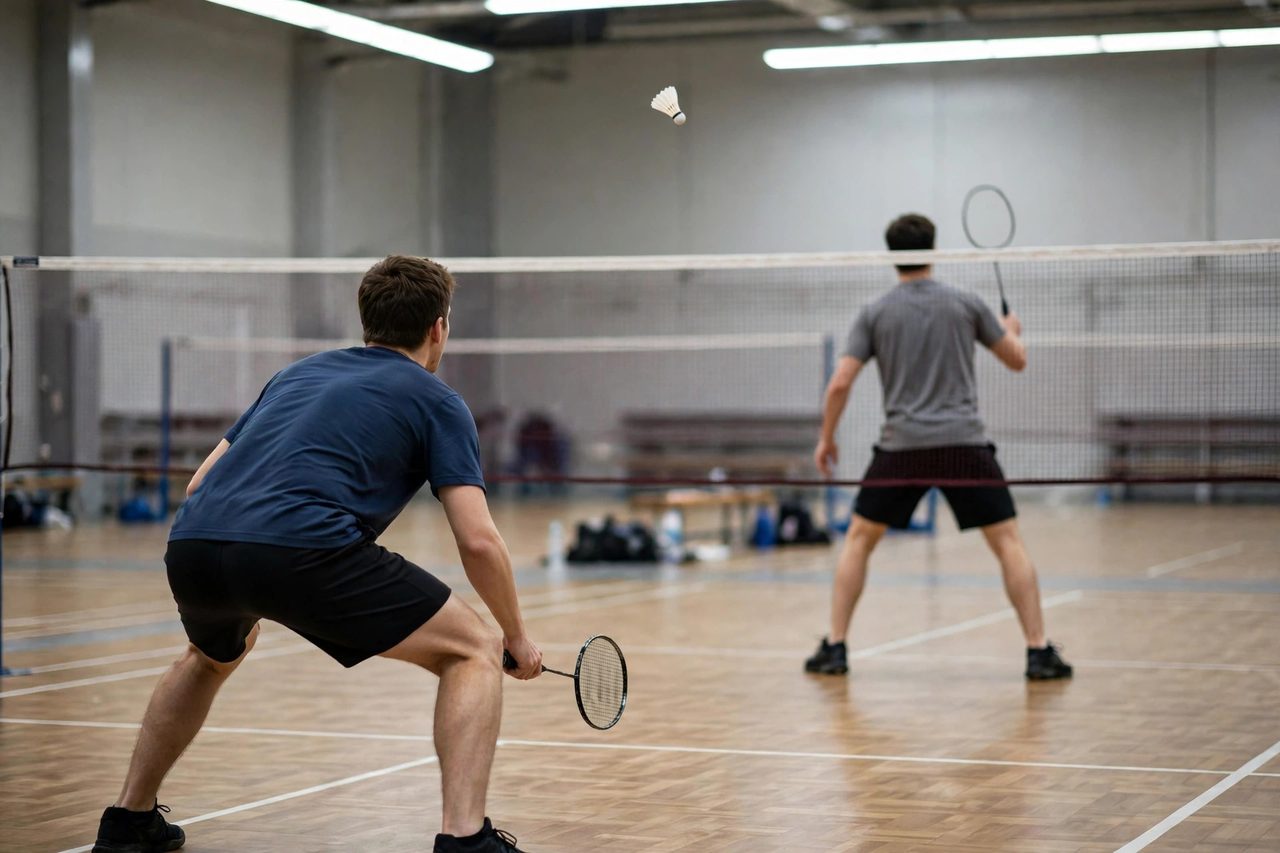
Doubles badminton looks fast and chaotic from the sidelines. It is not chaos, though. It is a simple system, and once you learn it, the game slows right down.
That system is called rotation. Rotation is the way doubles partners move around the court together so that every part of the court is covered and nobody covers the same spot twice.
The two shapes: front-and-back and side-by-side
Doubles has two main shapes, and you switch between them all rally long.
The first is front-and-back. Front-and-back means one partner stands near the net and the other near the back of the court. The front player looks after net shots and anything short; the back player looks after smashes and clears to the rear.
The second is side-by-side. Side-by-side means the two partners stand next to each other, each covering one half.
Here is the simple rule that ties them together. When your pair is attacking, play front-and-back. When defending, play side-by-side.
Most beginners stay in one shape too long: attacking from side-by-side leaves the net open, and defending from front-and-back leaves a whole side empty. Change shape when the rally changes.
Who takes the middle?
The middle causes more arguments than any other spot. Rule: the player whose forehand covers the middle takes it. Your forehand is the shot you hit on the same side as your racquet hand, and it is stronger and quicker than your backhand for most players.
The player who is closer and can hit a forehand should call it early. A short, loud “mine” stops both players swinging at the same shuttle, which is how racquets clash.
In front-and-back, the front player owns the middle at the net. If a shot comes soft and short through the centre, the front player takes it, and the back player stays back and trusts them. If both rush forward, one good lift beats you both.
A lift is a high shot hit from near the net up to the back of the court, usually to escape pressure. When your opponents lift, move into side-by-side, because a high shot gives them time to attack.
What triggers a switch?
A switch is the moment you change from one shape to the other. Four moments trigger it.
First, you smash and your opponents lift high: move into front-and-back, smasher following forward.
Second, your opponents smash at you. Block it short and stay ready at the net; lift it high and drop back into side-by-side.
Third, someone plays a drop shot. A drop shot is a soft shot that falls just over the net. A good drop of yours moves your pair forward into front-and-back; a good drop against you sends the nearest player to the net and the partner back.
Fourth, a drive changes everything. A drive is a fast, flat shot hit straight at your opponents, usually at body height. In a drive rally, both pairs flatten into side-by-side, because flat shots can go anywhere.
Move as soon as the shot is hit, not after you see where it lands. Good pairs move on the sound of the hit; late pairs move on the sight of the shuttle, and by then they are already beaten.
Rotating after you attack — and after you defend
Your partner smashes from the back. You, at the net, stay low, racquet up. A short reply gets killed at the net; a high reply gets smashed again. After the smash, the smasher steps forward to follow up. If the opponents lift past you both, move back into side-by-side together.
Never let both players rush to the net at once: one good lift over their heads ends the rally. One player must always hold the back until it is truly won.
Defending is the mirror image. Your opponents smash while you are in side-by-side; the player who takes it plays a block or a lift, and the partner shuffles across to stay level.
A block is a short, soft defensive shot that drops the shuttle just over the net. A good block lets you step into front-and-back and turn defence into attack. A high lift instead means staying in side-by-side, racquets up — do not creep forward.
How to recover between shots
Recovery is how you get back into position after each shot, and in doubles it is a pair job: after every shot, both players step back toward their shape. In front-and-back, each recovers toward the middle of their zone; in side-by-side, toward the middle of their own half. Short, quick steps beat big lunges.
Talk all the time. “Mine”, “yours”, “leave it”, “switch” — short words, said early, save more points than any fancy shot.
Three mistakes to fix first
First, standing in a straight line with your partner. If you are directly behind them, you cannot see the shuttle or cover anything. Stay offset, so you can both see the court.
Second, both players chasing the same shuttle. Decide before the rally who takes the middle, and call it during the rally.
Third, freezing after your shot. Hit, move, and be ready before the next shot comes.
Three drills for pairs
Try the front-back shadow drill first. Without a shuttle, one player stands at the net and the other at the back, swapping shapes when a friend calls “lift” or “drop”.
Next, the middle-call rally: play gentle rallies where every middle shot must be called out loud before it is hit.
Finally, the lift-and-defend drill. One pair attacks with smashes, the other defends in side-by-side, scoring every time they turn defence into attack by blocking short and stepping into front-and-back.
The payoff
Doubles rotation is not about being faster than your opponents. It is about being in the right place at the right time, together. Learn the two shapes, move when the rally changes, call the middle early, and never leave a whole side empty.
Practise it with the same partner for a few weeks and it starts to feel natural.
Related articles
The Backhand Smash: Badminton's Power Shot From the Wrong Side, Step by Step
The shuttle is high on your backhand side and you want to attack, not just survive. The backhand smash lets you hit down hard from the wrong side. Here is how it works, step by step.
The Forehand Clear: Badminton's Most Basic Shot, Done Right, Step by Step
The clear is the first shot every badminton player should learn — a high, deep shot that buys you time and space. Here is the grip, footwork and throwing motion, step by step.
The Around-the-Head Shot: Badminton's Trickiest Reach, Step by Step
The shuttle is over your left shoulder, but your forehand is your best shot. The around-the-head shot lets you reach across and hit it anyway. Here is how it works, step by step.