
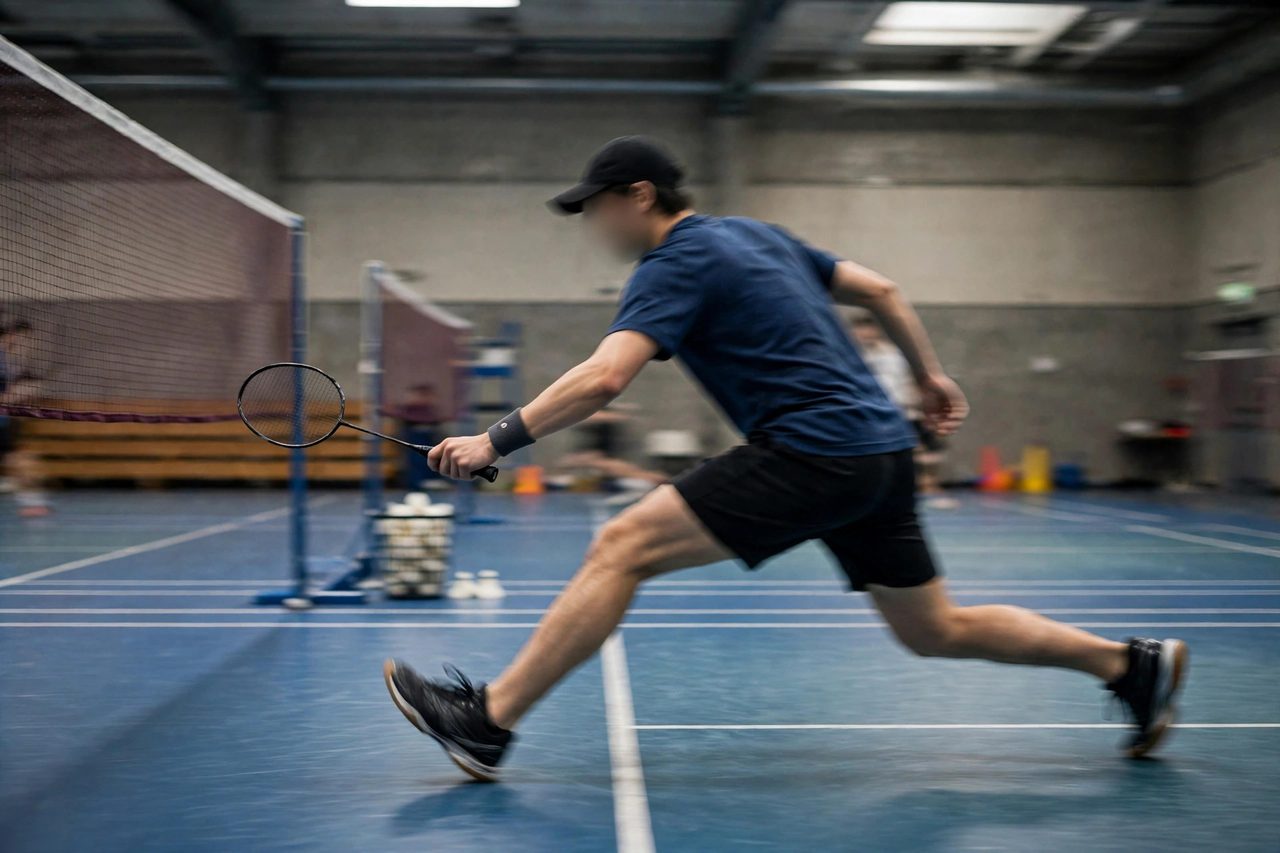
Watch a professional badminton player for five minutes and you will notice something strange. They never seem to run. They glide, they bounce, they appear exactly where the shuttle is going, and they look like they are barely trying. Then watch a beginner. They sprint, lunge, stumble, and arrive late anyway.
The difference is not fitness. It is footwork — the system of steps players use to move around the court. Good footwork saves energy, buys time, and makes every shot easier. Here it is, step by step.
Step 1: Start from the middle
Every rally starts from the same place: the centre of the court, slightly behind the middle. Coaches call this the base position. It is the spot from which you can reach every corner in roughly the same number of steps.
Stand with your feet about shoulder-width apart, knees slightly bent, weight on the balls of your feet, and your racquet up in front of you. The balls of your feet are the padded part just behind your toes. Standing on them, rather than flat-footed, lets you push off in any direction instantly.
This ready position is your home. After every shot, you come back here. Players who forget to return to base spend the whole rally chasing the game. Players who return to base are always ready for the next shot.
Step 2: Split step before every shot
Just before your opponent hits the shuttle, do a split step. That is a small hop where your feet land apart, about shoulder-width, at the same moment your opponent strikes.
The split step does two things. First, it stops you from standing flat-footed. Second, it loads your legs like a spring, so you can push off in any direction. It feels strange at first. After a few weeks of practice, it becomes automatic, and you will wonder how you ever played without it.
Timing matters more than height. A tiny hop at the right moment beats a big jump at the wrong one. Watch your opponent’s racquet, not the shuttle, and hop as they swing.
Step 3: Move in patterns, not in panic
Badminton movement follows patterns. There are only six directions that matter: front left, front right, back left, back right, and the two sides. Every shot your opponent plays sends you toward one of them, and each direction has its own step pattern.
To the front corners, use a lunge. That is a long step forward with your racquet-side leg, keeping your other leg stretched behind you for balance. Land on your heel first, then roll onto your foot, and push back to base with the same leg. Your non-racquet leg stays back like an anchor. Never let your knee travel past your toes on the lunge, or your knee will complain about it later.
To the back corners, turn sideways and use chasse steps. A chasse is a sideways step where one foot follows the other without crossing over, like a sideways shuffle. Take two or three chasse steps to the back, then a final crossover step — one foot crossing in front of the other — to reach the shuttle. Hit it, then chasse back to base.
To the sides, one or two chasse steps are usually enough. The key rule is the same everywhere: never cross your feet while moving unless you mean to, and always keep your body facing the net as much as possible.
Step 4: Hit, then recover immediately
Here is the secret most beginners miss. The shot is only half the movement. The recovery — getting back to base after you hit — is the other half, and it matters just as much.
Push back toward the centre the moment you make contact. Do not admire your shot. Do not wait to see if it was good. Your opponent is already hitting the next one, and if you are still standing where you hit the last shot, you are out of position.
In practice, this means your last step after a shot is always a push back toward base. Front lunge, push back. Back corner chasse, chasse back. Over time, movement becomes a loop: base, out, hit, back, base, out, hit, back. Watch a pro and you will see that loop running the whole rally.
Step 5: Stay low and stay small
Two more habits separate good movers from tired ones. First, stay low. Bent knees keep your centre of gravity — your body’s balance point — low, which makes you stable and quick to change direction. Standing tall looks relaxed but moves slowly.
Second, take small steps, not big ones. Beginners take huge steps and arrive off balance. Pros take lots of small, quick adjustment steps and arrive balanced, with their feet under them and their body ready to hit. Small steps also let you change direction mid-move, which big lunges do not.
A drill you can do tonight
You do not need a partner for this. Stand on your base position in the middle of a court. Have someone call out corners — front left, back right, side — or just pick them yourself. Move to the corner with the right pattern, shadow-hit an imaginary shuttle, and recover to base. Shadow hitting means swinging without a shuttle, just practising the movement.
Do it for two minutes, rest for one, and repeat five times. It is boring. It is also the single fastest way to improve your court coverage. Within a month, you will arrive at shots earlier, hit them with better balance, and finish matches less tired.
The payoff
Good footwork will not make your smash harder. It will make everything else easier. You will reach shots you used to watch fly past. You will hit from balanced positions instead of stretched ones. You will still have energy in the third game, when your opponent is running on empty.
The pros do not move like that by accident. They move like that because they practised the same loop — base, split step, pattern, hit, recover — thousands of times. Start tonight, and your game will feel different within weeks.
Related articles
The Backhand Smash: Badminton's Power Shot From the Wrong Side, Step by Step
The shuttle is high on your backhand side and you want to attack, not just survive. The backhand smash lets you hit down hard from the wrong side. Here is how it works, step by step.
The Forehand Clear: Badminton's Most Basic Shot, Done Right, Step by Step
The clear is the first shot every badminton player should learn — a high, deep shot that buys you time and space. Here is the grip, footwork and throwing motion, step by step.
The Around-the-Head Shot: Badminton's Trickiest Reach, Step by Step
The shuttle is over your left shoulder, but your forehand is your best shot. The around-the-head shot lets you reach across and hit it anyway. Here is how it works, step by step.