
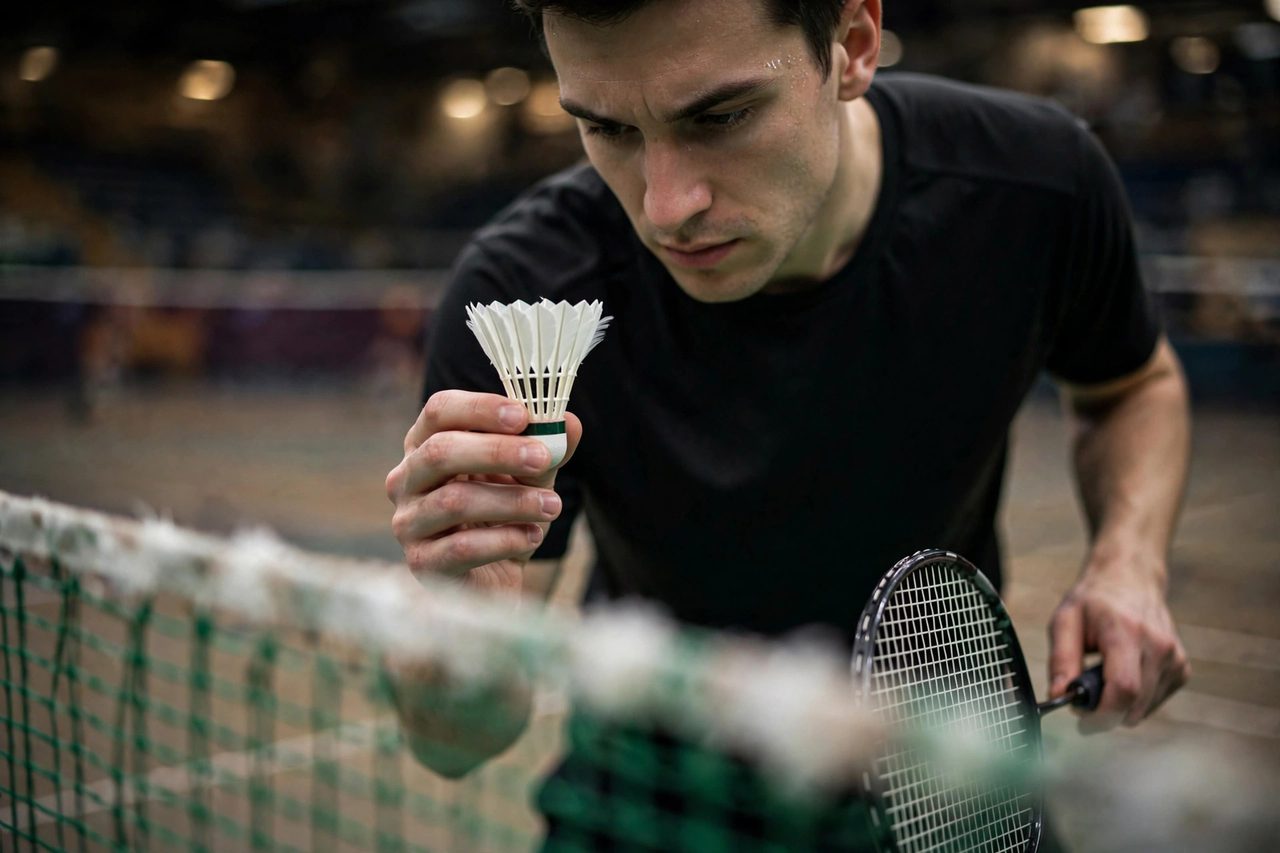
Every rally in badminton starts with a serve, and the serve is the only shot in the game that nobody can rush you into. Your opponent cannot touch the shuttle until you hit it. That makes the serve a weapon — if you know more than one way to use it. The two serves every player needs are the low serve and the flick serve. They look almost identical right up until contact. That is the whole point.
First, some basics. In badminton, you serve diagonally into your opponent’s service box — the marked area on the other side of the net. In doubles, the service box is short and wide; in singles, it is long and narrow. You must hit the shuttle below waist height, and in doubles the low serve is by far the most common serve you will see. A “rally” is just the back-and-forth exchange of shots after the serve.
The low serve: keep it tight, keep it flat
The low serve is your default. Its job is simple: get the shuttle just over the net and drop it as close to the front service line as possible, so your opponent cannot attack it and is forced to lift it gently back to you. A “lift” is a soft defensive shot played upwards, and when your opponent lifts, you get to attack.
Here is how to hit it, step by step.
Stand close to the front service line, with your racquet foot forward and your body relaxed. Hold the shuttle by its feathers at about waist height, just in front of your body. Hold your racquet with a relaxed grip, the head pointing down and slightly back.
Swing the racquet forward with a short, smooth push from your fingers and wrist — not a big arm swing. Think of it as a gentle tap, not a hit. Brush the base of the shuttle, the cork part, so it travels flat and low.
Aim for the shuttle to skim just over the top of the net tape and land close to your opponent’s front service line. If it lands long, your opponent can smash it. If it hits the net, you lose the point. The margin is small, which is why the low serve takes practice.
The most common mistake is swinging too hard. A low serve is not about power. It is about touch. Practise by placing a target — a towel, a spare shuttle — just inside the service line and trying to land the shuttle on it, over and over.
The flick serve: the surprise attack
The flick serve uses the same starting position, the same grip, and the same little backswing as the low serve. Everything looks the same — until the last instant, when you snap your wrist and send the shuttle high and fast towards the back of the court instead.
Its job is to punish an opponent who creeps too close to the net expecting a low serve. If they are standing on the front service line and you flick the shuttle over their head, they have to scramble backwards, and you have won the rally before it has really started.
Here is how to hit it.
Set up exactly as you would for a low serve. Same stance, same relaxed body, same shuttle position. This is crucial: if your set-up changes, your opponent will read the flick coming and step back.
At the last moment, flick your wrist sharply upwards and through the shuttle, hitting underneath the cork so it launches high. Use your fingers to add a final snap. The shuttle should travel fast and flat — not a lazy high lob, but a quick, attacking arc that reaches the back service line before your opponent can recover.
The most common mistake is telegraphing it: winding up bigger, tensing your shoulders, or changing your stance. A flick serve that your opponent sees coming is just a free attacking chance for them. Disguise is everything.
Putting them together
Here is the golden rule: the flick serve only works because the low serve exists. If you only ever serve low, your opponent will stand closer and closer to the net until they can kill your serve. If you only ever flick, they will stand at the back and wait for it. The threat is in the mix.
A good pattern for a beginner is simple. Serve low most of the time — say, four out of five serves. Then, when your opponent starts crowding the net, flick one over their head. Watch them step back. Now your low serve is safe again.
Practise both serves for ten minutes at the end of every session. Serve low until you can land ten in a row near the service line. Then practise the flick until your practice partner cannot tell which serve is coming. When they start guessing wrong, you have got it. The rally starts on your terms — and that is a very good place to start.
Related articles
The Backhand Smash: Badminton's Power Shot From the Wrong Side, Step by Step
The shuttle is high on your backhand side and you want to attack, not just survive. The backhand smash lets you hit down hard from the wrong side. Here is how it works, step by step.
The Forehand Clear: Badminton's Most Basic Shot, Done Right, Step by Step
The clear is the first shot every badminton player should learn — a high, deep shot that buys you time and space. Here is the grip, footwork and throwing motion, step by step.
The Around-the-Head Shot: Badminton's Trickiest Reach, Step by Step
The shuttle is over your left shoulder, but your forehand is your best shot. The around-the-head shot lets you reach across and hit it anyway. Here is how it works, step by step.