
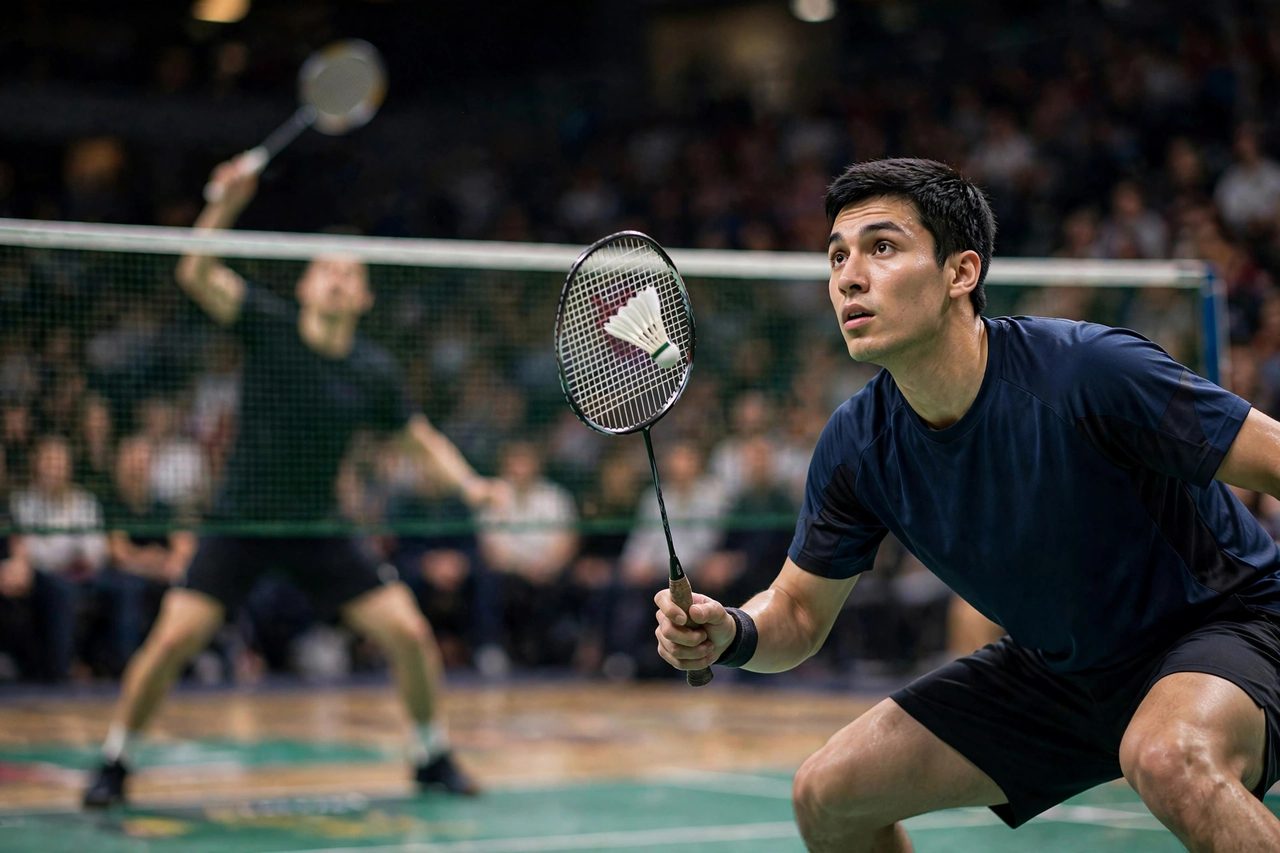
A smash is badminton’s most feared shot. It is an overhead shot hit downwards at full power, and at the top level it can travel at over 400 kilometres per hour. When your opponent winds up above their head, your first instinct might be to panic. Don’t. Defending a smash is a skill, and it can be learned step by step.
The goal of a good defence is not to win the point outright. It is to stay alive, make your opponent play another shot, and wait for your chance. Most rallies are won by the player who makes fewer mistakes, not the one who hits hardest.
Step 1: Get ready before the smash comes
Good defence starts before your opponent even hits the shuttle. The shuttle is the feathered projectile you hit back and forth — in badminton it is called a shuttlecock, or just a shuttle.
When you lift the shuttle high to the back of the court, expect a smash to come back. Get into a ready position: feet about shoulder-width apart, knees bent, weight on the balls of your feet, racquet up in front of your body. Your racquet head should be at about chest height, not down by your waist. If your racquet is low, you will never get it up in time.
Stand slightly to the side your opponent is less likely to attack, and keep your eyes on their racquet, not on the shuttle. The racquet tells you where the smash is going before the shuttle does.
Step 2: Read the smash early
A smash is not one shot. It can go straight down the line, cross-court, or right at your body. The body smash is the hardest to deal with, because you have no room to swing.
Watch your opponent’s shoulders and racquet face as they swing. If their body is turned and their racquet is angled, the smash is probably going cross-court. If they are square to the net, it is probably coming straight at you or down the line.
The earlier you read it, the more time you have. Even half a second of early reading is the difference between a clean block and a desperate flail.
Step 3: Block, don’t swing
This is the most important lesson in smash defence. Do not take a big swing at the shuttle. A big swing takes time, and time is exactly what you do not have.
Instead, block the shuttle. Hold your racquet steady in front of you, with a short, firm grip, and let the speed of the smash do the work. The shuttle is already travelling fast. You just need to redirect it.
Keep your swing short — a few centimetres of movement is enough. Think of your racquet as a wall, not a bat. Angle the racquet face slightly upward if you want the shuttle to go high, or flat if you want it to stay low.
The most common mistake beginners make is swinging hard at a smash. The shuttle flies out, or into the net, and the point is over. A soft, controlled block keeps you in the rally.
Step 4: Choose where the shuttle goes
A good block is not just about getting the shuttle back. It is about sending it somewhere useful. You have three main options.
The first is a block to the net. If you angle your racquet face gently, the shuttle drops just over the net, close to the floor. This is the best option when your opponent is stuck at the back of the court after smashing, because they have a long way to run. But it is risky: if your block is too high, they will kill it at the net. A net kill is a sharp downward shot played close to the net that finishes the rally.
The second is a lift to the back. If you angle your racquet face upward, the shuttle flies high and deep to the back of the court. This buys you time to recover your position. The danger is that it gives your opponent another smash. Only lift when you have to, and make it as deep as possible — a short lift is an invitation to be smashed again.
The third is a drive. A drive is a flat, fast shot hit roughly parallel to the floor. If the smash is not too steep, you can drive it back past your opponent, ideally at their body or into the space they have just left. This is the most attacking option, and the hardest to pull off, because it needs perfect timing. But it can turn defence into attack in one shot.
As a rule: block to the net when you can, lift when you must, and drive when the chance is there.
Step 5: Recover fast
Your job is not done when you block the shuttle. The moment it leaves your racquet, get back to the centre of your court and into your ready position again. Your opponent may smash again, and you need to be ready for it.
This is where fitness matters. Defending smashes is tiring, because you are reacting at full speed while your opponent is attacking. Short, quick steps back to the middle — not long, lazy ones — keep you balanced and ready.
If you play doubles, talk to your partner. One of you should take the middle, and the other should cover the sides. A lot of smash defence in doubles is about not leaving gaps, and gaps appear when partners do not communicate.
Step 6: Practise it properly
The best way to learn smash defence is with a partner. Ask them to smash at you from the back court, starting gently, and practise blocking to the net. As you get better, ask them to smash harder and to vary the direction.
Start with the block to the net, because it is the safest option and the one you will use most. Then practise the lift, making sure it goes deep. Only try the drive once the first two feel comfortable.
A useful drill is the “three-smash” game: your partner smashes three times in a row, and your only job is to keep all three in play. It teaches you the most important lesson in defence — that staying alive is a win in itself.
The mindset
Here is the secret that good defenders know. The player smashing at you is under pressure too. Every smash they hit that does not win the point costs them energy, and if they keep smashing and you keep getting it back, they start to doubt themselves. They smash harder, they make mistakes, and eventually they give you a short shuttle you can attack.
So do not fear the smash. Get ready early, block it softly, send it somewhere useful, and get back to the middle. Do that three or four times in a row, and you will find that the hardest shot in badminton is also one of the most satisfying to survive.
Related articles
The Backhand Smash: Badminton's Power Shot From the Wrong Side, Step by Step
The shuttle is high on your backhand side and you want to attack, not just survive. The backhand smash lets you hit down hard from the wrong side. Here is how it works, step by step.
The Forehand Clear: Badminton's Most Basic Shot, Done Right, Step by Step
The clear is the first shot every badminton player should learn — a high, deep shot that buys you time and space. Here is the grip, footwork and throwing motion, step by step.
The Around-the-Head Shot: Badminton's Trickiest Reach, Step by Step
The shuttle is over your left shoulder, but your forehand is your best shot. The around-the-head shot lets you reach across and hit it anyway. Here is how it works, step by step.