
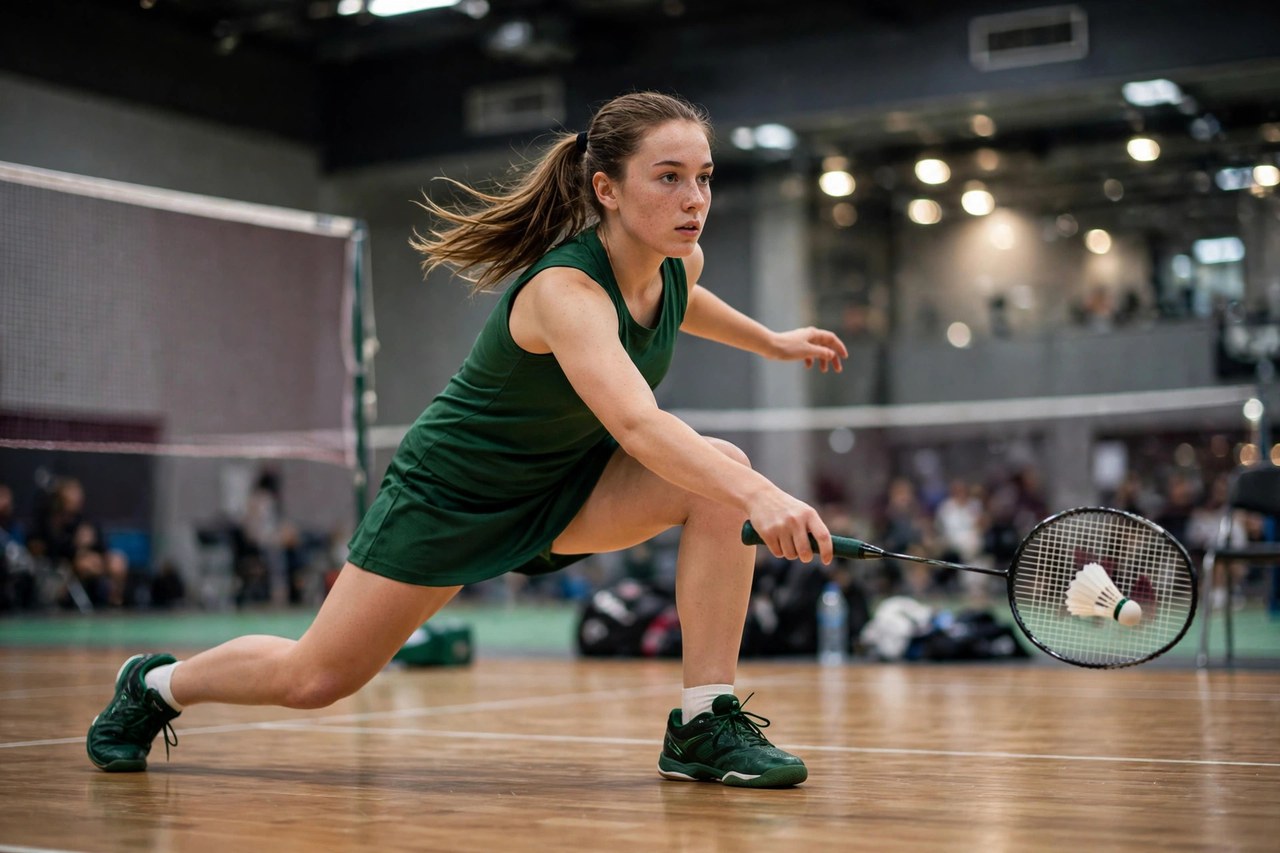
When the last shuttle landed, An Se-young did something she had never done before. She shaped a crown with her fingers and placed it on her own head.
It was Sunday, 25 October, in Paris. She had just beaten India’s P.V. Sindhu in the French Open final, 16-21, 21-11, 21-12. It was her third French Open title in a row. It was her tenth title of the season. And it was her fiftieth straight win.
“The season is winding down, and I wanted to pat myself on the back a little bit,” she told reporters back in Korea two days later.
She had earned the gesture. By the time the season reached November, An Se-young’s numbers looked like a typo. Seventy-one wins. One loss. Eleven titles. A winning streak of fifty-five matches and counting. No woman — and no man — had ever won eleven titles in a season twice in a row.
This is the story of that season: how it happened, how she plays, and why it matters for badminton.
The numbers that don’t look real
Let’s start with the plain facts, because they are strange enough on their own.
An Se-young has played 72 matches in 2026. She has won 71 of them. That is a win rate of 98.6 percent. Her only defeat came on 8 March, in the All England final in Birmingham, against China’s Wang Zhiyi. She has not lost since.
A winning streak is a run of matches won in a row without a single defeat. Hers now stands at 55. The last time she lost, it was still winter. Spring came and went. Summer came and went. She kept winning.
She has won eleven titles this year. A title is a tournament win — the trophy at the end of the week. Eleven in one season ties the record set by Japan’s Kento Momota in 2019, the most anyone had ever won in a single year. An matched that record in 2025, when she also won eleven. Now she has done it again. Nobody in badminton history had ever won eleven titles in two seasons in a row.
And here is the part that makes it even harder to believe: she won those eleven titles from just twelve tournaments. The All England final in March — the one match she lost — is the only event she entered this year and did not win.
A season of trophies, from January to November
The year started fast and never slowed down. An won the Malaysia Open and the Indonesia Open, the two biggest regular events on the tour. On the BWF World Tour — the sport’s main circuit of tournaments — events are ranked by size. Super 1000 events are the biggest, with the most ranking points and prize money. Super 750 events are the next level down, and Super 500 below that. An won at every level.
Her 2026 titles, in order of the season, tell the story of a player who showed up everywhere and lost almost nowhere: the Malaysia Open and Indonesia Open at Super 1000 level; the India Open, Singapore Open, China Masters, Denmark Open and French Open at Super 750; and the Korea Open at Super 500. Then there were the three titles that are not part of the weekly tour at all, the ones players dream about as kids: the Asian Championships in April, the World Championships in New Delhi in August, and the Asian Games in September.
Winning all three of those in one year is rare. The Korean press called it a career grand slam — the four biggest titles in the sport, with her Olympic gold from Paris 2024 completing the set. She is 24 years old.
The Asian Games win deserves a closer look. Badminton joined the Asian Games in 1962. In all that time, no woman had ever won the singles gold twice in a row. An did it in September in Aichi-Nagoya, Japan — and she did it without dropping a single game in five matches. A game is one set, played to 21 points. She won ten games in a row, and never let anyone take one from her.
The two finals that defined the season
If you only watched two matches from this season, watch the two finals in October and November. They show both sides of An Se-young: the fighter who comes back, and the closer who finishes the job.
The French Open final on 25 October was the comeback. Sindhu took the first game 21-16. Early in the third game, An was down 8-5. She had already won 49 matches in a row, and for a few minutes it looked like the streak might end in Paris. Then she did what she always does: she stopped missing. She won the second game 21-11 and the third 21-12. It was her eleventh straight win over Sindhu, and her fiftieth win in a row overall. That is when the crown came out.
Two weeks later came the Korea Open final, at home in Yeosu, on 8 November. Her opponent was Akane Yamaguchi of Japan, the world No. 2 and the player who had beaten An in the same final a year earlier. This time An won 21-12, 15-21, 21-16. It was her third Korea Open title, her first since 2023, and her eleventh title of the season. It was also her eleventh win in a row against Yamaguchi. Across 40 career meetings, An now leads their rivalry 25-15.
The Korea Open win mattered for another reason. An had arrived in Yeosu carrying a season’s worth of wear: a rolled ankle in the Denmark Open final in October, tape on her right knee in Paris, aches in her calf. Before the tournament, she was not sure she would even play. She played, and she won every match.
How she plays: winning by refusing to lose
An Se-young does not have the hardest smash in women’s badminton. She does not hit the ball — the shuttle, a small feathered object — harder than everyone else. She wins a different way, and once you see it, you cannot unsee it.
Her game is built on defence and patience. A rally is one back-and-forth exchange of shots. Most top players try to end rallies quickly, with a big attacking shot. An is happy to let rallies run long. She moves early, reads where the shuttle is going a fraction of a second before her opponent expects, and gets it back. Again. And again. And again.
Watch her in a long rally and you will see the pattern. She defends shots that look like winners — diving, stretching, somehow getting her racquet to them. Then, when her opponent has hit one hard shot too many and is slightly out of position, An attacks. A soft shot that drops just behind the net. A smash into the corner. The point ends, and her opponent has run further than she has.
It is a style that asks a lot of her body. Every long rally is another lunge, another hard stop, another change of direction. A player who attacks can finish a match in forty short rallies. An often needs sixty long ones. That is why the knee tape and the tired legs are part of this story, not a footnote to it.
It is also why her matches so often follow the same shape: lose the first game, or fall behind, then slowly take control. Opponents have to play perfect badminton for an hour to beat her. Almost nobody can. In 2026, nobody has — except Wang Zhiyi, once, in March.
The cost of never losing
There is a reason An withdrew from the Kumamoto Masters in Japan this week, the tournament running from 10 to 15 November. She chose rest over another trophy. After the Korea Open, she said she would take time off to recover before December’s World Tour Finals in Hangzhou, the season-ending event for the year’s best eight players in each discipline. A twelfth title there would set a new single-season record outright — twelve titles, something no player, man or woman, has ever done.
The decision to skip Kumamoto was not a surprise to anyone who has followed her career. An’s body has been the one opponent she cannot outlast. At the Asian Games final in October 2023, she tore a ligament in her right knee — the tough tissue that holds the joint together — and played on to win the gold. She has dealt with knee trouble ever since, including patellar tendinitis, a painful irritation of the tendon below the kneecap.
Then came Paris 2024. She won the Olympic gold medal, beating China’s He Bingjiao 21-13, 21-16 in the final. And instead of celebrating, she used her victory press conference to say her national team had not taken her knee injury seriously. She said she had been asked to keep playing through pain, that her requests to be sent abroad for treatment had gone nowhere, and that she had felt alone inside her own team.
It was an extraordinary moment — a 22-year-old, minutes after winning the biggest prize in the sport, risking a fight with the people who run it. She later said she was not trying to fight anyone. She wanted players to be protected, and to be heard.
Two years later, the results suggest the message landed. An now manages her schedule more carefully. She skips events when her body needs it, as she did this week. And the player who once felt alone in her team now plays like someone who trusts herself completely.
Why this season is different
An Se-young has been great before. That is what makes 2026 so remarkable: she was already great, and she got better.
In 2025 she won eleven titles too, and finished the year 68-4 — a 94.4 percent win rate. That was already one of the best seasons in the sport’s history. But 2025 ended with four losses and no World Championships gold. In 2026 she has one loss, and she won the World Championships, the Asian Games and the Asian Championships in the same year.
The 2025 season also ended at the World Tour Finals in December, where she won her eleventh title of that year. In 2026 she reached eleven titles in early November, with a whole tournament still to play.
And then there is the record she passed along the way. When she won the Denmark Open in October — beating Yamaguchi 21-23, 21-14, 21-18 in a 79-minute final — it was her 47th career title. That moved her past Indonesia’s Susi Susanti, whose 46 titles had stood as the women’s singles record since the great Indonesian retired in 1997. Susanti’s record had survived nearly three decades of brilliant challengers. An passed it at 24. Paris made it 48. Yeosu made it 49.
She has now been world No. 1 for more than 100 straight weeks, with 122,287 ranking points — a total that has not moved since early October, because the ranking system only counts a player’s best ten results over the past year, and she has maxed it out.
Compare that with the great seasons that came before. Momota’s 2019 was the gold standard: eleven titles, including the World Championships. But Momota lost more matches along the way, and he never repeated it. Carolina Marín’s best years were built on speed and attack, and cut short by knee injuries. Tai Tzu-ying, the magician of the sport, never won an Olympic gold or a World Championships title. An Se-young, at 24, already owns all four of the sport’s biggest titles — Olympic gold, World Championships, Asian Games, Asian Championships — and she has now put together the two best back-to-back seasons anyone has ever played.
What it means for Korea, and for badminton
In Korea, An Se-young is already more than a badminton player. She is the face of a sport that rarely gets the spotlight at home, and her season has turned badminton into front-page news in Seoul. Every title this year has been reported like a national event, and the numbers — 71-1, 55 in a row — have entered the everyday language of Korean sport.
For badminton itself, the timing matters. The sport has spent years looking for a star who can carry it beyond its strongholds in Asia and Europe. An is that star, and not only because she wins. She wins in a way that is easy to understand and hard to look away from: the player who never gives up on a rally, who comes back from behind, who turns defence into attack. You do not need to know the rules to feel what is happening when she dives for a shuttle that looks impossible to reach — and reaches it.
Her rivals know it too. Yamaguchi, the world No. 2, has now lost eleven in a row to her. Sindhu, a former world champion and Olympic medallist, has lost eleven in a row as well. Wang Zhiyi, the only player to beat An this year, knows better than anyone how narrow the gap is — and how wide it looks right now.
There is one event left. The World Tour Finals in Hangzhou in December will decide whether the season ends on eleven titles or twelve. Twelve would be a number badminton has never seen. But whatever happens there, the season is already settled. Eleven titles, one loss, fifty-five straight wins. The greatest season women’s badminton has ever seen — and, by the numbers, the greatest anyone has ever played.
An Se-young put a crown on her own head in Paris. Nobody else was going to do it for her. After a season like this one, nobody needs to.
Related articles
Carolina Marín: The Fighter From Huelva Who Changed Badminton
Three world titles, Olympic gold at Rio 2016, and three serious knee injuries. Carolina Marín put Spain on the badminton map — and her story ended in March 2026, when her body finally said stop.
Anders Antonsen: Denmark's Comeback King Keeps Climbing
World No. 3 Anders Antonsen has spent a decade near the top of men's badminton — and in 2026 he is still winning finals the hard way, coming from behind. Meet the Dane who never seems beaten.
Lee Zii Jia: The Free Spirit Fighting His Way Back
All England champion, Olympic bronze medallist, world No. 2 — and then injuries, a ranking slide and a long road back. Lee Zii Jia's career has never followed a straight line, and that is exactly why people love watching him.