
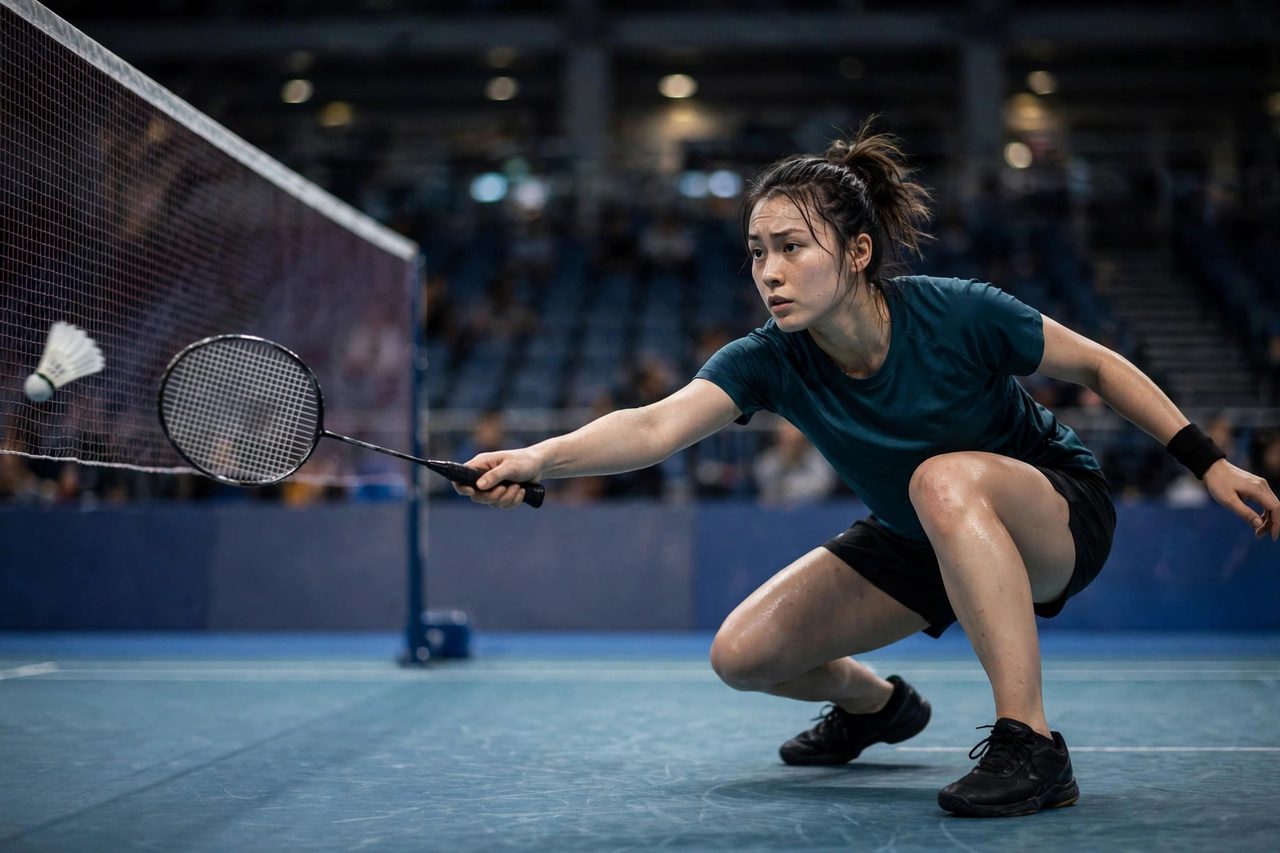
On Sunday in Odense, An Se-young did something that has become her trademark: she lost the first game of a major final, trailed in the second, trailed again in the decider — and won anyway. Her 21-23, 21-14, 21-18 victory over Japan’s Akane Yamaguchi in the Denmark Open final took 79 minutes and carried her to a number worth pausing on. It was her 47th international title, moving her past Indonesia’s Susi Susanti, whose 46 titles had stood as the women’s singles benchmark since the great Indonesian retired in 1997.
Consider what that means. Susanti’s record survived nearly three decades of brilliant challengers — China’s dynasties, Spain’s Carolina Marín, Japan’s Yamaguchi herself. An Se-young passed it at the age of 24, in the middle of a season in which she has lost exactly one match. She has now been world No. 1 for 105 consecutive weeks. She is the reigning Olympic champion and world champion, and in 2026 she added a second straight Asian Games singles gold, something no woman had done before.
The obvious question is how. The honest answer is less glamorous than the trophy count: An Se-young has built the most reliable game in women’s badminton, a style founded not on winners but on the refusal to lose rallies — and then she has defended that style with a will so stubborn that it once brought her into open conflict with her own federation. This is the story of the machine, and of the person who had to fight to keep it running.
A schoolgirl from Gwangju
An Se-young was born in 2002 in Gwangju, in the south-west of South Korea, and took up badminton at elementary school. Her rise through the Korean system was not so much fast as premature: she was selected for the senior national team in 2017 while still a school student, at an age when most prospects are years from senior selection. Coaches who saw her early describe the same qualities visible today — an appetite for defensive work that teenagers usually have to be forced into, and footwork that seemed to arrive pre-installed.
The announcement to the wider world came in 2019. As a 17-year-old, An won the French Open in Paris, one of the oldest and most prestigious events on the calendar, beating a field of established stars with a game built on retrieval and patience that belied her age. There were other titles that year, and a growing sense in the sport that the next era of women’s singles might be Korean.
Progress after a teenage breakthrough is rarely smooth, and An’s was interrupted by the pandemic years and the ordinary sorting of a brutal tour. But by the time she reached her early twenties, the raw materials were unmistakable. The question was whether a player whose foundation was defence could rule a game increasingly played at sprint speed. She was about to answer it in the most emphatic season women’s badminton had seen.
The wall
Watch An Se-young play and the first thing you notice is what does not happen: the shuttle does not go past her. Her game begins from a defensive structure of rare completeness — a low, balanced ready position, explosive first steps in every direction, and a lunge that seems to add an extra half-metre to her reach at the net. Opponents hit what would be winners against anyone else and watch the shuttle come back, usually deep, usually with interest.
The statistics of her matches tell the deeper story. An does not merely defend; she extends. Her rallies are among the longest on tour, her matches among the most physically demanding, because she treats every exchange as a test of who blinks first. Her clearing game pins opponents to the back tramlines. Her net play is tight enough to deny easy lifts she can be attacked from. And when the rally has been stretched to the length she wants — twenty shots, thirty, forty — she is the player whose technique breaks down last.
This is rally tolerance as a weapon, and it has a corrosive effect on the other side of the net. Attacking players know that a smash at ninety percent will come back, so they hit at a hundred, and then a hundred and five, and the errors arrive. Defensive players know they cannot out-wait her. Even her great rivals describe the same sensation: playing An Se-young is not like playing an opponent who beats you. It is like playing an opponent who waits for you to beat yourself, while quietly making sure you do.
She is not without attack — her counterpunching, especially the cross-court block and the sudden acceleration onto a short lift, is world-class, and her smash has grown heavier every season. But the attack is the garnish. The meal is the wall.
2023: the coronation
If 2019 announced her, 2023 crowned her. An’s season that year stands among the finest ever played in women’s singles. She won nine titles on the BWF World Tour. In August she rose to world No. 1 for the first time. Days later in Copenhagen she became world champion, beating Spain’s Carolina Marín in the final to become the first Korean woman ever to win the world singles crown.
Then came the Asian Games in Hangzhou, postponed a year and loaded with pressure, where she won team gold with Korea and then singles gold against China’s Chen Yufei. It was in that singles final that the season’s triumph acquired its shadow: An injured her right knee, a patellar tendon problem that would shape the next two years of her life. She finished the match, won the gold, and began the long management of a damaged knee with an Olympic Games less than a year away.
The pattern of her career was set in those months: extraordinary achievement and a quietly serious injury, travelling together.
Paris, and playing on one good knee
The 2024 season was an exercise in load management disguised as a title chase. An played selectively, protected the knee, and arrived in Paris still managing pain — she also hurt an ankle tendon in the pre-Olympic training camp. None of it stopped her. On 5 August 2024, she beat China’s He Bingjiao in the final to win Olympic gold, South Korea’s first badminton gold medal in sixteen years, completing a set of titles — Olympics, World Championships, Asian Games — that defines a career.
What happened in the hours after the final, however, is what made her front-page news at home. Speaking to reporters, the new Olympic champion criticised the Badminton Korea Association and the national team staff. She said her knee injury had been more serious than initially assessed and that she felt it had not been taken seriously; she described training practices she considered outdated, and said she had thought about whether she could continue with the national team at all.
The remarks detonated. In South Korea, where Olympic champions are expected to smile and thank the system, a 22-year-old gold medallist had used her moment of maximum glory to indict it. She would later say she would have spoken whether she had won or lost.
The fight with the federation
The aftermath ran for months, and it is worth telling carefully, because both the criticism and the response say something real about elite sport.
An clarified her position in a public statement in mid-August 2024. She said she wanted flexible, efficient support tailored to each player’s individual situation and injury, rather than customary one-size-fits-all practices, and that she regretted how rarely athletes’ concerns were heard. She also apologised to her fellow Olympians, recognising that her comments had overshadowed their own medal moments. The association, for its part, pushed back on the claim that her injury had been neglected, pointing out that it had assigned her a personal trainer from February 2024 and had spent more than 11 million won sending a traditional Korean medicine doctor to Paris when she was hurt there.
The dispute outgrew sport. South Korea’s sports ministry opened an investigation into the Badminton Korea Association, and on 31 October 2024 the ministry announced it would ask police to investigate the association’s president over alleged misappropriation and demanded his dismissal. Whatever the rights and wrongs of each individual claim, the structural point An had made — that a federation built for a previous era was managing modern athletes with modern injuries — had been heard at the highest level of government.
Months later, in December 2024, she said she did not regret speaking. She added that she had only wanted problems addressed so that things could move in a better direction. It is difficult to think of another athlete of her generation, anywhere in the world, who spent the capital of an Olympic gold medal so directly on the people who would come after her.
The machine years
And then there is what she did next, which was to become more dominant, not less.
In 2025, An won 11 titles, equalling the single-season record Kento Momota set in 2019 — a mark that covers men’s and women’s singles alike. China’s Wang Zhiyi, the world No. 2, lost six finals to her that year; the rivalry has become less a contest than a recurring appointment. Her 2026 season has been more extreme still: arriving at the Denmark Open, she had won 61 of 62 matches, a 98.4 percent win rate, with eight titles from nine individual events. Her only defeat of the year came in the All England final in March, against Wang Zhiyi. Along the way she regained the world title in New Delhi and won the Asian Games singles gold again in Nagoya — the back-to-back feat no woman had achieved — before title number 47 in Odense moved her beyond Susanti.
The numbers keep resolving into the same shape: near-total consistency sustained across years, surfaces of the calendar that break other players — injuries, travel, the grind of Super 1000 events in consecutive weeks — absorbed without visible effect. Her career win-loss record sits among the best in the history of the women’s game. She has, as the record books now formally state, won more international singles titles than any woman ever.
What makes her nearly unbeatable
Strip it down and her dominance rests on four pillars. The first is the defence itself: not a passive block but an active system that returns attacking shots with depth and neutralises the rally again and again. The second is endurance weaponised — fitness so complete that the third game of a long match is her territory, which is why she so often wins finals she trailed in, as she did against Yamaguchi in Odense. The third is error economy: she simply concedes fewer free points than anyone she plays, which means opponents must win every point the hard way, at full stretch, for an hour or more.
The fourth is the least measurable and perhaps the most important: an appetite for the structure of a match that borders on the inhuman. An Se-young does not need momentum, crowd energy or inspiration. She needs the next rally. Players talk about machines in sport when they mean consistency, but the metaphor fits her for a different reason — she has removed from her game almost everything that makes other players fluctuate. What is left is process: serve, rally, retrieve, extend, finish. Repeat for a decade.
The road ahead runs to the Los Angeles Olympics in 2028, where she will defend her title at 26, an age when her combination of youth and mileage may be at its absolute peak. Rivals will keep studying the wall for cracks — a slightly slower first step, a knee managed once too often. On the evidence of the last three years, they should not hold their breath. The machine is still improving, the records are still falling, and An Se-young is still, rally by rally, exactly where she intends to be: on the other side of the net, getting everything back.
Related articles
Carolina Marín: The Fighter From Huelva Who Changed Badminton
Three world titles, Olympic gold at Rio 2016, and three serious knee injuries. Carolina Marín put Spain on the badminton map — and her story ended in March 2026, when her body finally said stop.
An Se-young's Perfect Season: The Year Badminton Found Its Unbeatable Star
One loss in 72 matches. Eleven titles in a year — for the second season in a row. How An Se-young turned patience and defence into the greatest season women's badminton has ever seen.
Anders Antonsen: Denmark's Comeback King Keeps Climbing
World No. 3 Anders Antonsen has spent a decade near the top of men's badminton — and in 2026 he is still winning finals the hard way, coming from behind. Meet the Dane who never seems beaten.