
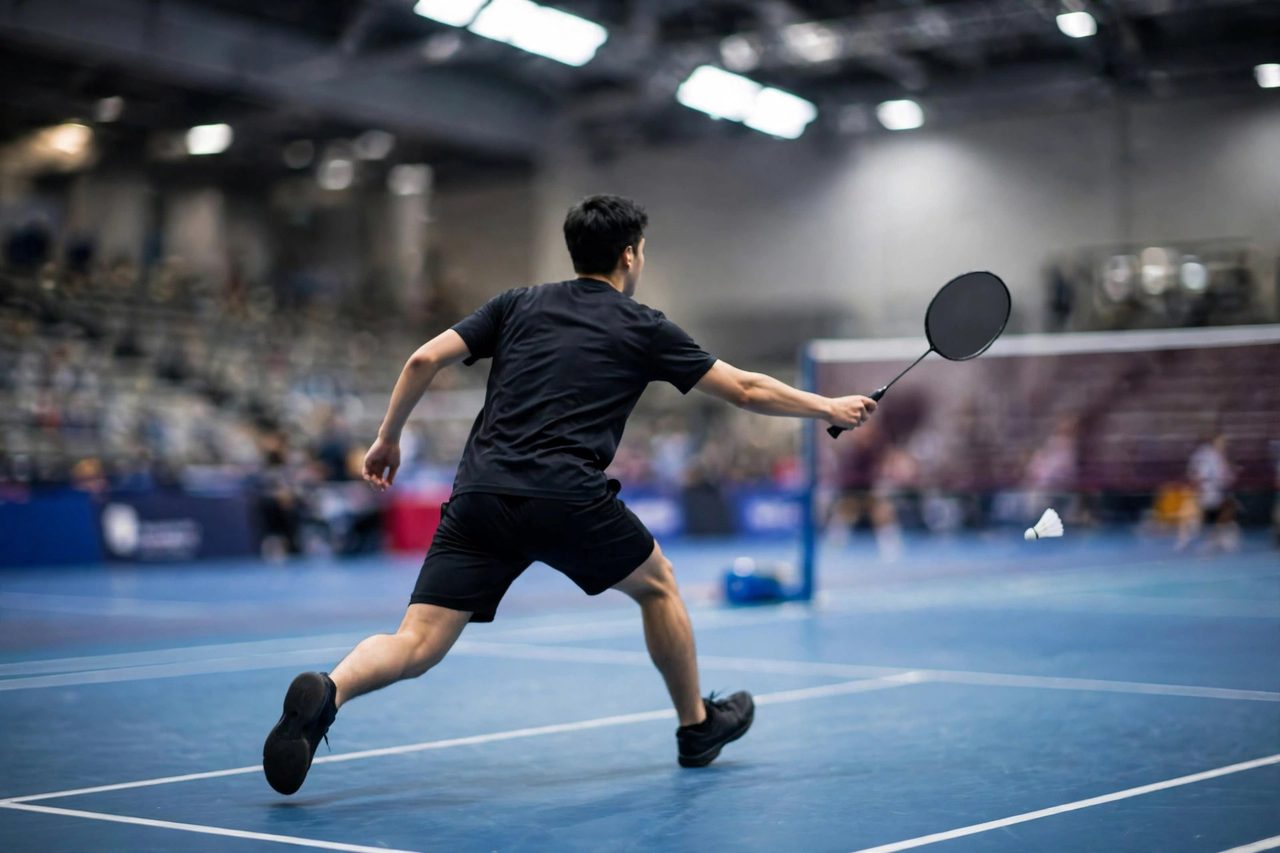
Some players win easily. Anders Antonsen rarely does — and that is exactly what makes him so fun to watch.
The 29-year-old Dane is ranked world No. 3 in men’s singles, the solo form of badminton where one player faces another. He has been near the top of the sport for years, has reached a career-high No. 2, and keeps producing finals that go down to the wire. Twice in 2026 alone he has lifted a trophy after losing the first game and staring defeat in the face.
If you are new to badminton, here is the short version of how a match works. Players hit a shuttlecock — a small, feathered object — back and forth over a net. A game goes to 21 points, and you usually need to win two games to win the match. A rally is one back-and-forth exchange of shots.
The boy from Aarhus
Antonsen was born on 27 April 1997 in Aarhus, Denmark’s second city. He picked up a racquet at six years old, learning the game from his father Per at the local club in Viby, a suburb of Aarhus, alongside his older brother Kasper. Kasper would later become his coach — badminton has always been a family affair for the Antonsens.
He climbed fast. In 2015 he won the European Junior Championships, the continent’s top event for young players, and was named Europe’s Young Player of the Year. By 2017, still a teenager in senior terms, he had already reached the final of the senior European Championships, taking silver. Two years later came his real breakthrough season: a first big tour title at the Indonesia Masters, where he beat Japan’s Kento Momota — then the world No. 1 and reigning world champion — in the final, followed by gold at the European Games in Minsk and silver at the World Championships in Basel.
The World Championships are badminton’s biggest solo event, held once a year outside Olympic years. Antonsen has now medalled there four times: silver in 2019, then bronze in 2021, 2023 and 2025. He is a two-time European champion too, winning the continental title in 2021 and again in 2024.
How he plays
Antonsen is right-handed and plays an attacking game built on sharp net play and deception. Deception means making a shot look like one thing and then doing another — shaping to play a soft drop shot, then flicking the shuttle somewhere else entirely. Opponents often describe him as a nightmare to read, because the same swing can produce three different shots.
He is also one of the sport’s great fighters. His matches tend to be long, physical and emotional. He talks to himself on court, pumps his fists, and feeds off the crowd. When a match gets tight, he usually gets better, not worse. That is a rare quality, and it explains why so many of his biggest wins have come from behind.
His career record tells the same story of consistency: more than 350 wins against just over 120 defeats at the top level. He won the season-ending World Tour Finals in 2020, an event that gathers only the year’s eight best players. A seed is a ranking-based spot in a tournament draw, designed to keep the top players apart until the later rounds — and Antonsen has been seeded near the top of almost every event he has entered for years.
The 2026 season so far
Antonsen started 2026 ranked world No. 3 and reached the semi-finals of the Malaysia Open in January, losing to China’s Shi Yuqi. The European Championships in Huelva, Spain, in April ended in another silver medal, this time after a 12–21, 19–21 final defeat to France’s Christo Popov.
Then came the comebacks. In May, at the Thailand Open in Bangkok, he lost the first game of the final 9–21 to home favourite Kunlavut Vitidsarn — the Thai star who had beaten him in the previous year’s final. Antonsen dug in, took a tense second game 24–22, then closed out the decider 21–18 after 97 minutes. A decider is the third and final game of a match. The win took him back to world No. 2 in early June.
October brought a repeat. At the Arctic Open in Vantaa, Finland, he beat Malaysia’s Lee Zii Jia in a three-game semi-final, then faced Japan’s Yushi Tanaka in the final. Antonsen lost the first game, saved a championship point — a point that would have given his opponent the title — in an extended decider, and won 16–21, 21–16, 27–25 after 86 minutes. It was his second title of the season and the 12th of his tour career.
A week later, back home in Denmark, he reached the Denmark Open final in Odense but lost to France’s Alex Lanier, the reigning world champion, in three games. Even in defeat, the run underlined his standing: with his great compatriot Viktor Axelsen retired in April 2026, Antonsen is now the man carrying Danish men’s badminton.
The one that got away
For all the medals, one prize still eludes him: a world title. Four World Championships medals without a gold is an unusual record, and it is the gap his rivals point to. He has also played at two Olympic Games, reaching the quarter-finals at Paris 2024, but an Olympic medal remains on the wish list too.
That is what makes the next year or two so interesting. Antonsen is 29, in his prime, and still adding trophies. The 2026 season shows a player who has learned how to win ugly — to survive bad starts, save match points and outlast younger opponents in third games. The question now is whether that toughness can finally carry him past the last hurdle, to the top step of a World Championships or Olympic podium.
On the evidence of Bangkok and Vantaa, you would be unwise to bet against him. Anders Antonsen does not win easily. He wins late. And that might be the most dangerous habit in badminton.
Related articles
Carolina Marín: The Fighter From Huelva Who Changed Badminton
Three world titles, Olympic gold at Rio 2016, and three serious knee injuries. Carolina Marín put Spain on the badminton map — and her story ended in March 2026, when her body finally said stop.
An Se-young's Perfect Season: The Year Badminton Found Its Unbeatable Star
One loss in 72 matches. Eleven titles in a year — for the second season in a row. How An Se-young turned patience and defence into the greatest season women's badminton has ever seen.
Lee Zii Jia: The Free Spirit Fighting His Way Back
All England champion, Olympic bronze medallist, world No. 2 — and then injuries, a ranking slide and a long road back. Lee Zii Jia's career has never followed a straight line, and that is exactly why people love watching him.