
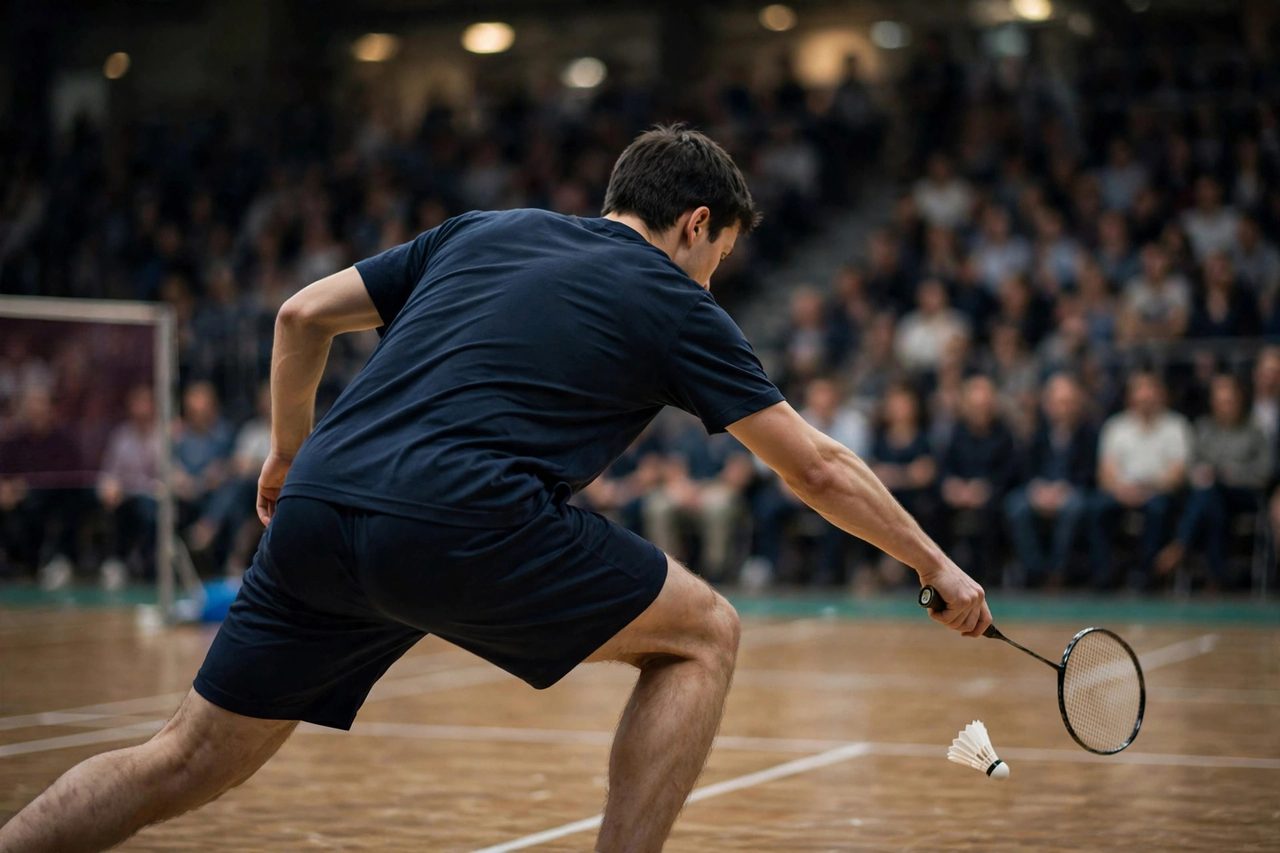
Kunlavut Vitidsarn does not beat you with one big shot. He beats you with fifty good ones.
The Thai star, known to everyone as View, is one of the hardest players in the world to put away. His game is built on patience, defence and fitness. He absorbs your best shots, sends them back, and waits for you to get tired or impatient. Then he strikes.
It is not flashy. It is brutally effective. And it has taken him to the very top of badminton.
The junior who won everything
Kunlavut was born on May 11, 2001, in Thailand. He grew up in the Thai badminton system, and by his teens he was already special.
He won the World Junior Championships three years in a row: 2017, 2018 and 2019. The World Junior Championships is the biggest tournament for players under 19. Winning it once is a huge deal. Winning it three times had never been done by a male singles player before.
That run told the badminton world two things. First, Kunlavut had every shot. Second, he had the mind to win big matches again and again. Juniors who dominate do not always make it as seniors. The senior game is faster, stronger and deeper. Kunlavut made the jump look easy.
Becoming Thailand’s first world champion
His senior breakthrough came at the World Championships in Copenhagen in 2023. The World Championships is badminton’s biggest individual tournament outside the Olympics. Kunlavut beat Japan’s Kodai Naraoka in the final in three games to take the title.
That win made history. He became the first Thai man ever to win the men’s singles world title. Thailand had produced great players before, but never a men’s world champion. Kunlavut changed that.
He had already shown he belonged at that level. A year earlier, at the 2022 World Championships in Tokyo, he reached the final and finished with silver, losing to Denmark’s Viktor Axelsen. He added another world silver at the 2025 edition in Paris.
Olympic silver in Paris
The biggest stage of all came at the Paris 2024 Olympics. Kunlavut fought his way to the final, where he met Axelsen again. The Dane won gold, and Kunlavut took silver.
An Olympic medal is the dream for most players. A silver medal is a career-defining achievement, and for Thailand it was a landmark result. It confirmed Kunlavut as one of the defining players of his generation.
World No. 1
In June 2025, Kunlavut reached world No. 1 in the BWF rankings. The BWF is badminton’s world governing body, and its rankings list every player based on their results over the past year. Reaching No. 1 made him the first Thai man to top the men’s singles list.
He did it the Kunlavut way: not with one hot month, but with months of deep runs. He won the Indonesia Masters and the Thailand Open in 2025, plus the Singapore Open, a Super 750 event. A Super 750 is the second tier of the BWF World Tour, just below the Super 1000s.
He also won gold at the 2025 Asian Championships, after China’s Lu Guangzu retired hurt in the final. And he started 2026 with a statement, winning the Malaysia Open, a Super 1000, after world No. 1 Shi Yuqi of China retired injured in the final.
Why he is called the Three-Game God
Fans call Kunlavut the “Three-Game God.” The nickname is a joke with a serious point. So many of his matches go to three games, because his style drags opponents into long, physical battles. And so often, he wins the third game, because he is still moving well when his opponent is running on empty.
His defence is the foundation. Defence in badminton means getting smashes and attacks back, staying alive when your opponent is trying to finish the rally. Kunlavut’s defence is so good that attackers start forcing shots, trying too hard to hit through him. That is when mistakes come.
But do not mistake patience for passivity. When the opening comes, Kunlavut attacks with power and precision. His own words sum it up: he relies on patience and long rallies, but when he must attack, he increases the pressure. The trick is knowing when.
The idol and the inspiration
Kunlavut grew up admiring Malaysia’s Lee Chong Wei, one of the greatest players of all time. You can see the influence. Both players built their games on speed, defence and rally control rather than raw power alone.
Now Kunlavut is the inspiration himself. Young Thai players can point to a world champion, an Olympic medallist and a world No. 1 from their own country. That matters. Before Kunlavut, Thai men’s singles had never reached those heights.
What comes next
Kunlavut is still only 25. His style should age well, because it depends more on fitness, timing and brains than on explosive power alone. The question is whether he can turn silver into gold at the very biggest events — another world title, or an Olympic gold.
His recent form suggests he is still hungry. A Malaysia Open title to start 2026 was a loud statement. And even when he loses, like his quarterfinal defeat to Japan’s Yushi Tanaka at the Arctic Open earlier this month, he loses fighting.
Kunlavut Vitidsarn will not give you a highlight reel of wild smashes. He will give you something harder to watch and harder to beat: a player who refuses to miss, refuses to quit, and makes you play one more shot than you wanted to. Most players, in the end, cannot.
Related articles
Carolina Marín: The Fighter From Huelva Who Changed Badminton
Three world titles, Olympic gold at Rio 2016, and three serious knee injuries. Carolina Marín put Spain on the badminton map — and her story ended in March 2026, when her body finally said stop.

An Se-young's Perfect Season: The Year Badminton Found Its Unbeatable Star
One loss in 72 matches. Eleven titles in a year — for the second season in a row. How An Se-young turned patience and defence into the greatest season women's badminton has ever seen.
Anders Antonsen: Denmark's Comeback King Keeps Climbing
World No. 3 Anders Antonsen has spent a decade near the top of men's badminton — and in 2026 he is still winning finals the hard way, coming from behind. Meet the Dane who never seems beaten.