
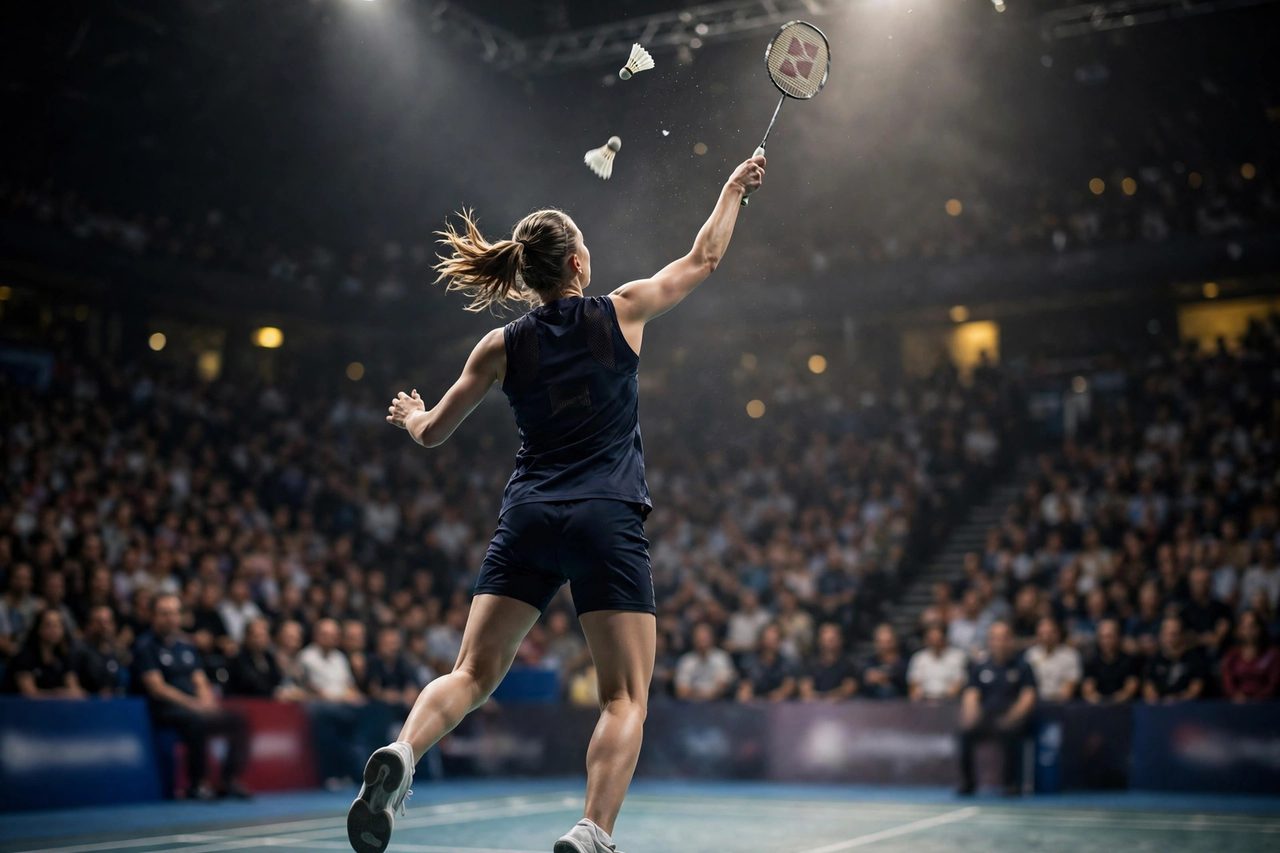
PV Sindhu is the most successful badminton player India has ever produced, and one of the most recognisable athletes in the country. She has won two Olympic medals, a world title, and a shelf full of other honours. And at 31, after injuries and a dip in form, she is fighting her way back to the top again.
This week she is the second seed at the Hylo Open in Germany, fresh from reaching the French Open final in Paris. It is a good moment to look at how she got here — and where she goes next.
The early years
Pusarla Venkata Sindhu was born on 5 July 1995 in Hyderabad, a city in southern India. Both her parents played volleyball at a high level, so sport was in the family. She started playing badminton at the age of eight.
She trained at the Pullela Gopichand Badminton Academy in Hyderabad. Gopichand is one of India’s most respected coaches — he won the All England title himself in 2001, and his academy has produced most of India’s top players. Sindhu’s early training was famously demanding, with long days and a long commute to practice.
The results came quickly. In 2013, at 18, she won a bronze medal at the World Championships in Guangzhou, China. The World Championships are the sport’s biggest individual event, held most years. She was the first Indian woman to win a medal there. She won another bronze the following year in Copenhagen.
Rio: the silver that changed everything
Sindhu’s breakthrough moment came at the Rio Olympics in 2016. She reached the final, beating higher-ranked players along the way, and lost a thrilling three-game match to Spain’s Carolina Marín, 19–21, 21–12, 21–15.
A game in badminton is a race to 21 points, and matches are best of three games. So Sindhu won the first game, lost the next two, and took silver.
That silver medal made her a star. She was the first Indian woman to win an Olympic silver medal in badminton, and at 21 she was the youngest Indian to win an Olympic silver in any sport. Badminton, which had always lived in cricket’s shadow in India, suddenly had a face that everyone knew.
World champion
If Rio made her famous, Basel made her a legend. At the 2019 World Championships in Basel, Switzerland, Sindhu won the gold medal, beating Japan’s Nozomi Okuhara 21–7, 21–7 in the final. It was one of the most one-sided world finals ever played.
She became the first Indian ever to win a badminton world title. She already had two world bronzes and two world silvers from earlier years, so the gold completed the set. No Indian player, man or woman, had done it before.
Then came Tokyo. The Tokyo Olympics were held in 2021, a year late because of the pandemic, and Sindhu won bronze by beating China’s He Bingjiao 21–13, 21–15. That made her the first Indian woman to win two Olympic medals, and the only Indian badminton player with two Olympic medals of any colour.
Along the way she also won gold at the Commonwealth Games — the multi-sport event for countries of the Commonwealth — in Birmingham in 2022, silver at the Asian Games in Jakarta in 2018, and the season-ending BWF World Tour Finals in 2018. Her career-high world ranking was No. 2, reached in April 2017.
The Sindhu game
Sindhu is tall for a women’s singles player, at 1.79 metres, and her game is built around that height. She has a big, steep smash — the overhead attacking shot hit downwards at full power — and she covers the court with long strides. She is also famously tough in long matches. Her fitness and fighting spirit have won her matches she looked like losing.
Her weakness, when she has struggled, has been consistency. At her best she can beat anyone in the world. At her worst she can lose early to players she should beat. That pattern has followed her through much of her career, and it is part of what makes her so compelling to watch.
She has also changed coaches several times in recent years, working with overseas specialists as well as Indian coaches, as she has searched for the formula that takes her back to the very top.
The comeback
The last couple of years have not been easy. Injuries and form dips pushed her down the rankings, and younger players — above all South Korea’s An Se-young, the current world No. 1 — have set a new standard at the top of the women’s game.
But 2026 has brought signs of a revival. Sindhu reached the semi-finals of the Malaysia Open in January and the Australian Open in June, won the Japan Open in July, and then reached the French Open final last weekend. She lost that final to An Se-young, but reaching a second Super 750 final in one season is a real statement.
She is ranked world No. 11 now, and seeded second at the Hylo Open. A title in Germany would push her back toward the top ten and confirm that the comeback is real.
The legacy
Whatever happens next, Sindhu’s place in Indian sport is secure. Together with Saina Nehwal, who won Olympic bronze in 2012, she changed how India sees badminton. More academies opened, more sponsors came in, and many more girls picked up a racquet because they had seen Sindhu do it on the biggest stage.
She has also shown remarkable longevity. She has been at or near the top of the sport for more than a decade, through injuries, coaching changes and the rise of a new generation. Most players do not last that long at the top. Sindhu has, and she is still going.
The Hylo Open this week is another chapter. Sindhu has won almost everything there is to win in this sport. A Super 500 title in Saarbrücken would not be the biggest trophy of her career. But for a champion proving she still belongs, it would mean a lot.
Related articles
Carolina Marín: The Fighter From Huelva Who Changed Badminton
Three world titles, Olympic gold at Rio 2016, and three serious knee injuries. Carolina Marín put Spain on the badminton map — and her story ended in March 2026, when her body finally said stop.
An Se-young's Perfect Season: The Year Badminton Found Its Unbeatable Star
One loss in 72 matches. Eleven titles in a year — for the second season in a row. How An Se-young turned patience and defence into the greatest season women's badminton has ever seen.
Anders Antonsen: Denmark's Comeback King Keeps Climbing
World No. 3 Anders Antonsen has spent a decade near the top of men's badminton — and in 2026 he is still winning finals the hard way, coming from behind. Meet the Dane who never seems beaten.