
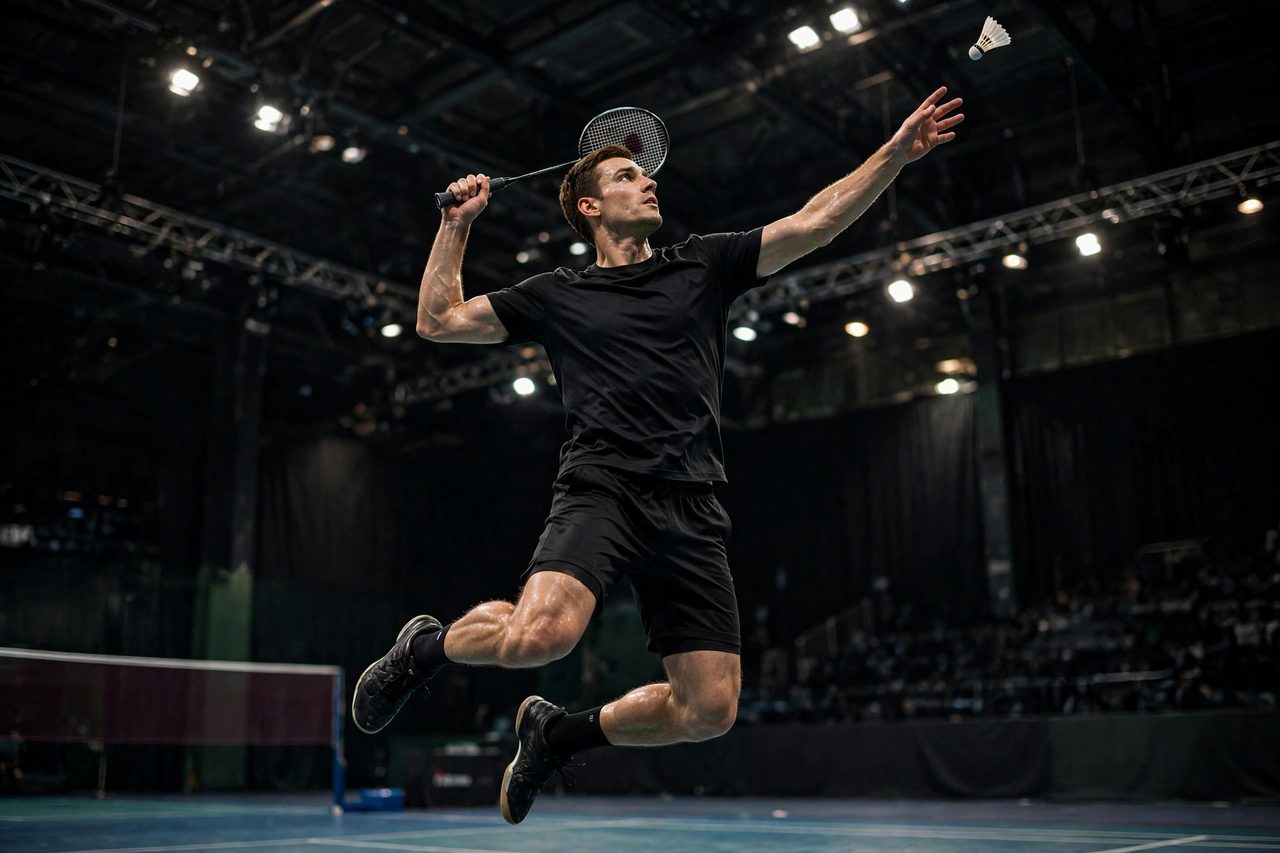
Viktor Axelsen retired in April 2026, at the age of 32, because his back would no longer let him play the way he wanted to. That single fact tells you two things about him: how high his standards were, and how long he held them. For nearly a decade, the tall Dane was the player everyone else had to beat.
Axelsen was born on 4 January 1994 in Odense, Denmark, and grew to 1.94 metres — about 6 foot 4. People told him he was too tall to be a great badminton player. Tall players, the thinking went, could not move fast enough around a court that demands constant lunging, jumping and changing direction. Axelsen spent his career proving that wrong.
The early promise
The first sign of what was coming arrived in 2010, when Axelsen became the first European to win the boys’ singles title at the World Junior Championships. The junior worlds are the sport’s under-19 championship, and winning them marks you out as a future star. He was 16.
His breakthrough among the seniors came in 2016, and it came all at once. He helped Denmark win the Thomas Cup — the men’s world team championship, a trophy that dates back to 1949 and had never left Asia before Denmark’s win. He beat the great Lin Dan to win bronze at the Rio Olympics. And he won his first major individual title at the season-ending Superseries Finals, the year-end event for the season’s best players. Until that win, he had lost his previous five finals. After it, he lost only seven of his next 42.
The peak years
Axelsen reached world No. 1 for the first time in September 2017, and he would go on to spend 183 weeks at the top of the rankings in total. Only two men in history have spent longer there: Malaysia’s Lee Chong Wei, with 398 weeks, and China’s Lin Dan, with 211.
The titles piled up. He won the World Championships — the sport’s biggest individual event, held most years — in 2017 and again in 2022. He won Olympic gold in Tokyo in 2021 and defended it in Paris in 2024, winning both finals without dropping a game. A “game” in badminton is one race to 21 points, and matches are best of three games — so winning an Olympic final without dropping a game means total dominance. In Paris he did it while playing through pain, taking painkillers to get through the tournament.
He also won three straight season-ending World Tour Finals titles between 2021 and 2023, two All England titles — the sport’s oldest and most prestigious annual event — and became the first man to win every Super 1000 singles title. The Super 1000s are the top tier of the world tour, the biggest regular tournaments in the sport.
The Axelsen method
What made Axelsen so hard to beat was not one weapon but the complete package. His height gave him a steep, punishing smash — the overhead attacking shot hit downwards at full power — and huge reach at the net. But he paired that with footwork and patience that tall players are not supposed to have, and with a tactical brain that rarely picked the wrong shot.
He was also famously meticulous. He moved his training base from Denmark to Dubai to cut down travel time to the Asian tournaments where most of the tour is played. He learned Mandarin Chinese, partly to understand his Chinese opponents better and partly to connect with the sport’s biggest fan base. He became fluent enough to do interviews in the language, and Chinese fans adopted him as one of their own, giving him the name An Sai Long.
His great rival in the later years was Thailand’s Kunlavut Vitidsarn, who lost to him in the 2022 world final and the 2024 Olympic final. When Axelsen retired, Vitidsarn wrote: “Thank you for every battle we shared. You pushed me to be better every single time.”
The end
The back problems had been building for years. Axelsen had surgery on his back in April 2025, and he had not played since the French Open in October 2025. In April 2026, his doctors told him that continuing at the elite level risked more surgery and lasting damage. He listened.
“Due to my recurrent back issues, I am no longer able to compete and train at the highest level,” he wrote in his retirement announcement. “Accepting this situation has been incredibly difficult. But I have now reached a point where my body won’t allow me to continue.”
He had wanted to reach the Los Angeles Olympics in 2028. Instead, he left with everything else: two Olympic golds, a bronze, two world titles, and a place among the greatest men’s singles players the sport has ever seen. He also left a lesson for every tall kid told they move too slowly for badminton: the game is big enough for giants, if they are willing to do the work.
Related articles
Carolina Marín: The Fighter From Huelva Who Changed Badminton
Three world titles, Olympic gold at Rio 2016, and three serious knee injuries. Carolina Marín put Spain on the badminton map — and her story ended in March 2026, when her body finally said stop.
An Se-young's Perfect Season: The Year Badminton Found Its Unbeatable Star
One loss in 72 matches. Eleven titles in a year — for the second season in a row. How An Se-young turned patience and defence into the greatest season women's badminton has ever seen.
Anders Antonsen: Denmark's Comeback King Keeps Climbing
World No. 3 Anders Antonsen has spent a decade near the top of men's badminton — and in 2026 he is still winning finals the hard way, coming from behind. Meet the Dane who never seems beaten.