
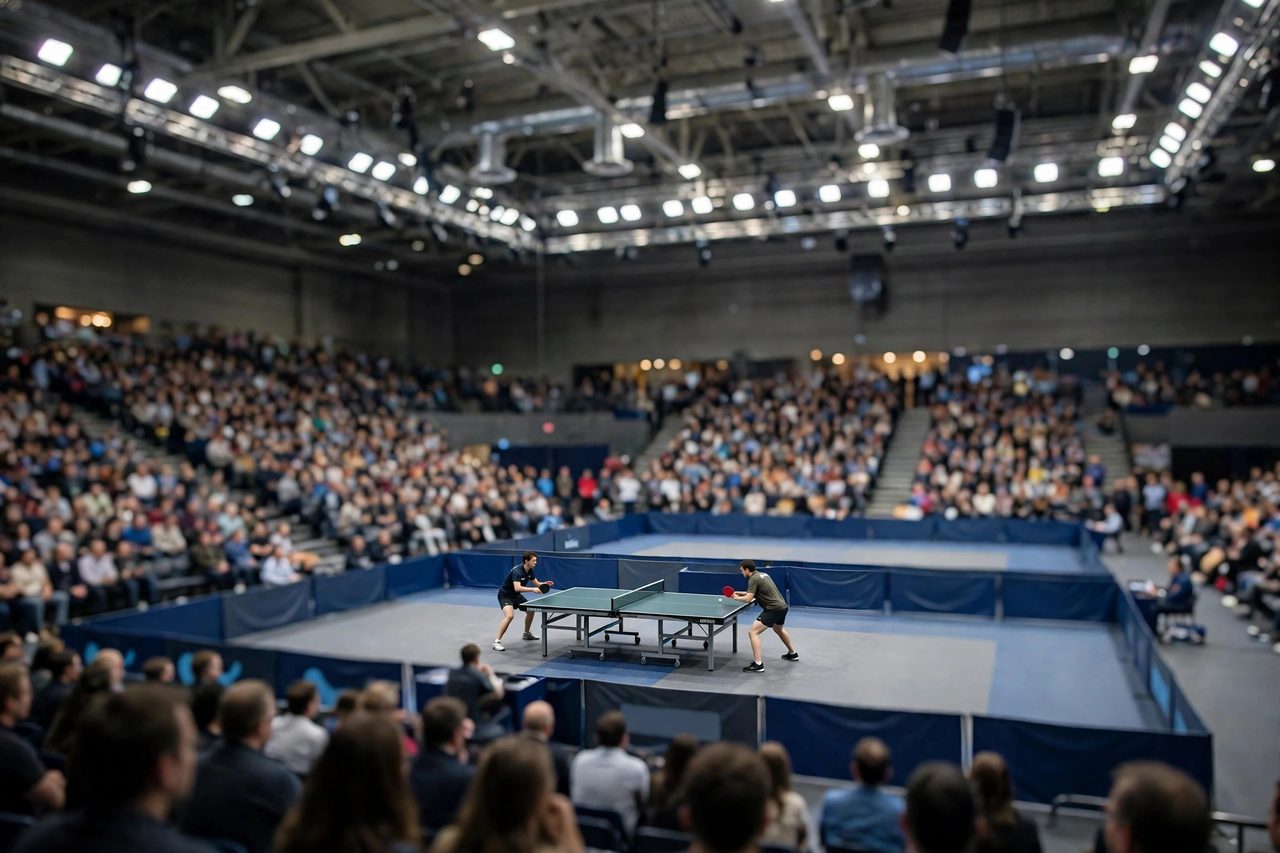
Table tennis has one tournament that confuses almost everyone, and it is the sport’s biggest: the World Championships. The confusion is simple to explain. The World Championships are actually two different tournaments, and they take turns.
In odd-numbered years, the World Championships are an individual event: men’s singles, women’s singles, men’s doubles, women’s doubles and mixed doubles. In even-numbered years, they are a team event: one men’s team competition and one women’s team competition, where countries play each other instead of individuals playing each other.
The ITTF is the International Table Tennis Federation, the sport’s world governing body. It has run the World Championships since 1926, making them one of the oldest world championships in any sport. Until 1999, all seven events were played at the same tournament. Since then, the two formats have alternated, one per year.
The team event: countries against countries
The team championship is the one coming up next. The 2026 edition will be held in London from 28 April to 10 May, and it will be the biggest in history, with 64 men’s teams and 64 women’s teams.
A team match is called a “tie”. Each tie is best of five individual matches, so the first country to win three matches wins the tie. Each individual match is best of five games, and each game is played to 11 points — you need to win by two clear points if the score reaches 10-10.
The 2026 format has three stages. In Stage 1B, the lower-ranked teams play in groups of four, and the group winners and best runners-up advance. In Stage 1A, the top seven teams plus hosts England play a seeding round — a round that only decides the draw, with nobody eliminated. Then Stage 2 is a straight knockout bracket, from the round of 32 to the finals, with the women’s final on 9 May and the men’s final on 10 May.
The men’s team trophy is called the Swaythling Cup. The women’s team trophy is the Corbillon Cup. China has dominated both for decades, but the expanded field is designed to give more countries a real path into the knockout rounds — and more chances for an upset.
The individual event: five crowns
In odd years, the spotlight turns to individuals. The individual World Championships crown five champions: men’s singles, women’s singles, men’s doubles, women’s doubles and mixed doubles.
Singles draws are built around the world rankings. The top players go straight into the main draw, and everyone else fights through a qualifying competition for the remaining places. Every match is a knockout: lose once and you are out. Singles matches at the sharp end are usually best of seven games, so a champion needs to win four games to take a match — and six or seven matches to take the title.
This is the event that makes legends. Winning the singles world title is the hardest prize in table tennis outside the Olympics, because the draw is full of Chinese stars, and China has won the men’s and women’s singles titles at nearly every World Championships of the modern era.
Why it matters
The World Championships sit alongside the Olympic Games and the World Cup as one of table tennis’s three biggest prizes. But they are different from both. The Olympics only happen every four years and limit each country to two singles players. The World Cup is a smaller, invitation-only event.
The World Championships are the one place where the whole sport shows up: every country, every style, every generation. A teenager from a small table tennis nation can draw a Chinese superstar in the first round of the singles, and a team like Brazil or Denmark can build a whole campaign around one great week.
That is why London 2026 matters so much. A hundred years after the first World Championships, the team event returns to the city where the sport’s modern story began, with the biggest field it has ever had. China will start as favourite, as always. But with 64 teams per event and a draw full of dangerous outsiders, the 2026 edition has more room for a surprise than any World Championships before it.
Related articles
How the WTT Finals Work: Table Tennis's Season-Ending Showdown
Sixteen men, sixteen women, eight mixed doubles pairs, five days in Hong Kong. The WTT Finals is where the table tennis season is decided — here is how it works.
How the Tournament of Champions Works
Squash's grandest stage, inside New York's Grand Central Terminal: a simple guide to the format, the history and the magic.
How the US Open Squash Championships Work
The US Open is the biggest squash event in America. Here is how it works, from the glass court in Philadelphia to the prize money and the history behind it.