
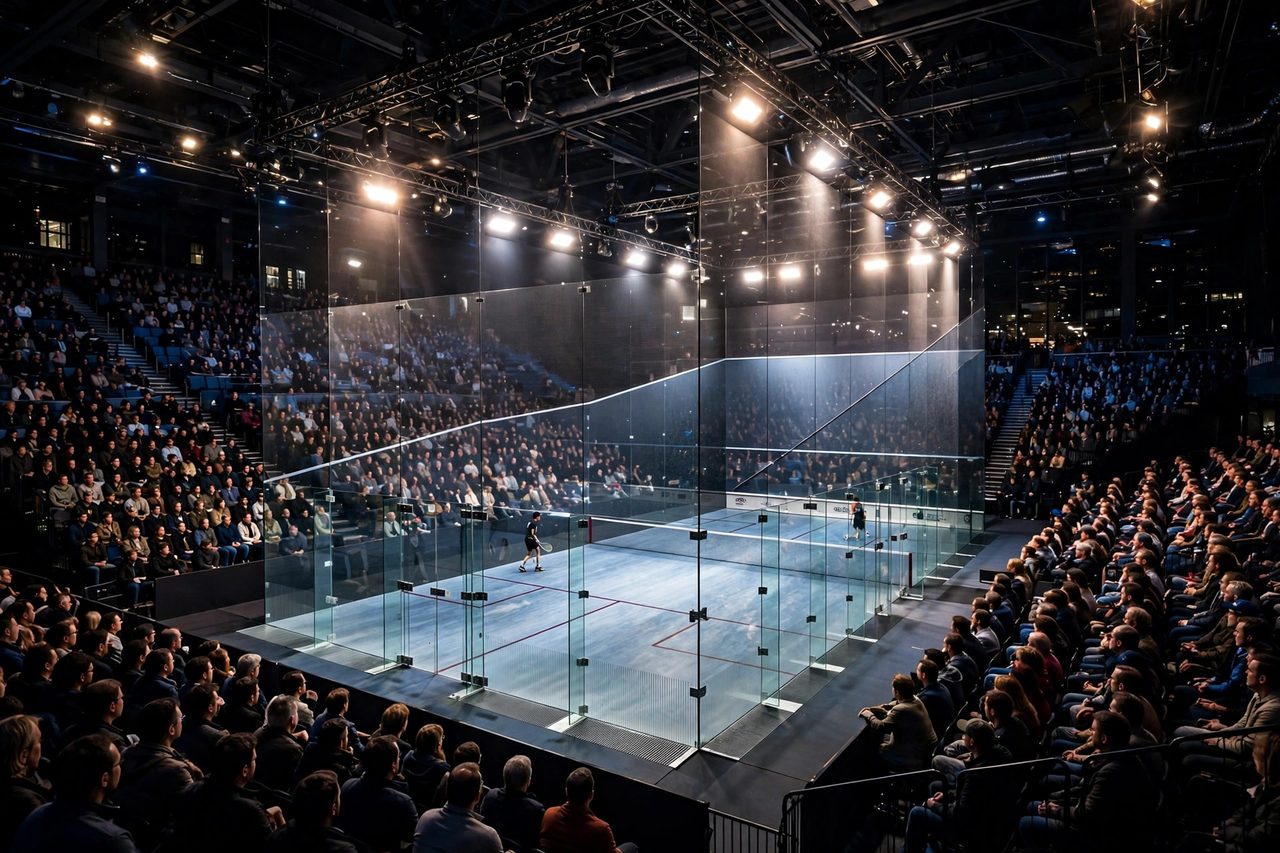
At the end of every season, squash does something no other tournament does: it takes the eight best men and the eight best women of the year and locks them in a room together. The PSA Squash Tour Finals is the season-ending World Event of the tour — a prestige finale where you cannot qualify by ranking alone, and where a single Diamond-level title can punch your ticket months in advance.
Who gets in
Sixteen players qualify — eight per gender — but the door has three locks:
- Diamond winners qualify automatically. Win one of the tour’s biggest Diamond-level events during the season and you are in, regardless of where you sit in the standings.
- The reigning World Champions qualify automatically. Hold the World Open title and your place is booked.
- Everyone else comes through the Race. The remaining spots go to the highest-placed players on the Race to the Finals standings, with points on offer at every PSA World Event through the season.
It is a system that rewards both peak moments and season-long consistency — and it means the race leaderboard is a storyline in its own right all year.
How it is played
Traditionally, the Finals use a round-robin format rather than a straight knockout. The eight players are split into two groups of four, with the top seed placed in Group A, the second seed in Group B, and the remaining seeds drawn in pairs. Every player plays everyone in their group in best-of-three-game matches. The scoring table is unforgiving in its precision: a 2-0 win earns 4 points, a 2-1 win earns 3, a 1-2 loss earns 1, and a 0-2 loss earns nothing. The top two in each group advance to the semi-finals (still best of three), and the final is played over best of five.
Ties are broken by number of wins, then head-to-head results, then the percentage of points won — which is why every game matters, even in a dead rubber.
Formats evolve, though. The 2025-26 edition, held at Centquatre-Paris (Le 104) in Paris from 17 to 20 June 2026, switched to a straight knockout draw — first plays eighth, second plays seventh, and so on — with defending champions Joel Makin and Nouran Gohar, who had lifted the trophies in Toronto, defending their crowns in the first European staging of the event since 2013. The PSA presents the Finals with title sponsorship from TWG Global.
Where this season’s race stands
The 2026-27 race is already taking shape, and the first names are on the board. On 20 October 2026, 19-year-old world No. 1 Amina Orfi and world No. 3 Diego Elías became the first players to qualify for the season-ending event, courtesy of their title wins at the Diamond-level CIB Egyptian Open in Cairo.
Orfi’s numbers are startling: 14 matches unbeaten to start the season, only one game dropped in the Egyptian Open, and a lead of more than 3,000 points at the top of the women’s leaderboard. Behind her, Sivasangari has climbed to fourth after a quarter-final in Cairo, Nouran Gohar has jumped eleven spots to sixth after reaching the semis, and Nele Gilis rounds out the top eight — with world No. 7 Satomi Watanabe and world No. 3 Nour El Sherbini hunting her down.
In the men’s standings, world No. 1 Mostafa Asal holds the top spot with 4,815 points despite Elías’s Cairo triumph, followed by France’s world No. 6 Victor Crouin and world No. 2 Paul Coll. Joel Makin’s return to action has carried the Welshman back into the top eight.
The message of the early race is clear: the young guard is not waiting its turn. Orfi is 19. The Diamond titles are already falling. And every World Event from here to the season’s end is a qualifying event — which means the race leaderboard will be one of the sport’s best stories all year.
Why this format exists
The Finals have a long pedigree under various names — the event descends from the old World Series Finals, the season-ending championship of a previous tour era — and the round-robin structure is deliberate. A straight knockout can be won by a lucky draw; two groups of four, with every game carrying points, tests who can sustain excellence across a week rather than survive a day. The best-of-three group matches also create the tournament’s signature tension: a player who has already qualified can still deny a rival the points needed to advance, which means there are effectively no dead rubbers.
It also produces the season’s most honest champion. The player who lifts the trophy has beaten three or four top-eight opponents in a single week — a gauntlet no regular tour event demands. That is why the Finals carry a prestige beyond their prize money, and why the automatic qualifying spots for Diamond winners matter so much: they guarantee the season’s biggest peaks are all in the room, no matter what the standings say.
Related articles
How the WTT Finals Work: Table Tennis's Season-Ending Showdown
Sixteen men, sixteen women, eight mixed doubles pairs, five days in Hong Kong. The WTT Finals is where the table tennis season is decided — here is how it works.

How the Tournament of Champions Works
Squash's grandest stage, inside New York's Grand Central Terminal: a simple guide to the format, the history and the magic.
How the US Open Squash Championships Work
The US Open is the biggest squash event in America. Here is how it works, from the glass court in Philadelphia to the prize money and the history behind it.