
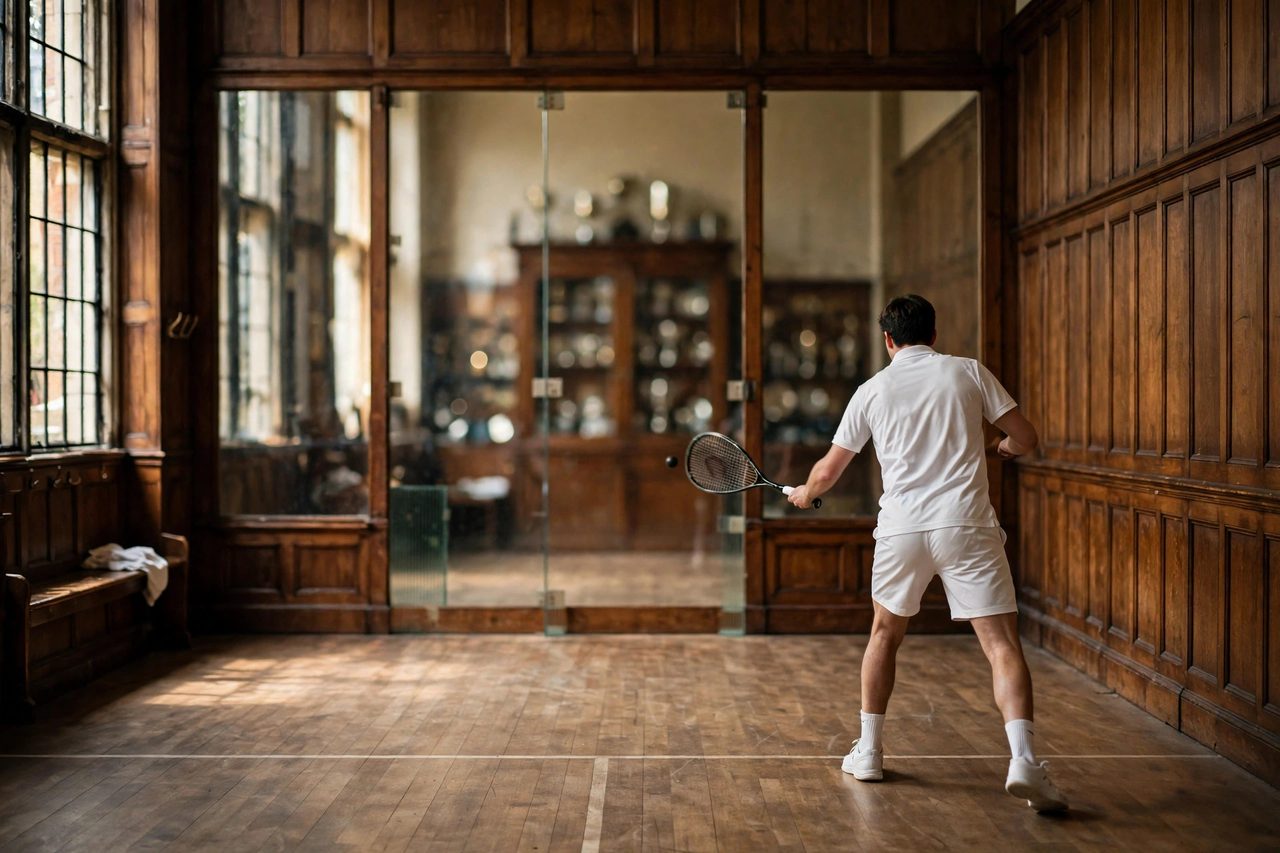
Every sport has a trophy that means more than the others. In tennis it is Wimbledon. In squash it is the British Open. The British Open Squash Championships are the oldest open tournament in the game, and for decades they were the unofficial world championship. Winning one puts your name alongside the greatest players who ever lived. Here is how the tournament works, and why it still matters so much.
The oldest trophy in squash
The men’s British Open began in 1930. Open means the tournament is open to both professional and amateur players, so anyone good enough can enter. Before 1930 there were separate professional and amateur championships, but they never played each other. The British Open changed that.
The early years were strange by modern standards. Instead of a normal knockout draw, the tournament used a challenge system. A challenge system means the champion keeps the title until someone challenges them for it. The first designated champion was Charles Read, a British professional who had dominated for years. To challenge him, a player had to prove they were good enough and guarantee at least 100 pounds in prize money, which came from ticket sales and player contributions. In December 1930, Don Butcher challenged Read and beat him in two legs, one at each player’s home club, to become the first British Open champion.
That challenge system lasted until 1947. In 1948 the tournament switched to the knockout format we know today. Knockout means you lose once and you are out. It is simple, brutal, and fair, and it is how almost every big squash tournament works now.
The women’s story started even earlier. A women’s amateur championship began in 1922, won in its first year by Joyce Cave, who beat her own sister Nancy in the final. It stayed amateur-only until 1974, when the women’s event became fully open. The men’s and women’s events have been held together as one joint tournament since 1983.
How the modern tournament works
Today the British Open is a Platinum event on the PSA Squash Tour. The PSA is squash’s professional tour, and Platinum is its top tier, just below the World Championships. That means it carries huge ranking points and big prize money, and it draws the best players in the world.
The format is a straight knockout draw for men and women. The top players are seeded. A seed is a ranking given to the top players so that they do not meet each other in the early rounds. The No. 1 seed and the No. 2 seed can only meet in the final, if they both keep winning. Lower-ranked players and qualifiers fill out the rest of the draw. A qualifier is a player who earns their place by winning matches in a qualifying event held just before the main tournament.
Matches are best of five games, played to 11 points. A player needs to win three games to win the match. In squash, every rally scores a point, no matter who served. That is called point-a-rally scoring, and it means matches can swing fast. One loose stretch of three or four rallies can cost you a whole game.
The tournament is famous for its glass show court. A show court is a court built inside a theatre or arena, with glass walls and seating around it, so a big crowd can watch. The British Open has been played in theatres, sports centres and arenas all over England, from London’s Wembley to Hull and Birmingham. The most recent edition was held in Birmingham, at the Birmingham Repertory Theatre.
Why it matters more than other tournaments
Until the World Championships began in 1976, the British Open was the de facto world championship. De facto means “in practice, even if not officially”. There was no world championship, so everyone agreed that the British Open champion was the best player in the world. That history still hangs over the trophy. Players talk about the British Open differently from other events. It is the one their heroes won.
The list of past champions reads like a hall of fame. Pakistan’s Jahangir Khan won it 10 times in a row, from 1982 to 1991. Ten in a row is one of the great streaks in all of sport. Australia’s Geoff Hunt won it eight times. Pakistan’s Hashim Khan won it seven times, and Jansher Khan and England’s Jonah Barrington won it six times each.
On the women’s side, the record belongs to Australia’s Heather McKay, who won the title 16 times in a row from 1962 to 1977. Sixteen straight titles. Nobody in any racquet sport has matched it. More recent champions include New Zealand’s Paul Coll in the men’s event and Egypt’s Amina Orfi in the women’s event, which tells you how global the sport has become. Egypt now produces more top squash players than any other country.
The trophy and the future
The British Open trophy is one of the most photographed objects in squash. Winners lift it, kiss it, and pose with it on the glass court while the crowd roars. For a sport still fighting for mainstream attention, that image matters. Squash will make its Olympic debut at Los Angeles 2028, which should bring new fans to the game. When those new fans ask where the sport’s history lives, the answer will be the British Open.
That is why players want this title so badly. A Platinum win anywhere is worth a lot of ranking points. A British Open win is worth all of that, plus a place in a story that started in 1930. When the next champion lifts the trophy, they will not just be winning a tournament. They will be joining Jahangir, McKay, Hunt and every other legend whose name is already on it. And that is what makes the British Open the Wimbledon of squash.
Related articles

How the WTT Finals Work: Table Tennis's Season-Ending Showdown
Sixteen men, sixteen women, eight mixed doubles pairs, five days in Hong Kong. The WTT Finals is where the table tennis season is decided — here is how it works.
How the Tournament of Champions Works
Squash's grandest stage, inside New York's Grand Central Terminal: a simple guide to the format, the history and the magic.
How the US Open Squash Championships Work
The US Open is the biggest squash event in America. Here is how it works, from the glass court in Philadelphia to the prize money and the history behind it.