
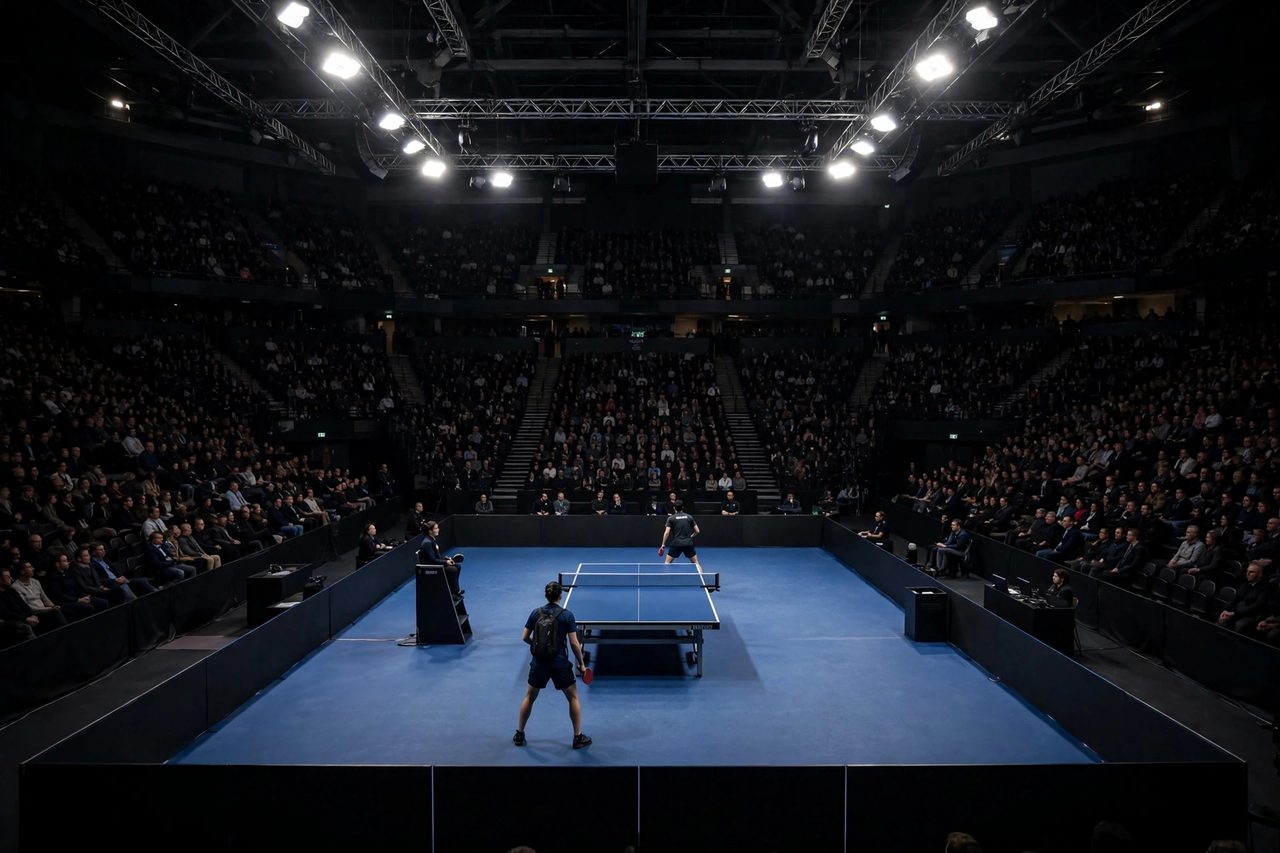
The ITTF World Cup is table tennis’s great mid-season showdown: no teams, no doubles, just the best singles players on the planet in a format designed to produce drama from the first ball. Brought back to the calendar in Macao in 2024 after a break of several years, it has quickly re-established itself as one of the sport’s marquee events — the 2026 edition carried a USD 1 million prize pool.
Here’s how it works.
The field: 48 and 48
There are two events — men’s singles and women’s singles — each with 48 players. The field is assembled from the world rankings, continental qualification pathways and host-country nominations, which is why the draw mixes the sport’s superstars with continental champions and emerging talents from every corner of the table tennis world.
Stage 1: the group gauntlet
The 48 players in each draw are split into 16 groups of three for a round-robin first stage. Every player faces the other two in their group — and only the group winner advances.
This is what makes the World Cup uniquely brutal. There is no safety net: finish second in your group and you’re out, even if you lost only to the eventual champion. In the 2026 edition, the group matches were played as best-of-five games — a change from the previous format, where each group match was contested over four games and could end in a 2-2 draw, with game ratios deciding the tight groups.
The jeopardy is real from day one. At the 2026 event in Macao, India’s Manika Batra — ranked 47th in the world — found herself in a group with Japan’s world No. 5 Miwa Harimoto and USA’s Lily Zhang, needing something close to a miracle just to reach the last 16. Meanwhile world No. 1 Sun Yingsha cruised through her group with two 3-0 wins to underline why she started as the favourite.
A format that keeps evolving
The group stage hasn’t always looked like this. When the World Cup returned in Macao in 2024, each group match was played over four games — and could end in a 2-2 draw, with game ratios settling the tight groups. It was a quirk that produced genuine tactical chess: players weren’t just trying to win, they were counting games. The 2026 switch to best-of-five group matches simplified the maths while keeping the brutality: win your group or go home, with no drawn matches to hide behind.
It’s a reminder that the World Cup is still a young event in its modern form, and its organisers aren’t afraid to tinker. The two-stage skeleton — groups, then knockouts — has held firm; the details around it will likely keep evolving.
Stage 2: best-of-seven knockouts
The 16 group winners feed into a straight single-elimination bracket: round of 16, quarter-finals, semi-finals, final. From here, every match is best-of-seven games — the full championship distance.
This is where the tournament earns its reputation. The 2026 men’s final was an instant classic: China’s Wang Chuqin edged Japan’s Sora Matsushima 4-3 to lift the title. Seven games, the season’s two form players, everything on the line — exactly the spectacle the format is built to deliver.
The trophies
The champions lift two of the most historic trophies in the sport: the Evans Cup for the men and the Hammarlund Cup for the women. In a sport whose biggest prizes are mostly associated with the World Championships and the Olympics, the World Cup’s cups carry their own weight — a line of winners stretching back through the decades of the event’s history.
Why the format matters
Table tennis is a sport of fine margins, and the World Cup’s structure is engineered to expose them. The group stage punishes slow starters and rewards players who can handle must-win pressure immediately — there’s no time to play yourself into form. The knockout stage then tests something different: the ability to sustain excellence across four best-of-seven matches in four days.
It’s also a format that creates the sport’s best stories. A world No. 1 can be ambushed in the groups by a fearless qualifier. A mid-ranked player who tops their group suddenly finds themselves two wins from a semi-final. And because every edition is a standalone event — no ranking points race, no season-long narrative — the only thing that matters is who holds their nerve in Macao.
Seven days, 96 players, two cups. Few tournaments in racquet sports pack this much jeopardy into a single week.
Related articles
How the WTT Finals Work: Table Tennis's Season-Ending Showdown
Sixteen men, sixteen women, eight mixed doubles pairs, five days in Hong Kong. The WTT Finals is where the table tennis season is decided — here is how it works.
How the Tournament of Champions Works
Squash's grandest stage, inside New York's Grand Central Terminal: a simple guide to the format, the history and the magic.
How the US Open Squash Championships Work
The US Open is the biggest squash event in America. Here is how it works, from the glass court in Philadelphia to the prize money and the history behind it.