
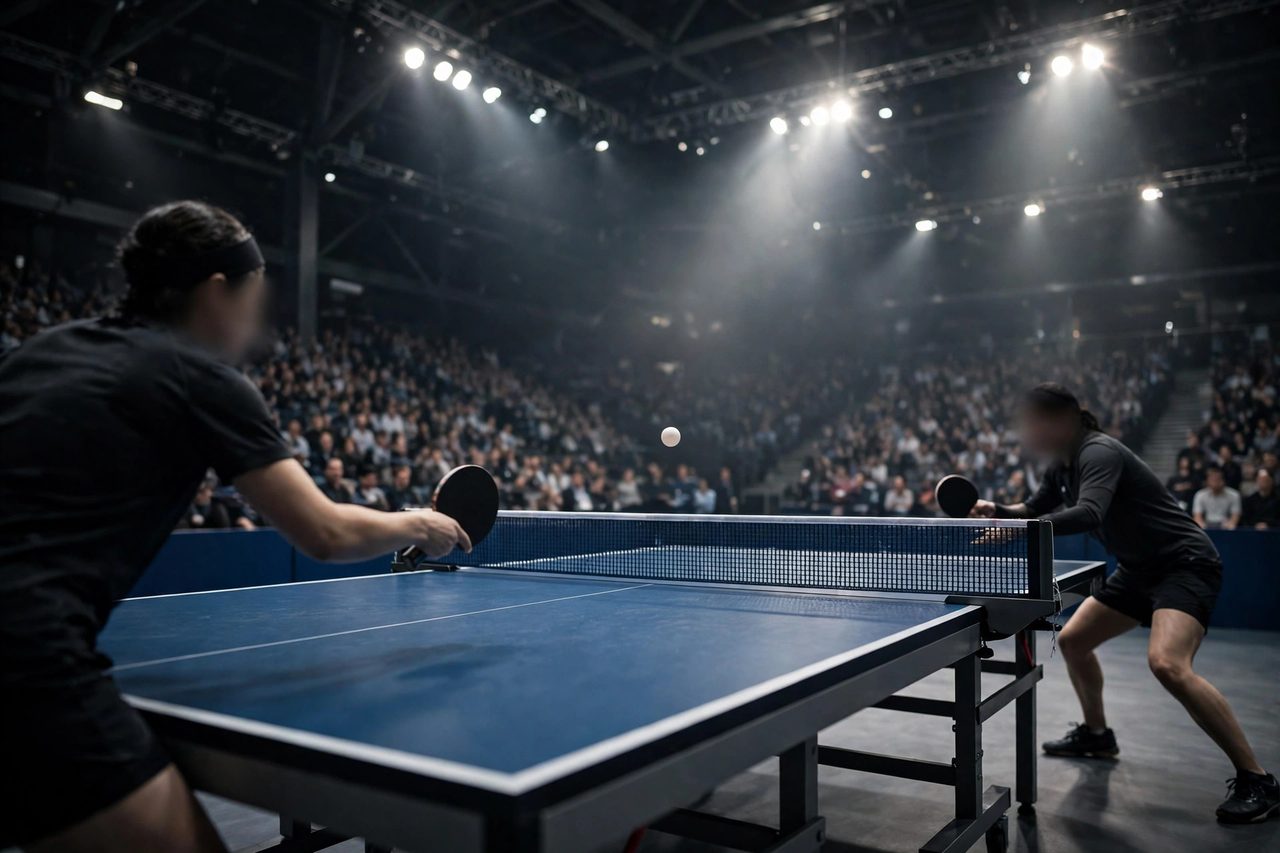
Every sport needs a final exam. In table tennis, it is the WTT Finals: after a year of tournaments around the world, only the best players of the year get in, and only one man and one woman leave as champions. Here is how it works, in plain terms.
The 2026 edition: Hong Kong, December 9 to 13
The 2026 WTT Finals take place from Wednesday, December 9 to Sunday, December 13, at Kai Tak Arena in Hong Kong. Kai Tak Arena is the new indoor arena inside Kai Tak Sports Park, and this is the first time the Finals have been played there.
Hong Kong is hosting for the second year in a row. In 2025 the event was held at the Hong Kong Coliseum; this year it moves to Kai Tak.
Five days, three titles: men’s singles, women’s singles and mixed doubles. Mixed doubles means a team of one man and one woman playing together. There are no men’s doubles or women’s doubles, and no qualifying rounds.
Who gets in: the season’s best 16
The field is tiny on purpose. Sixteen men and sixteen women qualify for the singles. Eight pairs qualify for the mixed doubles. Nobody can buy a spot. If you are in the draw, you earned it over the season.
So how does a player earn it? Only results from WTT events count — the World Championships, the World Cup and continental championships do not count towards this race, even though they are huge events in their own right.
WTT adds up each player’s best results from the season: their four best Grand Smash results, their four best Champions results, and their six best results from the Contender events. The 16 men and 16 women with the most points qualify, and the same idea applies to the mixed doubles pairs. That is why the last events of the autumn matter so much — a player sitting 17th can still sneak in with one great week, and a player sitting 14th can still drop out with one bad one.
The format: lose once, go home
The singles are straight knockout. Knockout means there is no second chance: lose one match and your tournament is over. The draw runs from the round of 16 to the quarter-finals, the semi-finals and the final, so to win the title a player must win four matches in a row, all against top-16 opponents.
Every singles match is the best of seven games. A game is the race to 11 points, and a player needs to win four games to take the match — the longest format in WTT events, which rewards staying sharp for a long match, not just starting fast.
The mixed doubles works a little differently. The eight pairs start in two groups of four, with every pair playing the other three in its group. The top two pairs from each group go through to the semi-finals, and from there it is knockout to the final.
The points and the money
The winners earn 1,500 world ranking points each. World ranking points decide a player’s place in the world rankings, and those rankings decide seedings — where each player is placed in the draw — and invitations at every big event. Only a Grand Smash win (2,000 points) is worth more on the WTT tour.
The total prize pool for the 2026 Finals is $1.3 million, shared across the three events. At the 2025 edition, each singles champion took home $80,000. By the standards of tennis or golf, these are modest sums — but by the standards of table tennis, this is one of the richest weeks of the year.
How it differs from the other big events
Table tennis has a lot of events with similar names. Here is the simple version.
A Grand Smash is the biggest regular event on the tour. There are four a year — in 2026, Singapore, the United States, Europe (in Sweden) and China. Each one lasts around ten days, has 64 players in each singles draw, and stages all five events. The singles winners earn 2,000 ranking points, and the Singapore Smash in 2026 had a total prize pool of $1.55 million. A Grand Smash is the sport’s version of a tennis Grand Slam.
A Champions event is shorter and sharper. Only 32 men and 32 women play, singles only, no doubles at all. The prize pool is $500,000, the winner takes $40,000 and 1,000 ranking points. Think of it as a greatest-hits show: every match is between two top players.
The Finals is different from both. It is not open to a large field, and it is not a one-off show. It is the reward for a whole season. You cannot enter it on the strength of one good week — you have to have been one of the best players across the entire year. A Grand Smash says you had the best week. The Finals say you had the best year.
The World Championships and the World Cup are different again. They are run by the ITTF, the sport’s world governing body, not by WTT, and they do not count towards Finals qualification.
A short history
The Finals replaced the old ITTF World Tour Grand Finals, which ended in 2020, and the first edition under the new name was held in Singapore in 2021. Last year in Hong Kong, Tomokazu Harimoto of Japan won the men’s title and Wang Manyu of China won the women’s title, while South Korea’s Lim Jonghoon and Shin Yubin took the mixed doubles.
The one thing to remember
If you watch one table tennis event in December, watch this one. The draws are small, so every match is between two of the best players in the world. Nobody is there by accident, nobody gets a second chance, and the two singles champions can fairly call themselves the players of the year.
Related articles
How the Tournament of Champions Works
Squash's grandest stage, inside New York's Grand Central Terminal: a simple guide to the format, the history and the magic.
How the US Open Squash Championships Work
The US Open is the biggest squash event in America. Here is how it works, from the glass court in Philadelphia to the prize money and the history behind it.
How the WTT Champions Series Works: The Invitation-Only Events With No Qualifiers
A WTT Champions event has just 32 men and 32 women, no doubles, no qualifiers and no easy matches. Here is how the invitation-only series works — with Montpellier this week as the live example.