
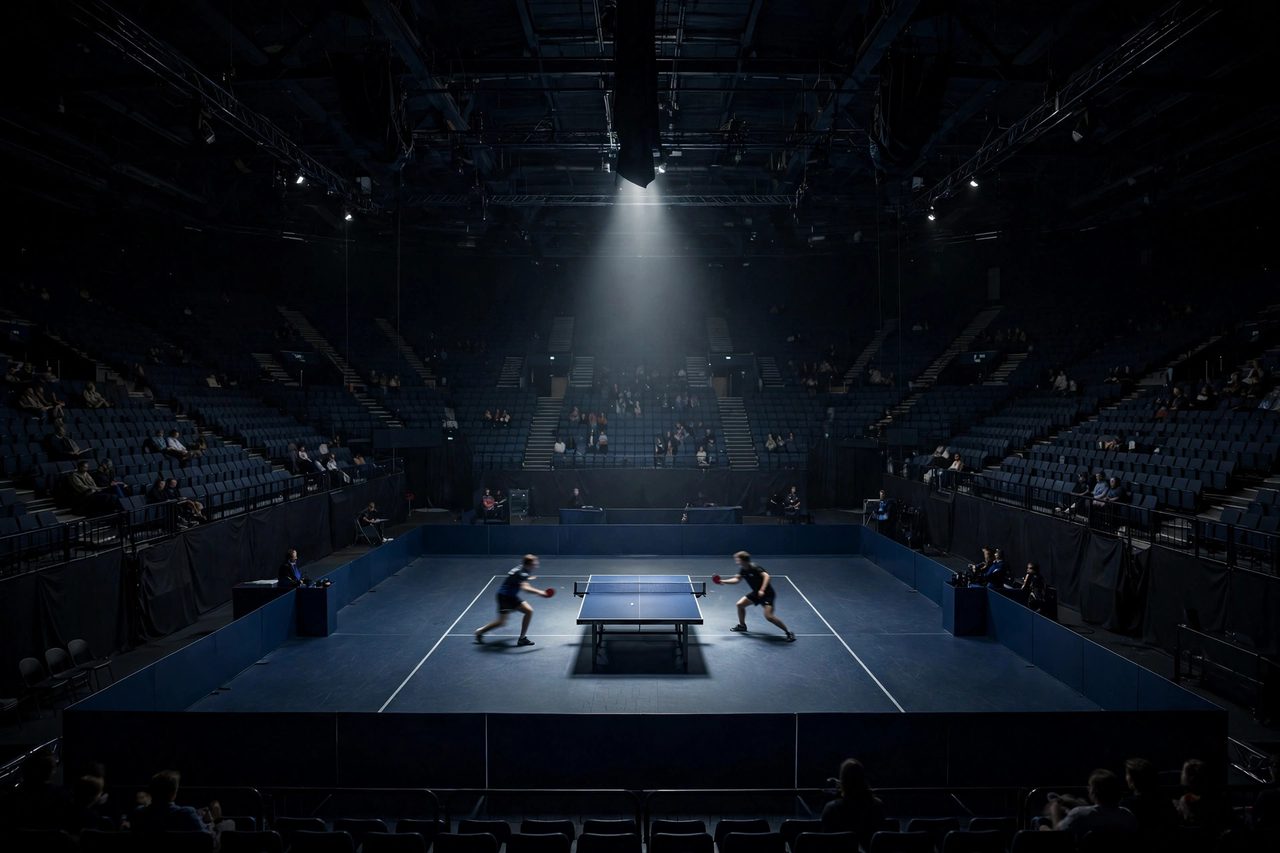
Imagine a tournament where you cannot qualify for it. There is no qualifying draw, no back door, no lucky loser spot. You are either invited, or you are watching from home. That is the WTT Champions series, and it is playing out right now in Montpellier.
WTT stands for World Table Tennis. It is the company that runs the professional world tour. The tour has several levels. At the top are the Grand Smash events, the biggest tournaments with the largest draws and the most points. Below them sit the Champions events. Below those are the Star Contenders and Contenders, where up-and-coming players fight their way up the rankings.
A Champions event is different from all of them. It is small on purpose.
Who gets in: 32 and 32
Each Champions event has exactly two draws: a men’s singles draw of 32 players and a women’s singles draw of 32 players. Singles means one player against one player. There are no doubles events at all. No men’s doubles, no women’s doubles, no mixed doubles.
Almost all of the 32 spots go to the top players in the world rankings. The world ranking is a list of the best players, based on points earned in tournaments over the past year. The host also gets a wildcard spot, which is a free invitation given to a player who would not otherwise qualify, often a local favourite. WTT itself gets one nomination spot per event. The idea is simple: the best 32 players in the world, in one room, for one week.
That also means there is no qualifying tournament. A qualifier is a separate mini-tournament held before the main event, where lower-ranked players fight for a few spots in the main draw. Champions events do not have one. If you are ranked 40th in the world, you do not get a chance to play your way in. You wait for an invitation that will not come, and you play a Contender event instead.
There is also a limit on how many players one country can send: a maximum of four per event, not counting the host wildcard and the WTT nomination. Without that rule, China could fill half the draw on its own. The limit keeps the field international, which is part of the appeal.
The format: straight knockout, best of five
Once the 32 players are in, the format is brutally simple. It is a straight knockout. Lose once, and you are out. There are no groups, no second chances, no round-robin stage where you can lose a match and still advance.
Matches are best of five games. A game is played to 11 points, and you must win by two clear points. The first player to win three games wins the match. That is shorter than the best-of-seven format used at Grand Smash events and the World Championships. Shorter matches mean more surprises. A slow start can end your week in under half an hour, and a hot streak can carry an underdog through two rounds before anyone has time to adjust.
The whole event is played on one table. That is unusual. Most big tournaments run several tables at once, so matches overlap. At a Champions event, every match is the main event. The cameras, the crowd and the spotlight are all on the same table, one match at a time. It makes the event feel like a television show, which is exactly the point.
What is at stake
The winner of a Champions event earns 1,000 world ranking points. That is half of what a Grand Smash winner gets, and more than a Star Contender title. For players chasing the season-ending WTT Finals, where only the top 16 players of the year qualify, 1,000 points can change a season.
The prize pool is 500,000 dollars per event, with the champion taking 40,000 dollars. That is not the biggest cheque in the sport, but it is a serious one, and the ranking points matter more than the money for most of the field.
Montpellier: the live example
This week’s event is WTT Champions Montpellier, running from October 27 to November 1 at the Sud de France Arena in Montpellier, in the south of France. It is a perfect example of why the format works.
The first round alone produced huge matches. France’s Simon Gauzy beat Japan’s Tomokazu Harimoto 3-0 in front of a loud home crowd. France’s Félix Lebrun, the world No. 2, opened with a 3-0 win over Denmark’s Anders Lind. Germany’s Patrick Franziska beat Lebrun’s brother Alexis 3-2. And there was an upset: Vladimir Sidorenko, playing under a neutral flag, knocked out Slovenia’s Darko Jorgic 3-1 before the second round had even begun.
That is the Champions promise in action. With only 32 players per draw, there is no warm-up match. The world No. 1 can face a top-ten player in the first round. Every match matters, because every match could end someone’s week.
The finals are scheduled for Sunday, November 1. By then, 62 players will have gone home disappointed, and two will have survived five knockout rounds to lift the trophy.
Why the format divides opinion
Not everyone loves the Champions model. Critics say it shuts the door on rising players. A young talent ranked 50th in the world cannot earn their way in, no matter how well they play that month. They must climb the rankings through Contenders and Star Contenders first, which takes time.
Supporters say that is the whole point. Champions events are not meant to be open. They are meant to be the sport’s shop window: the best players, on one table, with nowhere to hide. The Contenders and Star Contenders are the ladder. The Champions events are the room at the top of it.
Both arguments have merit. But one thing is hard to argue with: when the draw is this small and this strong, every round feels like a final. That is why Montpellier’s arena is full, and why the Champions series has become one of the most watchable weeks on the table tennis calendar.
Related articles
How the WTT Finals Work: Table Tennis's Season-Ending Showdown
Sixteen men, sixteen women, eight mixed doubles pairs, five days in Hong Kong. The WTT Finals is where the table tennis season is decided — here is how it works.
How the Tournament of Champions Works
Squash's grandest stage, inside New York's Grand Central Terminal: a simple guide to the format, the history and the magic.
How the US Open Squash Championships Work
The US Open is the biggest squash event in America. Here is how it works, from the glass court in Philadelphia to the prize money and the history behind it.