
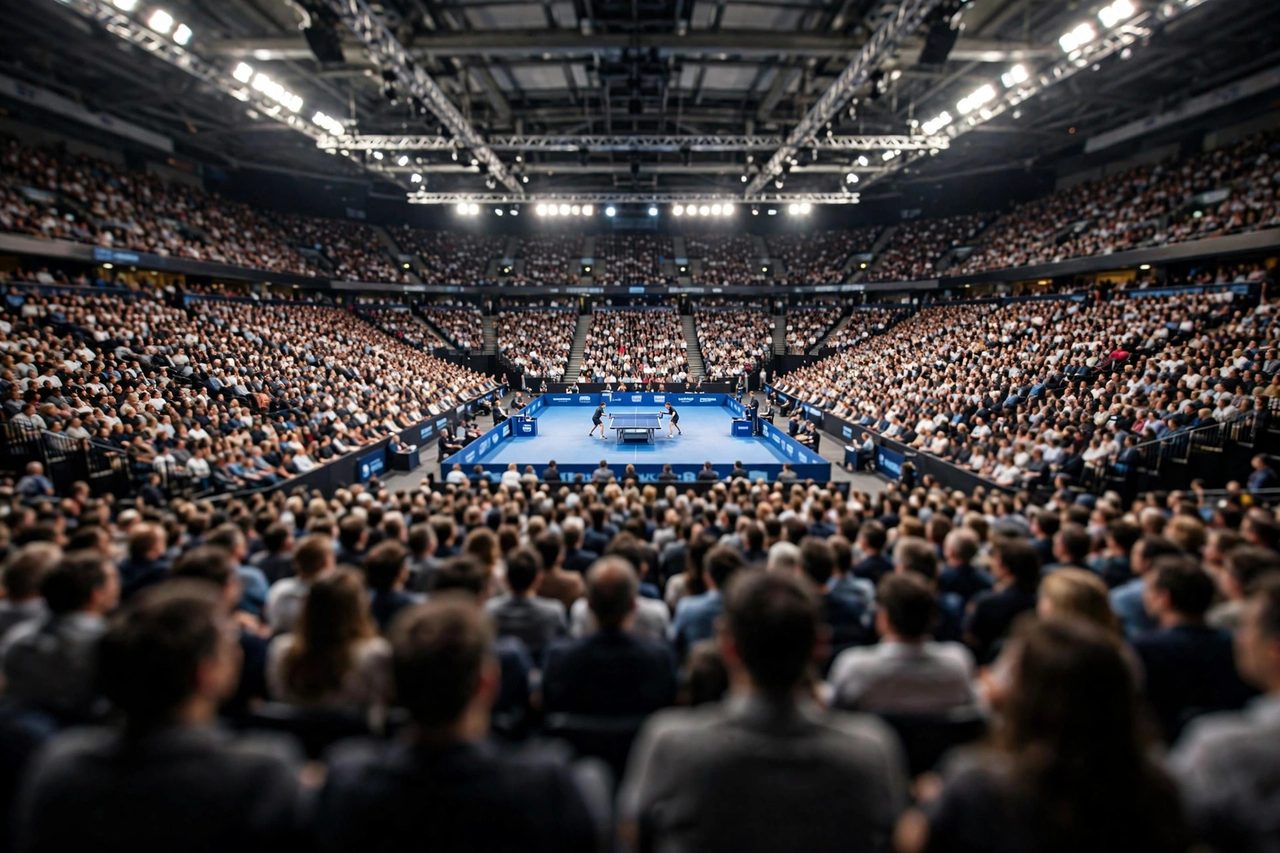
If you only watch table tennis four times a year, watch the Grand Smashes. They are the biggest events on the WTT calendar: the largest draws, the most ranking points, the biggest prize money, and almost every top player in the world. Here is how they work, in plain terms.
What is WTT?
WTT stands for World Table Tennis. It is the professional arm of the ITTF, the sport’s world governing body. Think of it like this: the ITTF runs the sport, and WTT runs the big commercial tour, the way the ATP runs men’s tennis.
The WTT tour is a pyramid. At the bottom are Feeder events, small tournaments where young players earn their first points. Above them are Contenders. Then come Champions events, short elite tournaments for the top 32 players. And at the very top sit the Grand Smashes, four per year.
Since 2025, the four Grand Smashes are Singapore, the United States, Europe (held in Malmö, Sweden), and China (held in Beijing). The China Smash, played in early October, is the last of the four each season, which makes it a key moment in the race for the season-ending Finals.
The format: five events, one big draw
A Grand Smash is the only WTT event that stages all five disciplines of the sport: men’s singles, women’s singles, men’s doubles, women’s doubles, and mixed doubles. Mixed doubles means a team of one man and one woman playing together.
The singles draws have 64 players each. The doubles draws have 24 pairs each. That makes a Grand Smash much bigger than a Champions event, where only 32 singles players compete and there is no doubles at all.
Not everyone starts in the main draw. The top players are “seeded” — placed in the draw according to their world ranking so the best players cannot meet each other in the first round. The remaining spots are filled through qualifying rounds, played over the first few days. A lower-ranked player must win up to three qualifying matches just to reach the main draw. From there, it is straight knockout: lose once and you are out.
Matches are played over about ten or eleven days. The early rounds happen on many tables at once. By the final weekend, everything narrows to one show court, and the finals take centre stage.
The points: why everyone cares
Here is the number that explains everything: 2,000. That is how many world ranking points a Grand Smash singles champion earns. It is the same as winning the Olympic Games or the World Championships. No other WTT event comes close. A Champions event winner gets 1,000 points. A Contender winner gets 400.
The points drop off round by round: the runner-up gets 1,400, a semi-finalist 700, a quarter-finalist 350. Even losing in the first round of the main draw earns a few points, and qualifying wins earn points too. That matters because the world rankings decide seedings, invitations and, at the end of the season, who qualifies for the WTT Finals, the year-end event for the season’s best players.
So a Grand Smash is not just a trophy. It is a ranking earthquake. One great week can move a player ten places up the rankings. One bad week can cost them their seeding at the next big event.
The money
Grand Smash prize pools are large by table tennis standards. The China Smash offers a total pool of about $2.05 million, with the singles champions taking home $135,000 each. The Europe Smash offers $1.55 million. Doubles champions earn far less — around $12,000 per pair at the China Smash — which is one of the sport’s long-running debates.
By the standards of tennis or golf, these are modest sums. By the standards of table tennis, they are the biggest paydays on offer outside the Olympics.
Why the Smashes matter beyond points
The Grand Smashes are also where the sport’s stories happen. The first ever Grand Smash was Singapore 2022, won by Fan Zhendong and Chen Meng. Since then, the events have produced the moments fans remember: Wang Chuqin has won four Grand Smash singles titles, more than anyone else, while Truls Möregårdh of Sweden became the first European to win one when he beat Lin Shidong in the Europe Smash final in Malmö in 2025.
They also matter because of who must play. Top-ranked players are expected to compete at Grand Smashes — there is no skipping the big ones to rest, the way players sometimes do at smaller events. That is why the draws feel complete, and why a Grand Smash title carries so much weight in any debate about who is the best in the world.
The one thing to remember
Table tennis has plenty of tournaments, and it is easy to lose track of which ones count. Here is the simple rule: if it says Grand Smash, it counts more than anything else on the WTT tour. Same points as the Olympics. The full field. Five events. Four times a year.
The next time you see a Grand Smash on the calendar, you will know exactly what is at stake — and why every top player in the world is fighting so hard for it.
Related articles
How the WTT Finals Work: Table Tennis's Season-Ending Showdown
Sixteen men, sixteen women, eight mixed doubles pairs, five days in Hong Kong. The WTT Finals is where the table tennis season is decided — here is how it works.

How the Tournament of Champions Works
Squash's grandest stage, inside New York's Grand Central Terminal: a simple guide to the format, the history and the magic.
How the US Open Squash Championships Work
The US Open is the biggest squash event in America. Here is how it works, from the glass court in Philadelphia to the prize money and the history behind it.