
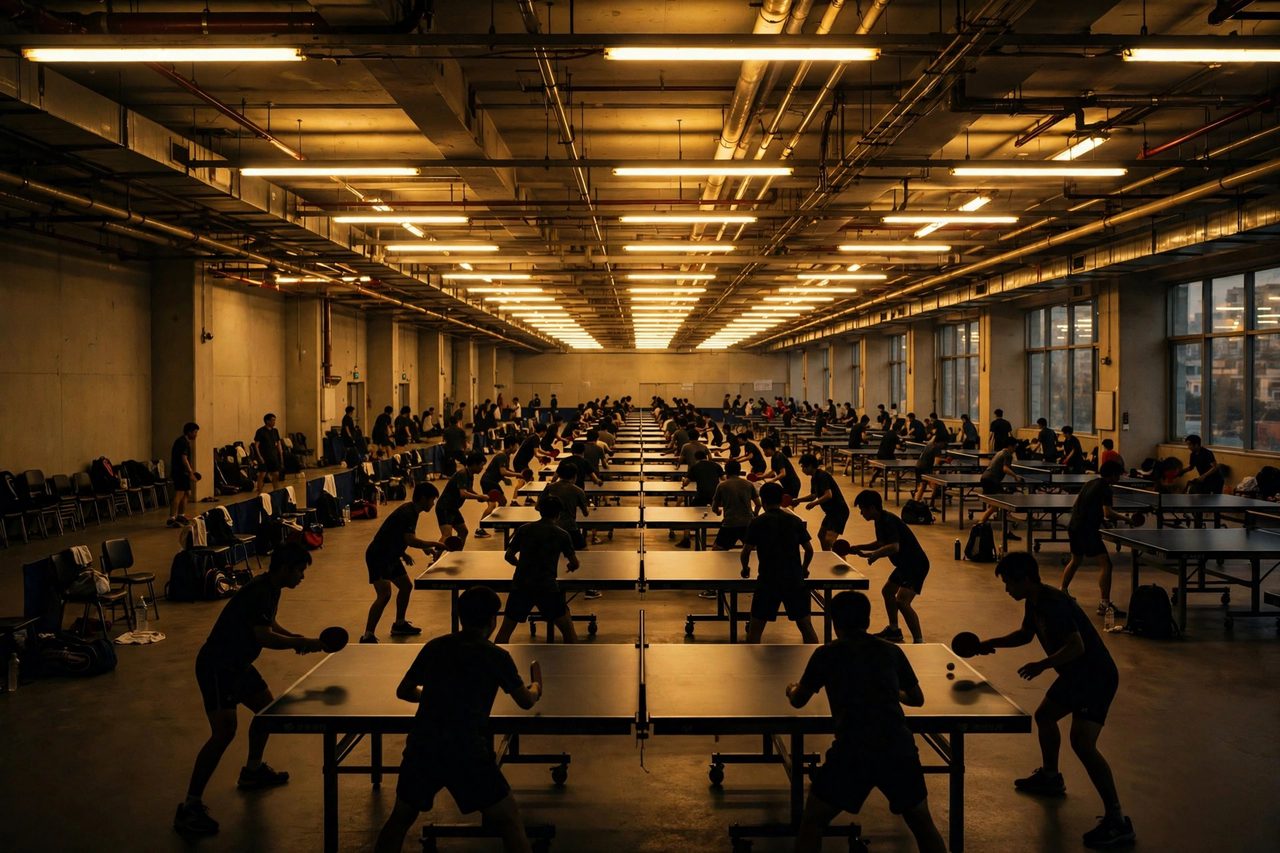
In China, table tennis is not really a sport. It is closer to a national language — spoken in schoolyards, parks, factories and offices, understood by grandparents and toddlers alike. No country on earth is as intertwined with a single game.
The numbers are staggering: hundreds of millions of casual players, tables in virtually every public park, and a professional system that has dominated world table tennis for the better part of half a century. But the culture runs deeper than dominance. It runs to identity.
The first champion
The story starts in 1959, when Rong Guotuan won the men’s singles at the World Championships in Dortmund — the first world title in any sport for the People’s Republic of China. In a young nation hungry for international recognition, a table tennis championship carried enormous symbolic weight. Rong became a national hero, and the sport became a vehicle for national pride.
Tragically, Rong’s story ended in darkness during the Cultural Revolution, and he died in 1968. But his legacy was fixed: he had shown China what winning looked like, and the country never looked back.
Ping-pong diplomacy
Table tennis then did something no sport had done before: it changed geopolitics. In 1971, an American table tennis team’s visit to China — the famous “ping-pong diplomacy” — cracked open the door to US-China relations, paving the way for President Nixon’s historic 1972 visit.
It remains the textbook example of sport as soft power. A small celluloid ball did what years of diplomacy had not: it gave two hostile nations a reason to talk.
The system
What followed was the construction of the most formidable talent machine in sports. The Chinese system identifies promising children early, funnels them into specialized sports schools, and subjects them to training of legendary intensity. The internal competition is famously harder than most international tournaments — Chinese players often say the toughest matches of their careers were against teammates in training.
The result is a dynasty without parallel: decades of Olympic and World Championship dominance, across men’s and women’s events, that no other nation has come close to breaking.
The people’s game
And yet, for all the elite machinery, table tennis in China remains stubbornly democratic. The tables in the parks fill at dawn with retirees playing fierce, laughing matches. Office workers play at lunch. Children learn in school corridors. The gap between the park player and the world champion is vast, but they are playing the same game, with the same gestures, on the same-sized table.
That is the secret of the culture: it belongs to everyone. The national team wins the gold medals, but the nation owns the sport. In China, table tennis is not watched so much as lived — one rally at a time, in a million parks, every single day.
Related articles
The Squash Ball: Why the Ball That Barely Bounces Makes Squash So Hard
A cold squash ball drops like a stone. Warm it up, and it comes alive. Here is the strange science behind the smallest, quietest ball in racquet sports — and the coloured dots that tell you which one to play with.
From Celluloid to Plastic: The Little Ball That Changed Table Tennis
The table tennis ball is smaller than a golf ball and weighs less than a coin — yet it has been changed twice in 25 years, and players still argue about it.
Ping Pong vs Table Tennis: One Sport, Two Names, One Big Argument
Ping pong and table tennis are the same sport, so why do we argue about the name? The answer starts with a trademark from 1901.