
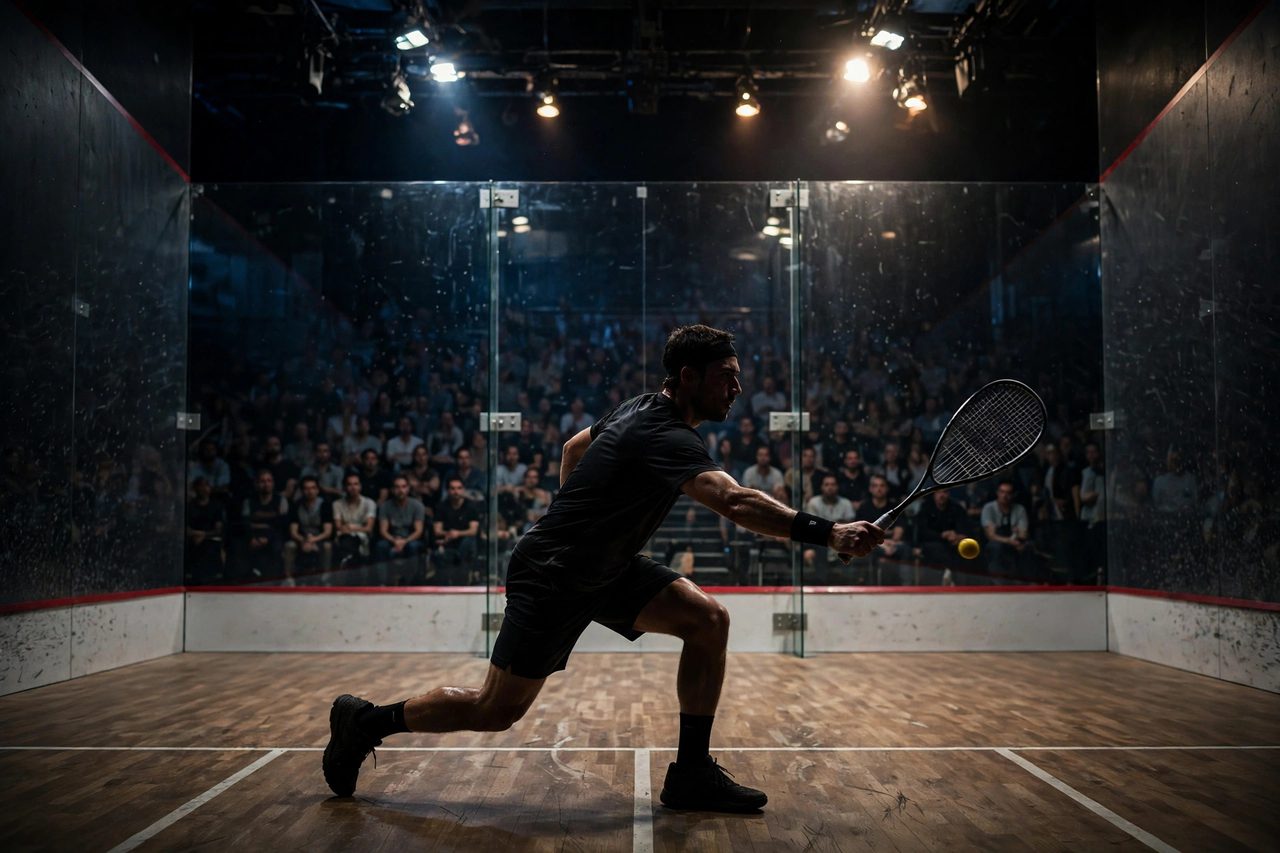
On finals night at the World Championships in Giza this May, the last match of the tournament was, in a sense, a home fixture. An 18-year-old Egyptian, Amina Orfi, beat the great Nour El Sherbini — also Egyptian, holder of eight world titles — in a fifth game that finished 14-12 and ran to 106 minutes, the longest women’s world final of the modern scoring era. Orfi became the youngest women’s world champion in history. In the men’s final, Mostafa Asal, an Egyptian, beat Youssef Ibrahim, an Egyptian, in straight games.
Nobody inside the sport treated this as a surprise. All-Egyptian finals are not an event anymore; they are the default. The interesting question about Egyptian squash is no longer whether it dominates. It is how the machine was built, why it keeps producing champions faster than they retire, and whether the rest of the world has any realistic way of catching up before squash makes its Olympic debut at Los Angeles 2028.
The numbers at the top
Start with the rankings, because they are startling however you slice them. In the PSA list published in mid-2025, five of the men’s top ten were Egyptian: Asal at No. 1, plus Karim Abdel Gawad, Youssef Soliman, Aly Abou Eleinen and Youssef Ibrahim. Two more players in that top ten, the brothers Mohamed and Marwan ElShorbagy, were born and raised in Alexandria and learned the game in Egypt before switching their allegiance to England. On the women’s side the picture was starker still: Nouran Gohar, Nour El Sherbini and Hania El Hammamy held the top three places between them, with the teenage Orfi already fifth.
Nor is this a recent spike. Analysts who track ranking history reckon Egypt’s share of the men’s top ten peaked at around two-thirds in 2021, and the women’s at more than half in 2022. The Egyptian women have won every World Championship since Nicol David’s last title in 2014 — a run of more than a decade. Ali Farag, the elegant Harvard graduate who fronted the men’s game for years, spent well over 200 weeks at world No. 1 in total before retiring in 2025, and his departure barely caused a ripple: Asal simply took the ranking over, and a queue of younger Egyptians formed behind him.
Every dynasty in squash history before this one — the Khans of Pakistan, the Australian waves, the English women — eventually thinned out and ended. Egypt’s keeps renewing itself, and it is younger than it looks. The average age of Egypt’s leading women is in the mid-twenties. The machine is not winding down. It is mid-production.
Older than you think
Egyptian squash did not begin with the current generation, or even with their parents’. The game arrived with the British in the 1930s, Egypt formed a national federation in 1931, and F. D. Amr Bey — an Egyptian diplomat who played with a touch his contemporaries described as magical — won the British Open, then the sport’s supreme title, again and again through the 1930s. For a brief period before the Second World War, the best squash player in the world was already Egyptian.
Then the centre of the sport moved on: to Pakistan and the Khan dynasty, to Australia, to England. Egypt stayed a respectable squash nation rather than a superpower, its big Cairo clubs keeping the game alive through quiet decades. What never disappeared was the infrastructure of affection — courts in the great sporting clubs, fathers and uncles who played, a place in the culture. When the revival came, it did not have to start from zero. It had to start from memory.
That distinction matters. Countries trying to build a squash programme today are planting seeds. Egypt, in the 1990s, was waking a garden that had been tended, on and off, for sixty years.
1999: the year the door opened
The spark has a date. In September 1999, the World Open was staged on a glass court in front of the pyramids at Giza, and a 22-year-old Egyptian named Ahmed Barada — world No. 2 by then, a star at home — reached the final. He lost to Scotland’s Peter Nicol, but more than 5,000 people watched in the desert and the match was shown live on national television. A generation of Egyptian children saw one of their own, under the lights, in front of the monuments, playing for the biggest title in the sport.
Weeks later, Barada and a squad that included Omar El Borolossy and a teenage Amr Shabana won the World Team Championship — Egypt’s first. Omar Mosaad, who became a top-five player himself, later said that watching Barada and the Al-Ahram tournament in Cairo inspired not just him but most of his generation, including Ramy Ashour and Mohamed ElShorbagy. Barada’s own career was cut short soon afterwards, but the door he had pushed open never closed again.
What followed was a golden generation that any country would envy: Shabana, the left-hander of supernatural touch, became Egypt’s first men’s world champion in 2003 and won four world titles; Ashour, all wrist and invention, won three; Karim Darwish reached world No. 1 in 2009. The men broke through first. The women followed about a decade behind, as the rankings data shows — but when they came, they came in even greater numbers.
The club is a way of life
To understand why it keeps happening, forget the professional tour for a moment and go to Zamalek, the leafy island in the Nile where the Gezira Sporting Club has stood since the late 19th century. Gezira has 16 squash courts, and it is not unusual: Cairo and Alexandria are dotted with vast multi-sport clubs — Gezira, Heliopolis, Al Ahly, Sporting — some with memberships running past a hundred thousand people. These are not gyms. They are small cities of sport, with restaurants, pools, gardens and several generations of the same family spending the whole day inside the gates.
That social structure is the real engine of Egyptian squash. A talented child at Gezira or Heliopolis is not dropped off for an hour’s lesson and collected. She grows up at the club. She trains in the morning, eats lunch with her grandparents, watches the senior players on the show court, and trains again. Her parents know the coaches; the coaches knew her older siblings. Squash is not an activity the family supports from outside. It is the water the family swims in.
The second effect is density of competition. Because so many good players live in so few places, an ambitious 13-year-old in Cairo does not need to travel to find a hard match. She walks to the club. There is a domestic tournament somewhere roughly every fortnight, and in daily training she is, as the players themselves put it, up against the best of the best without leaving home. In the lean years of the 1970s and 80s, when numbers were thin, Egyptian juniors simply played against adults to fill the draws — Shabana was playing men’s tournaments at 12 — and that brutal early education became part of the system’s DNA. Nobody in Egyptian squash is protected from losing to better players. They are fed to them, early and often.
An industry of juniors
On top of the old clubs now sits something more deliberate: an academy industry. The biggest operations are run by former champions. Karim Darwish’s academy at Wadi Degla works with around 2,000 players and roughly 100 coaches. Omar El Borolossy’s academy, founded in 2005, is among the largest squash schools in the world. At Black Ball Sporting Club, children are tracked from under-11 to under-19 through graded levels with formal assessments every few months. Corporate money — above all from CIB, the bank that sponsors the tour’s biggest events in Egypt — keeps the whole structure funded.
The scale of demand at the bottom is absurd by world standards. Amir Wagih, the former national coach, has described around 600 children trying to qualify for the Egyptian national championships in the under-11 age group alone. Six hundred under-11s, in one country, chasing places in one draw. From a pool like that, world-class talent is not a hope; it is a statistical certainty.
The results show up first at the British Junior Open, the sport’s most prestigious junior event. Egypt won all eight titles there in 2010, and at the 2024 edition, in Birmingham, Egyptian juniors did something never done before: they won all ten age-group titles, under-11 to under-19, boys and girls, with six of the finals being all-Egyptian affairs. The boys’ under-19 title has been won by an Egyptian every year since 2006. The British Junior Open is, in effect, an Egyptian national championship played abroad — and everyone in the sport knows the senior rankings are just those results, delayed by five years.
Crucially, the champions stay in the loop. Egyptian professionals are contracted to their clubs, and it is written into those contracts that they play with the juniors. A 13-year-old British Junior Open champion from Cairo might practise with the world No. 1 as part of an ordinary week. Most of Egypt’s stars still live and train at home, so the ladder is visible, physical and climbable: the kid on court three can see, touch and occasionally beat the legend on court one. Every other country asks its juniors to chase ghosts on video. Egypt’s juniors chase people they had lunch with.
Teach the basics, then let them fly
There is also a style, and it is not an accident. Egyptian squash is attacking squash: early volleys, holds and flicks, deception at the front, a willingness to go for the nick that coaches elsewhere might drill out of a teenager. Watch Asal’s explosiveness, El Sherbini’s feathered hold, Ashour’s otherworldly wrist work a decade ago — the family resemblance is obvious, and it comes from a coaching culture that behaves differently from the systems it beats.
The formula described by the men who built it — Darwish and Shabana among them — is simple to state and hard to copy: drill the fundamentals relentlessly when the players are young, then deliberately leave them room to improvise. Egyptian juniors train in small, intense groups, constantly playing up against older and better opponents, and the coaching prizes creativity once the basics are grooved. Where many systems produce excellent, predictable athletes, Egypt produces artists with engines. In a sport where rallies are won by the player who can make the ball do something unexpected at full stretch, that difference compounds, match after match, year after year.
It also makes Egyptian players box office, which feeds the loop: sponsors pay for spectacle, television follows the stars, and the next eight-year-old at Heliopolis wants to be the one on the glass court at the pyramids.
Can anyone catch up?
The honest answer, in the short term, is no — and the most telling evidence is the nationality column. When two of the best “English” players in the world are Alexandrians who came through this very system, the machine is not just beating the rest of the world; it is supplying it. Peru’s Diego Elías and New Zealand’s Paul Coll have won the biggest titles as individuals, and America’s Olivia Weaver has broken into the women’s top five, but challengers arrive as lone talents, not as waves. Egypt is the only country that produces them in batches.
There are routes into the gap. The American college system now recruits Egyptian juniors heavily — a pipeline that gives rivals access to Egyptian training habits, but just as often exports Egypt’s advantage. Wealthy federations can buy coaching, build glass courts and centralise their squads; what they cannot easily buy is a hundred-thousand-member club culture, a domestic calendar with a tournament every fortnight, and six-year-olds who treat the world No. 1 as a neighbour. Those things take generations, and Egypt has a two-generation head start.
Los Angeles 2028 will therefore be a fascinating stress test. Squash finally becomes an Olympic sport, with the whole world watching a singles draw that, on current evidence, Egypt could plausibly sweep. The rest of the sport has two years to find an answer — and the machine, of course, is not standing still while they look. Somewhere in Cairo tonight, in a club with a waiting list and a hundred years of history, a hall full of ten-year-olds is finishing training. A few of them will be world champions. In Egypt, that is not a prediction. It is a production schedule.
Related articles
The Squash Ball: Why the Ball That Barely Bounces Makes Squash So Hard
A cold squash ball drops like a stone. Warm it up, and it comes alive. Here is the strange science behind the smallest, quietest ball in racquet sports — and the coloured dots that tell you which one to play with.
From Celluloid to Plastic: The Little Ball That Changed Table Tennis
The table tennis ball is smaller than a golf ball and weighs less than a coin — yet it has been changed twice in 25 years, and players still argue about it.
Ping Pong vs Table Tennis: One Sport, Two Names, One Big Argument
Ping pong and table tennis are the same sport, so why do we argue about the name? The answer starts with a trademark from 1901.