
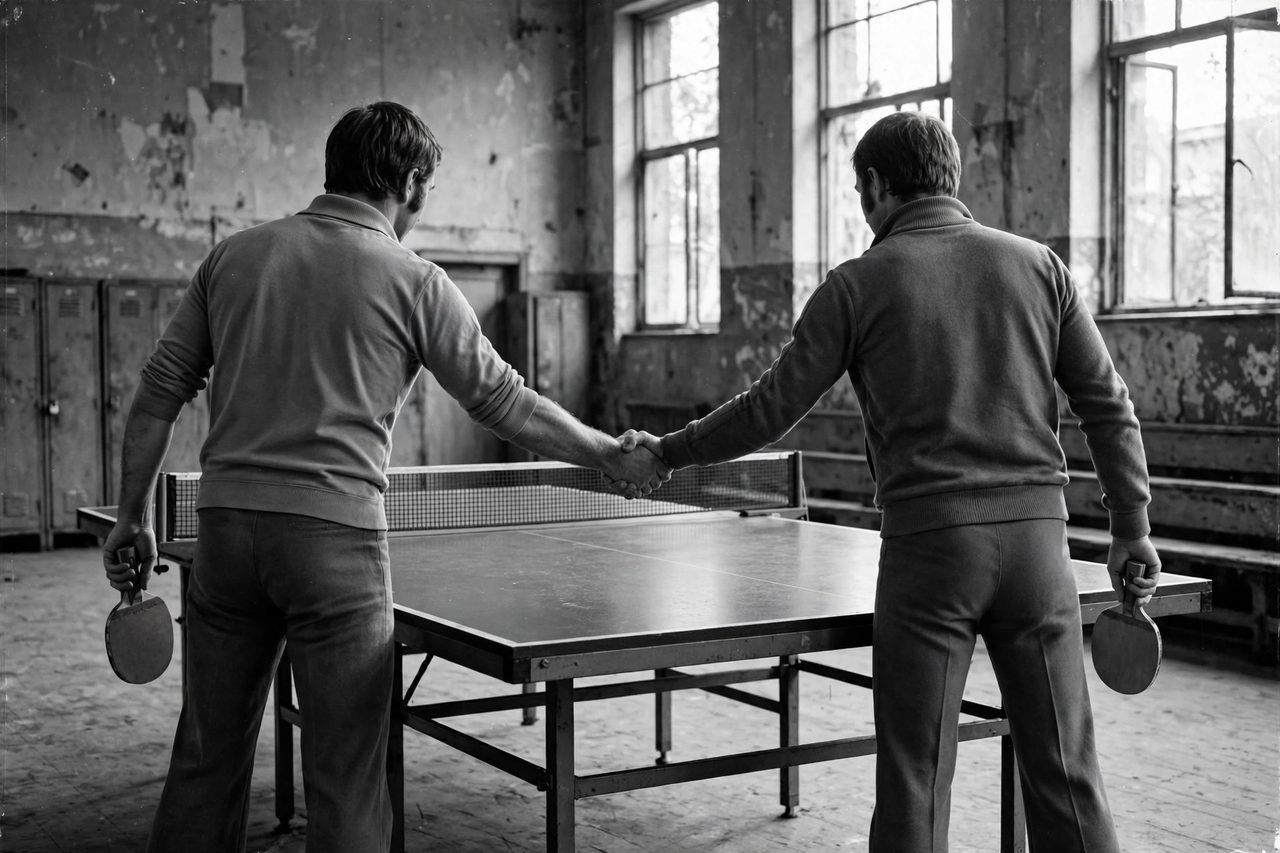
No sport has ever changed the world quite like table tennis did in the spring of 1971. It started with a missed bus — and ended with the President of the United States in Beijing.
Nagoya, April 1971
The 31st World Table Tennis Championships were being held in Nagoya, Japan, from late March to early April 1971. Among the delegations was the American team — not a powerhouse (the US men were ranked around 24th in the world), but present, and notable for one more reason: China and the United States had had no meaningful contact since the Communist victory in 1949. Two decades of Cold War silence.
Nineteen-year-old Glenn Cowan, the American team’s long-haired character, missed the US team bus after a practice session. He flagged down the next bus — which happened to be the Chinese team’s. He climbed aboard to total silence. The Chinese players had strict orders to avoid contact with the Americans.
Then Zhuang Zedong stood up. The three-time world champion walked over to Cowan and, through an interpreter, presented him with a silk-screen portrait of the Huangshan Mountains — a gift of friendship. The next day, Cowan reciprocated with a red, white and blue T-shirt bearing a peace emblem. The international press, already in Nagoya for the championships, reported the exchange immediately.
The invitation
Chairman Mao Zedong read the newspaper accounts and saw an opening. “Zhuang Zedong is not just a good table tennis player,” he reportedly observed. “He’s a good diplomat as well.” With Mao’s approval, the Chinese team extended a formal invitation to the American team to visit China for a friendly exchange.
On April 10, 1971, a 15-strong American delegation — players, officials and spouses — crossed the bridge from Hong Kong into mainland China. They were the first Americans officially welcomed into the country since 1949. What followed was an eight-day tour: exhibition matches and cultural visits in Beijing, Shanghai and Guangzhou, with Western journalists documenting every move.
The symbolism was electric. Here were ordinary young athletes — not diplomats, not generals — doing what governments could not: talking to each other. The US team wasn’t even particularly good at table tennis, and that almost made it better. This wasn’t about sport as competition. It was about sport as a door.
The thaw
The visit detonated diplomatically. Within months, the machinery of rapprochement was moving: in July 1971, President Nixon announced he would visit China, and in February 1972 he did — meeting Mao, touring the country, and issuing the Shanghai Communique that began the normalisation of relations.
Time magazine called it “the ping heard round the world.” Full diplomatic normalisation would take until 1979, but the trajectory was set the moment a table tennis team crossed a bridge from Hong Kong.
The exchange didn’t end with the Americans’ visit, either. In April 1972 the Chinese team made the return trip: a two-week tour of the United States, playing exhibition matches before curious American crowds, including a stop at Stanford University’s Maples Pavilion. The symmetry was the point — sport as a two-way street, each side hosting the other, each crowd applauding players it had been taught to see as enemies.
Why it worked
Ping-pong diplomacy worked for reasons that still matter. Table tennis was China’s national game — the one arena where the country felt confident, proud and in control — which made the invitation a gesture of strength rather than concession. The players were young, unthreatening and visibly human. And the whole thing was, at its origin, an accident: a missed bus, a generous champion, a gift. No committee could have planned it, which is precisely why both publics believed it.
The legacy
The phrase “ping-pong diplomacy” entered the language as shorthand for sport’s power to do what politics cannot. Every subsequent sporting thaw — from cricket between India and Pakistan to the joint Korean marches at the Olympics — gets measured against Nagoya.
And it remains table tennis’s proudest claim: the only sport that can say it opened a country. The ball is small. The table is smaller. But in April 1971, they were big enough to move the world.
Related articles
The Squash Ball: Why the Ball That Barely Bounces Makes Squash So Hard
A cold squash ball drops like a stone. Warm it up, and it comes alive. Here is the strange science behind the smallest, quietest ball in racquet sports — and the coloured dots that tell you which one to play with.
From Celluloid to Plastic: The Little Ball That Changed Table Tennis
The table tennis ball is smaller than a golf ball and weighs less than a coin — yet it has been changed twice in 25 years, and players still argue about it.
Ping Pong vs Table Tennis: One Sport, Two Names, One Big Argument
Ping pong and table tennis are the same sport, so why do we argue about the name? The answer starts with a trademark from 1901.