
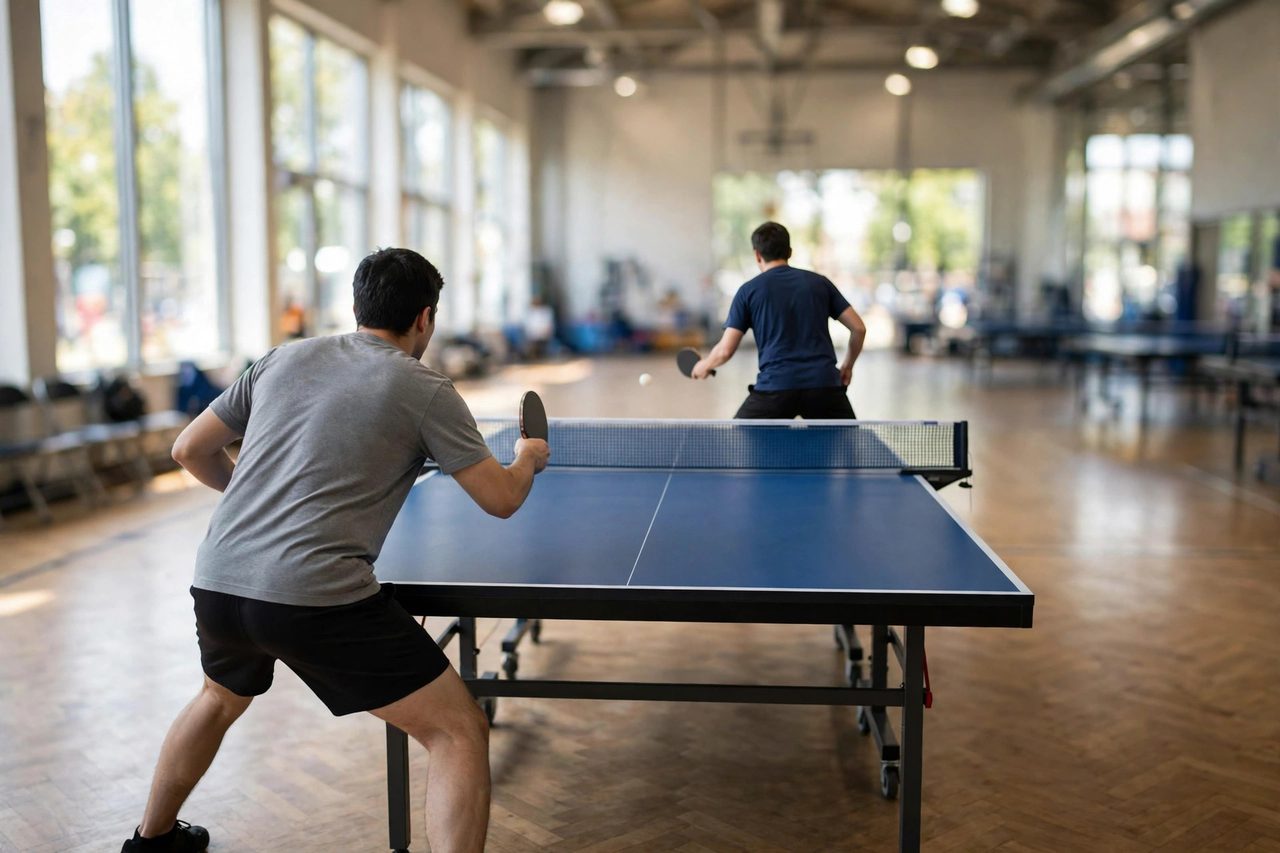
Say “ping pong” in a room full of table tennis players and watch what happens. Some people smile. Some people roll their eyes. A few will correct you.
It is one of the oldest arguments in racquet sports. And it is strange, because both sides are talking about the exact same game: a small ball, a table, two paddles, and a net in the middle.
So why does one sport have two names? The answer starts in Victorian England, passes through a trademark, and ends with a moment that changed world history.
It started as a game after dinner
Table tennis began in England in the 1880s. Rich families played it after dinner, using whatever was lying around the house. Books became the net. A cigar box lid or a book became the paddle. The ball was often a champagne cork.
It was indoor lawn tennis, for people who wanted to play without going outside. It was quick, noisy, and easy to pick up — and it still is.
Back then, nobody agreed on what to call it. Different companies sold their own versions of the game, each with its own name. There was Gossima. There was Whiff-Waff. There was Indoor Tennis. And there was Ping Pong.
The name came from the sound
“Ping pong” is a sound word. It copies the noise the ball makes: a sharp ping off the paddle, a softer pong off the table.
The name stuck because it was fun to say. In 1901, the English games company J. Jaques & Son trademarked the name “Ping-Pong” and sold sets under that brand. They later licensed it to Parker Brothers in the United States, the company behind Monopoly.
“Ping pong” was not just a nickname. It was a brand name, owned by a company.
In 1901, two rival groups formed in England: the Table Tennis Association and the Ping Pong Association. They merged in 1903, but the name problem stayed. If a tournament used the name “Ping Pong,” the company could demand that only its equipment be used — or threaten legal action.
Table tennis became the official name
As the sport grew, it needed a name that nobody owned. “Table tennis” was the obvious choice. It was simple, it described the game, and no company could claim it.
In 1926, the International Table Tennis Federation (the ITTF) was founded in Berlin, and the first World Championships were held in London the same year. The ITTF is the sport’s world governing body. It is the organisation that sets the rules and runs the biggest events. From that point on, the official name of the sport was table tennis.
That is why the Olympics call it table tennis. The sport joined the Olympic programme at Seoul in 1988.
So why does “ping pong” refuse to die?
Because a good name is hard to kill. “Ping pong” is short, playful, and easy to say in almost any language. It sounds like a game. “Table tennis” sounds like a sport with rules and a dress code.
In the United States especially, “ping pong” stayed popular. The Parker Brothers sets were everywhere, and generations of families grew up calling the table in the basement the ping pong table.
The split is also about feeling. Say “ping pong” and people picture a basement, a garage, or a youth club. It feels casual and fun. Say “table tennis” and people picture a serious match, a fast rally, and a player who trains every day. A rally is a run of shots back and forth across the net. In a pro match, a rally can last for dozens of shots, with the ball flying at over 100 kilometres per hour.
That gap in feeling is why some players get annoyed. They train hard, and they want the sport to be taken seriously. When someone says “ping pong,” they hear a joke. When someone says “table tennis,” they hear respect.
The name that changed the world
But “ping pong” has one story that table tennis can never match. In 1971, at the World Championships in Nagoya, Japan, an American player named Glenn Cowan missed his team bus and got on the Chinese team’s bus by mistake. The Chinese star Zhuang Zedong shook his hand and gave him a gift. Two days later, China invited the whole American team to visit.
Nine American players crossed into China in April 1971. They were the first group of Americans to visit the country in decades. The trip helped open the door between the United States and China, and it led to President Richard Nixon’s historic visit to China the next year.
History calls it “ping-pong diplomacy.” Not “table-tennis diplomacy.” The fun name got the job done.
Can both names live together?
Here is the honest answer: yes. They already do.
“Table tennis” is the official name. It is what the ITTF, the Olympics, and the world championships use. If you follow the sport seriously, that is the name you will see.
“Ping pong” is the people’s name. It is what you say when you invite a friend to play. It is what the game is called in films, in bars, and in basements around the world. Nobody is confused about what you mean.
The argument is really about identity. Some players want the sport to sound serious. Some want it to sound fun. The truth is that it is both. Table tennis is a sport where the ball spins so fast that the pros need years of practice to read it. Spin is what happens when the ball rotates in the air, curving and bouncing in strange directions. And it is also a game you can learn in five minutes with a friend.
So call it what you like. Just know the story behind the name you choose.
Sources: ITTF history of table tennis (ittf.com); NBC Sports on the ping-pong name; U.S. National Museum of American Diplomacy on ping-pong diplomacy.
Related articles
The Squash Ball: Why the Ball That Barely Bounces Makes Squash So Hard
A cold squash ball drops like a stone. Warm it up, and it comes alive. Here is the strange science behind the smallest, quietest ball in racquet sports — and the coloured dots that tell you which one to play with.
From Celluloid to Plastic: The Little Ball That Changed Table Tennis
The table tennis ball is smaller than a golf ball and weighs less than a coin — yet it has been changed twice in 25 years, and players still argue about it.
The Glass Court Revolution: How Squash Became a Show
Squash used to hide behind club walls where almost nobody could watch it. Then came the all-glass court, and suddenly the sport moved into train stations, shopping malls and famous landmarks — and everyone could see it.