
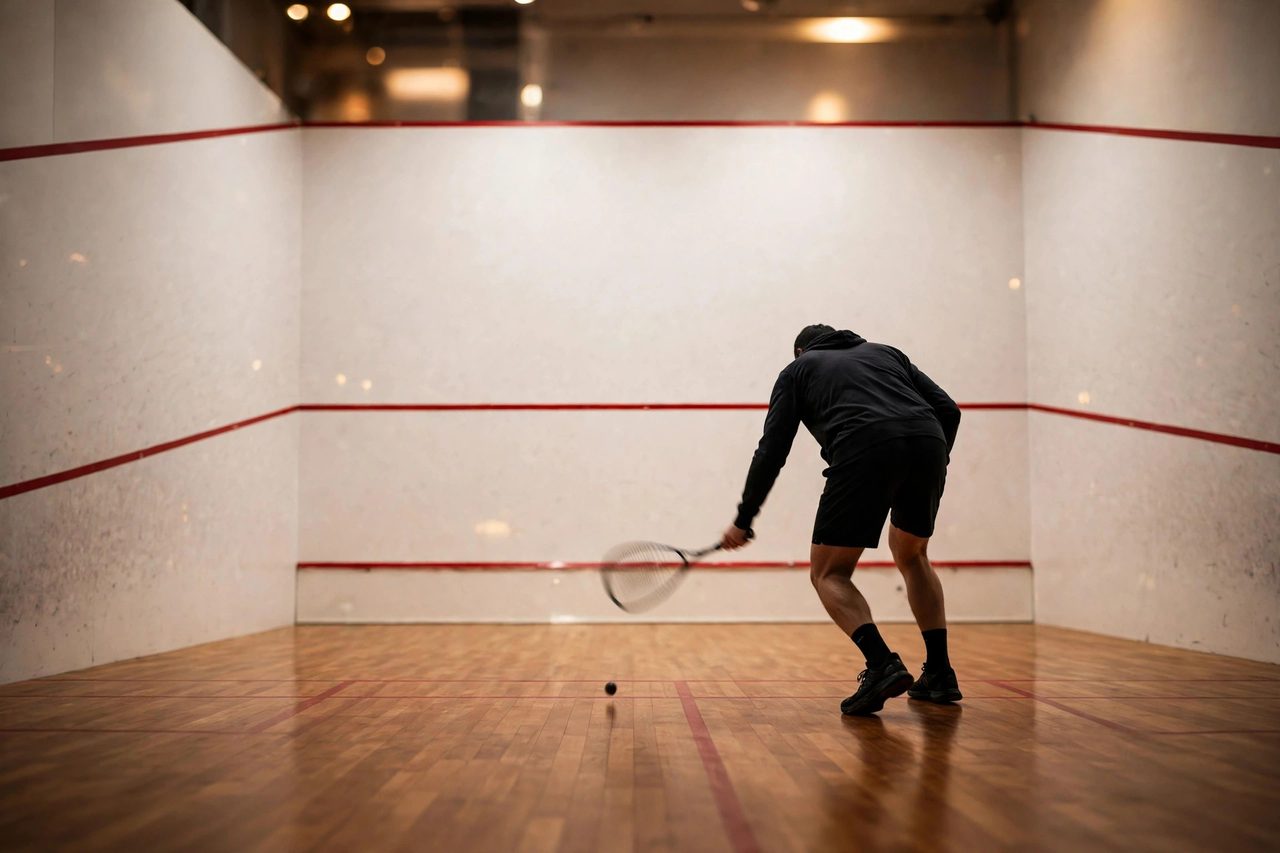
Pick up a squash ball for the first time and something feels wrong. It is small, black, and soft. Drop it on the floor and it barely bounces. It just lands with a dull little thud and rolls away.
That cannot be right, you think. Every other ball bounces. A squash ball seems broken.
It is not broken. That dead little bounce is the whole point of squash — and it is what makes the game so hard, so fast, and so addictive once you understand it.
A ball that needs warming up
A squash ball is a small hollow ball made of rubber, about 40 millimetres across — roughly the size of a golf ball. Unlike a tennis ball, it has almost no bounce when it is cold. The rubber is stiff, and the air trapped inside it is cool and low in pressure. Hit a cold ball and most of the energy just disappears into the rubber. The ball dies on the floor.
Warm it up, though, and everything changes. A few minutes of hitting it hard against the wall does two things. The repeated impacts create friction, and friction makes heat. That heat warms the air inside the ball, which pushes outward like a tiny over-inflated tyre. At the same time, the warm rubber gets softer and springier. The ball starts to bounce properly.
This is why every squash match starts the same way. Before the first point, both players spend a few minutes hitting the ball up and down the court, warming it up — and warming themselves up too. Skip that step and you cannot have a rally. A rally is a run of shots back and forth between two players, and a cold ball kills a rally after two or three shots. Even during a match, the ball keeps cooling down, so pros keep it moving and hit it hard, never letting it rest for long.
The coloured dots: a code for how fast the ball plays
Look closely at a squash ball and you will see one or two small coloured dots on it. Those dots are a code. They tell you how fast and how bouncy the ball is — and who it is made for. The rule surprises most beginners: the faster the ball, the easier it is to play with. The slower the ball, the harder the game gets.
From fastest to slowest, the dots run like this:
Blue dot — fastest, highest bounce. This is the beginner’s ball. It is bigger than the others and bounces the most, so rallies last longer and you get more time to reach the ball. If you are just starting out, this is your ball.
Red dot — fast, high bounce. A step up. It bounces a little less than the blue ball, so you need better timing and more control.
Green dot — medium speed, medium bounce. The middle of the range, for regular club players.
Single yellow dot — slow, low bounce. Now things get serious. This ball was the official ball of professional squash until 2001. It bounces less, so you have to hit it harder and move faster to keep the rally going. It is also the ball to reach for on a hot court, where a faster ball would bounce too much.
Double yellow dot — slowest, lowest bounce. This is the pro ball. Since 2001, the World Squash Federation has made it the official ball for professional tournaments. It barely bounces unless it is warm and being hit hard. That is the point: at the top level, players are so fast and so strong that a bouncier ball would fly around the court out of control. The double yellow dot keeps the game in check — and makes it brutally hard.
So when a beginner picks up a double yellow dot ball and wonders why the game feels impossible, the answer is simple: they are playing with the hardest ball in the sport. Start with blue, work your way down, and the game opens up.
Why a dead ball makes a great game
Squash is played in a small enclosed court, with four walls and two players sharing the same space. If the ball bounced like a tennis ball, it would never stop. Instead, the ball’s low bounce puts a clock on every rally. A drop shot is a soft shot that dies low on the front wall and drops to the floor, and it only works because the ball barely bounces. A boast is a shot that hits a side wall first and then the front wall, and it only works because the ball stays low and tight.
That is also why squash is such a workout. The ball does not come to you. You have to go and get it, every single time, before it dies on the floor. There is no standing around waiting for a big bounce. Miss by a step and the point is gone.
The fastest shot in racquet sports
For all its softness, the squash ball can move. The fastest recorded squash shot was hit by Australian player Cameron Pilley in 2014, measured at 176 miles per hour — faster than the fastest serves in tennis. The ball is small and dark, and at that speed it is almost invisible, which is another reason the pros need a slow ball.
So the ball that barely bounces is not a flaw in the design. It is the design. It sets the speed of the game, rewards players who move well and think fast, and punishes anyone who stands still.
Next time you step on a squash court, take a moment before you start. Hold the ball in your hand. Then hit it against the wall, again and again, and feel it wake up. Five minutes later, that dead little ball will be bouncing, flying, and demanding everything you have got. That is squash: a game built around a ball that refuses to bounce until you earn it.
Related articles
From Celluloid to Plastic: The Little Ball That Changed Table Tennis
The table tennis ball is smaller than a golf ball and weighs less than a coin — yet it has been changed twice in 25 years, and players still argue about it.
Ping Pong vs Table Tennis: One Sport, Two Names, One Big Argument
Ping pong and table tennis are the same sport, so why do we argue about the name? The answer starts with a trademark from 1901.
The Glass Court Revolution: How Squash Became a Show
Squash used to hide behind club walls where almost nobody could watch it. Then came the all-glass court, and suddenly the sport moved into train stations, shopping malls and famous landmarks — and everyone could see it.