
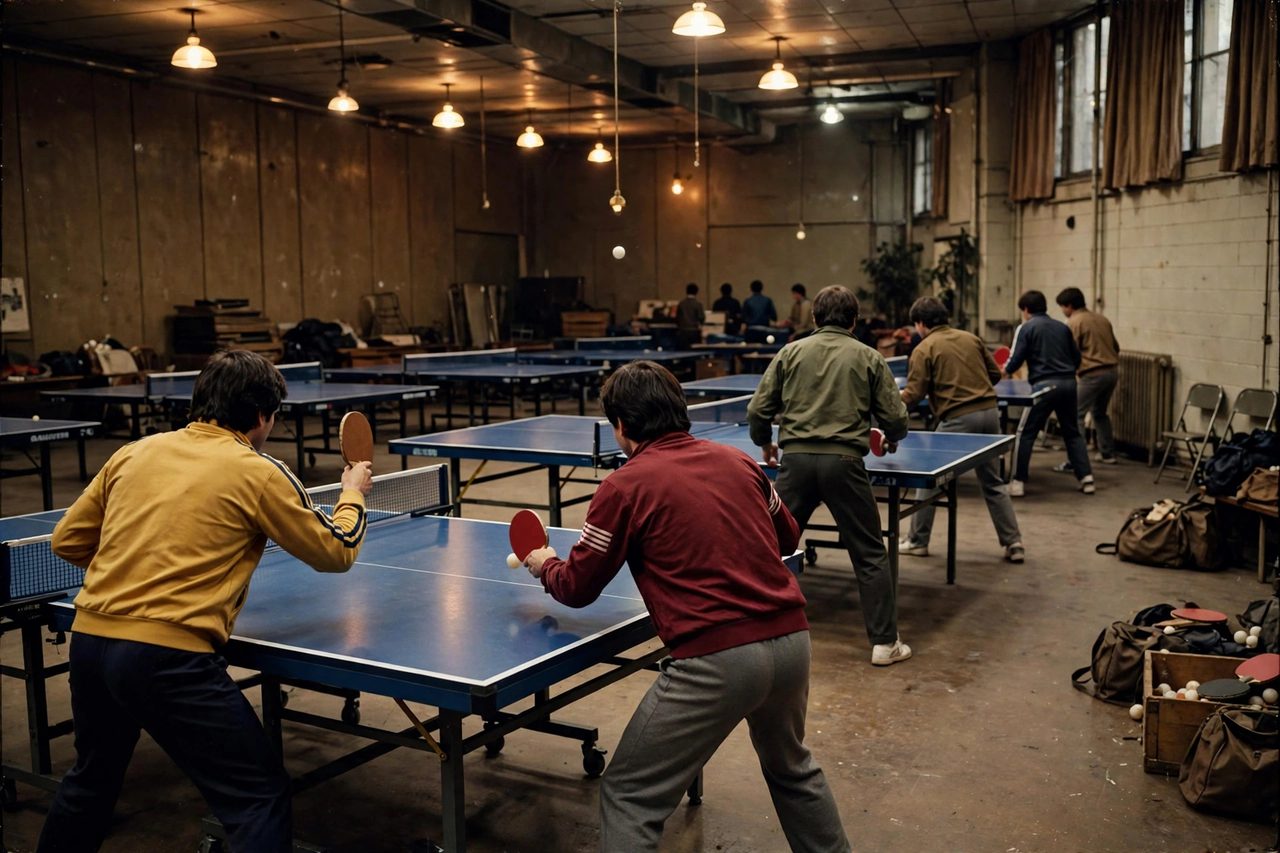
In the late 1980s, the most feared team in world table tennis was not Chinese. It was Swedish — five players from a country of eight million people, playing a game the rest of the world had long since conceded to Asia. Between 1989 and 2000, Sweden won four World Team titles, produced three different men’s singles world champions, and reached every World Team final from 1983 to 1995. It was the greatest upset in the sport’s history, sustained for a decade. And it started, of all places, in Dortmund.
Dortmund, 1989: the 5-0
The 1989 World Championships in Dortmund, West Germany, staged the final that changed everything. Sweden — Mikael Appelgren, Peter Karlsson, Erik Lindh, Jörgen Persson and Jan-Ove Waldner — met China in the Swaythling Cup final and beat them 5-0. Not 5-4, not 5-3. Five-nil, against the country that had owned the sport for a generation.
The final had its own drama: in the fourth match, China’s Jiang Jialiang refused to continue against Waldner after being called for a service foul, and was booed for the remainder of the match after play resumed. But the scoreline was no fluke. Sweden had been building toward this for six years, reaching the team final in every edition since 1983. Dortmund was not an accident. It was an arrival.
Waldner completed the double in Dortmund, beating Persson in the men’s singles final — an all-Swedish final, the first all-European men’s singles final since 1953. The golden age had its coronation, and its king.
The players
What made Sweden extraordinary was not one genius but a generation. Waldner, the Mozart of the sport, played with a touch and imagination that made the impossible look casual; he would go on to win the singles world title again in 1997 and Olympic gold in 1992, and to remain in the world top ten for an astonishing 18 consecutive years. Persson, the 1991 singles world champion, was the power and the heartbeat — a relentless attacker whose forehand could end rallies from anywhere. Appelgren, the elegant left-hander, was the stylist, a European champion and the team’s elder craftsman.
Behind them stood Lindh and Karlsson, world-class players in their own right, and a system that produced them all. Sweden’s secret was not a single academy or a single coach. It was depth: at one point, Appelgren noted, Sweden had five or six players in the world top ten simultaneously. Club table tennis in Sweden was fiercely competitive — lose to a fellow Swede and, as Waldner later put it, you never heard the end of it. That internal murder, as the players called it, forged a team that feared no one.
The decade
Dortmund was the beginning, not the peak. Sweden defended the team title in 1991 and 1993, with Persson winning the singles title in 1991 — beating Waldner in the final — and the team reaching every final through 1995. From 1989 to 2000, Sweden collected some thirty championship medals. And then, in 2000, came the last stand.
By then Waldner and Persson were nearing the end of their careers, and everyone in Sweden knew it. The 2000 World Team final, again against China, was shown live on Swedish television and became one of the biggest news stories in the country that day. Sweden won. It was the fourth team title, the final triumph of the golden generation, and the players knew as they celebrated that it would likely be the last time they beat China. They were right.
Why it ended — and why it matters
The golden age ended the way golden ages do: the great players aged, and the system that produced them could not replace them fast enough. Waldner himself won the Swedish closed championship for a ninth time in 2010, at an age when he should long since have been a spectator — a testament to his genius, and an indictment of what came after. The younger Swedes — Mattias and Kristian Karlsson, Anthony Tran, Hampus Söderlund — were talented, but they were not Waldner and Persson, and nobody is.
But the golden age matters beyond nostalgia. It proved something the sport had stopped believing: that China could be beaten, not by luck but by system, by depth, and by a style of play — creative, attacking, fearless — that was distinctly European. Every non-Chinese team since, from Germany’s Timo Boll generation to the French Lebrun brothers and Japan’s Harimoto era, walks a path Sweden cleared. The Dortmund 5-0 did not just win a title. It broke a spell.
Today, Swedish table tennis lives in the long shadow of its golden age — in the clubs where old men still talk about Dortmund, in the DONIC blades named for Waldner, Persson and Appelgren, in the highlight reels of a genius who made the sport look like art. The generation is gone. The proof remains: a small country, a basement game, and ten years when the world belonged to Sweden.
Related articles
The Squash Ball: Why the Ball That Barely Bounces Makes Squash So Hard
A cold squash ball drops like a stone. Warm it up, and it comes alive. Here is the strange science behind the smallest, quietest ball in racquet sports — and the coloured dots that tell you which one to play with.
From Celluloid to Plastic: The Little Ball That Changed Table Tennis
The table tennis ball is smaller than a golf ball and weighs less than a coin — yet it has been changed twice in 25 years, and players still argue about it.
Ping Pong vs Table Tennis: One Sport, Two Names, One Big Argument
Ping pong and table tennis are the same sport, so why do we argue about the name? The answer starts with a trademark from 1901.