
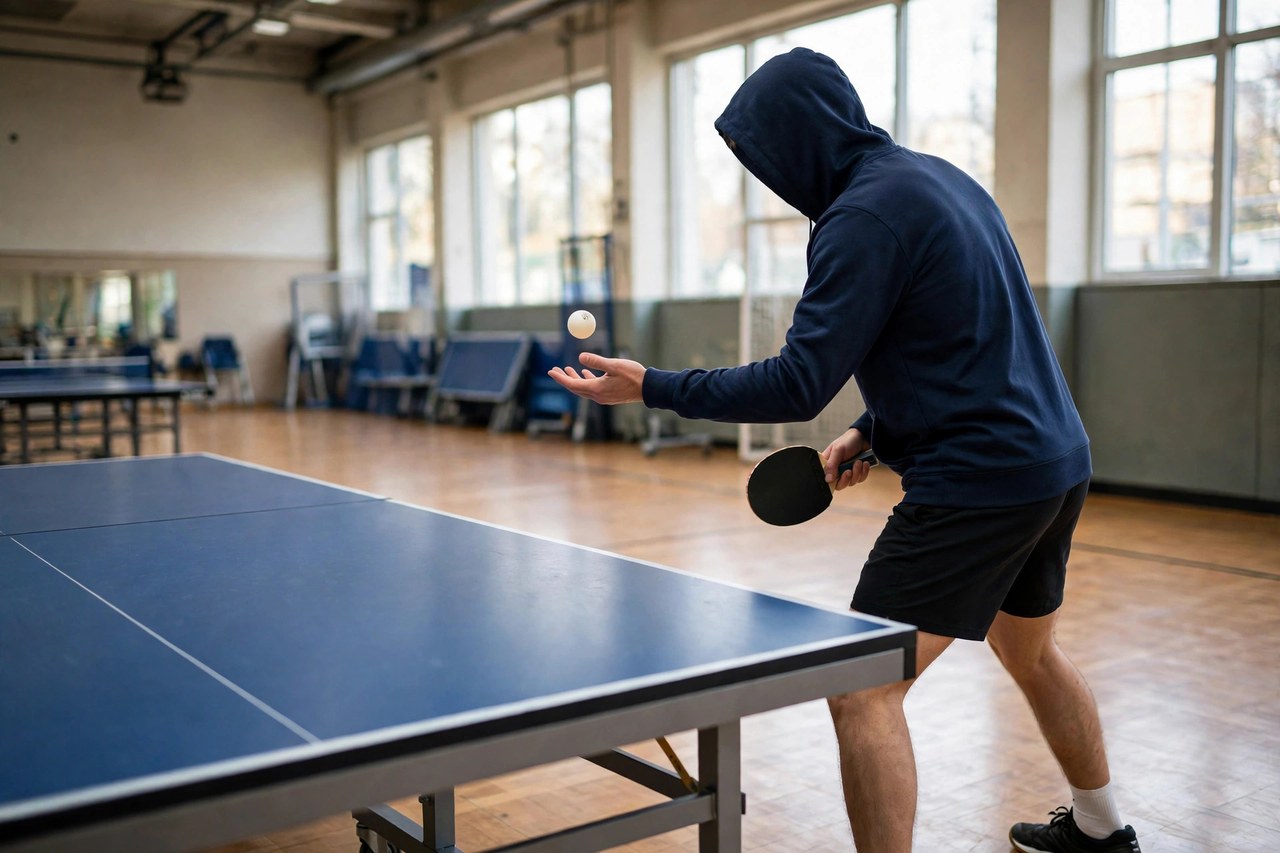
The smallest ball in racquet sports has caused some of the biggest arguments. It is 40 millimetres across — about the size of a bottle cap — and it weighs 2.7 grams, less than a sheet of paper. Pick it up and it feels like almost nothing. But change that little ball, and you change the whole game.
Table tennis has done exactly that, twice in 25 years. First the ball grew bigger. Then it changed material completely. Each time, the game got slower, the rallies got longer, and players argued about it.
This is the story of a ball that started as a toy, became a fire hazard, and ended up as a piece of high-tech plastic — and why players still cannot agree on it today.
The celluloid years: a toy ball with a famous sound
Table tennis began in England in the 1880s as an after-dinner game. Early players hit whatever they had: champagne corks, rubber balls, even balls of string. None of them bounced well enough for a proper game.
Then, around 1901, an Englishman named James Gibb came home from a trip to the United States with a box of small celluloid toy balls. Celluloid was one of the first plastics ever made. It was light, it bounced true, and it made a sharp little noise off the paddle. That noise gave the game one of its names: ping pong.
The celluloid ball became the standard. For almost a century, the official ball was 38 millimetres across and weighed 2.5 grams, and players built their whole game around it.
Spin is what happens when the ball rotates in the air. A spinning ball curves, dips, and bounces in strange directions. With a small, light celluloid ball, the best players could put a wild amount of spin on it. A rally is a run of shots back and forth across the net. But in the 1990s, rallies were getting shorter, not longer. The ball flew so fast that points were over in a blink, and fans watching on television could barely follow it.
There was another problem, too. Celluloid is highly flammable: it catches fire easily and burns fast. It was the same material used to make early cinema film, and warehouses full of celluloid balls were a fire risk. Shipping them by air got harder and more expensive, and fewer and fewer factories wanted to make them.
2000: the ball grows up
After the Sydney Olympics in 2000, the ITTF — the sport’s world governing body — made its first big change to the ball in a hundred years. On 1 October 2000, the official ball grew from 38 millimetres to 40 millimetres, and its weight went up from 2.5 to 2.7 grams.
Two millimetres does not sound like much. But a bigger ball moves through the air more slowly, and it takes less spin. The ITTF wanted longer rallies and a game that was easier to watch. Sydney was the last big event played with the old 38-millimetre ball.
Rallies got a little longer, and the ball was easier to see on television. But some players complained that the game had lost some of its speed and sting. The argument had begun.
2014: goodbye celluloid, hello plastic
The bigger problem was still the material. Celluloid was dangerous to store and ship, and the factories that made it were disappearing. The ITTF decided in 2011 to look for a replacement, and in 2012 it agreed: from 1 July 2014, every official ITTF event would use balls made of plastic, not celluloid.
The new balls were made from a tough plastic called ABS. They were marked “40+” because they could be a fraction bigger than the old 40-millimetre celluloid balls — up to 40.6 millimetres. The 2015 World Championships in Suzhou were the first Worlds played with the plastic ball.
Players noticed the difference straight away. The plastic ball spins less and flies a little slower than the celluloid ball did. It bounces slightly differently, and it makes a different sound — a harder, higher click instead of the old soft ping. Rallies got longer again, which suited players who liked to defend and build points slowly. A loop is an attacking shot where the player brushes up the back of the ball to load it with topspin. Loop players — the attackers who win points with heavy topspin — felt the change the most, because their biggest weapon had got weaker.
Why players still argue about it
More than ten years later, the debate has not gone away. Players who learned the game with a celluloid ball often say the old ball was better: faster, spinnier, more alive. Younger players shrug — the plastic ball is the only ball they have ever known.
The arguments are not just about feeling. Early plastic balls had a reputation for breaking easily and bouncing inconsistently. Quality has improved a lot since 2014, but players still argue about which brand is best, and tournaments still get complaints when a batch feels wrong.
There is a real trade-off at the heart of it. A slower ball with less spin means longer rallies, and longer rallies are easier and more fun to watch. But it also means the game rewards patience more than raw attacking power, and some of the sport’s wildest shots have got tamer.
In 2023, the ITTF quietly closed the book on the old era: the rules no longer mention celluloid at all. The official ball is now, simply, a ball made of plastic.
So the next time you pick up a table tennis ball, give it a second look. It weighs less than a coin, it is smaller than a golf ball, and millions of people have argued over it. It started life as a toy, survived as a fire hazard, and became a piece of sports science. And somewhere, a player is still convinced the old one was better.
Sources: ITTF history of the ball and rule changes; PingSkills on the history of table tennis; All About Table Tennis on the 38mm to 40mm and celluloid to plastic changes.
Related articles
The Squash Ball: Why the Ball That Barely Bounces Makes Squash So Hard
A cold squash ball drops like a stone. Warm it up, and it comes alive. Here is the strange science behind the smallest, quietest ball in racquet sports — and the coloured dots that tell you which one to play with.
Ping Pong vs Table Tennis: One Sport, Two Names, One Big Argument
Ping pong and table tennis are the same sport, so why do we argue about the name? The answer starts with a trademark from 1901.
The Glass Court Revolution: How Squash Became a Show
Squash used to hide behind club walls where almost nobody could watch it. Then came the all-glass court, and suddenly the sport moved into train stations, shopping malls and famous landmarks — and everyone could see it.