
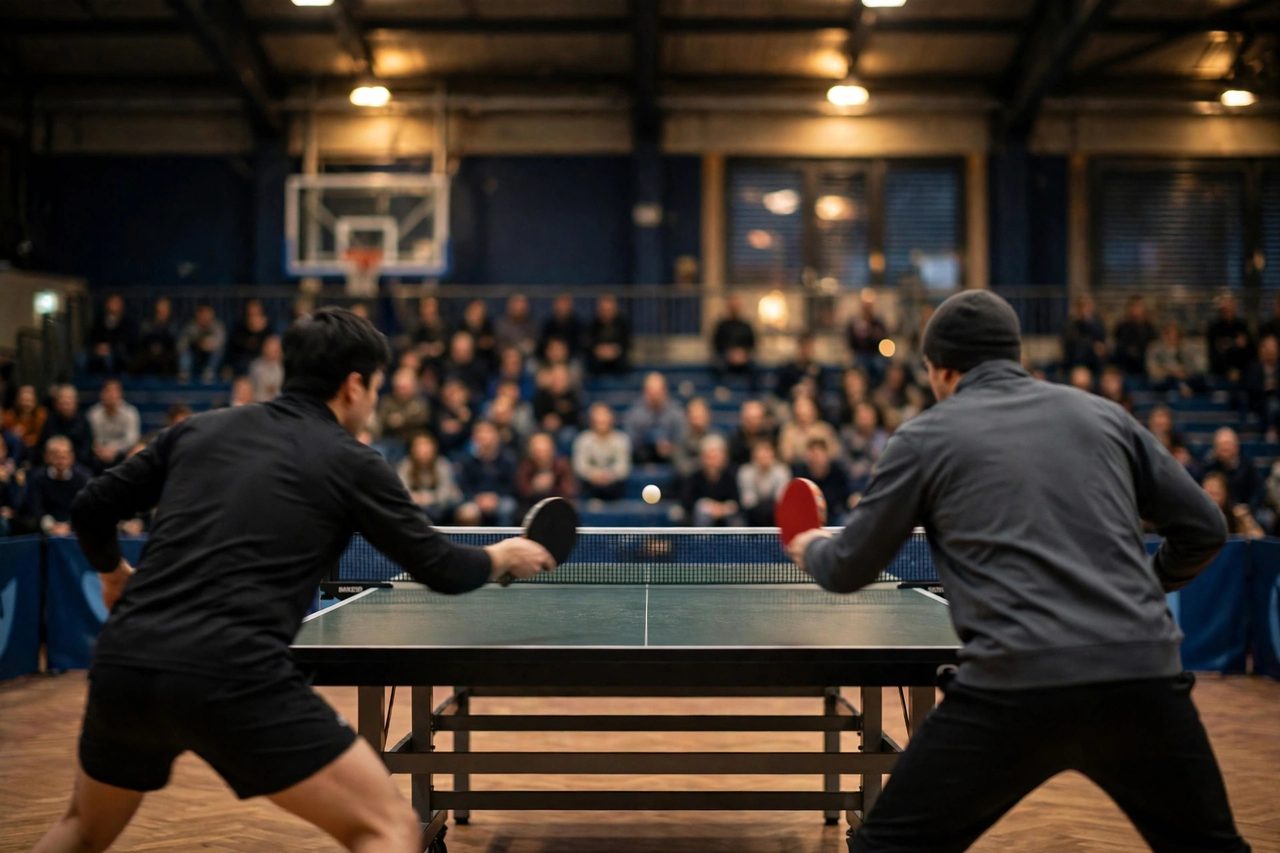
In Germany, football gets the crowds, the money and the headlines. But if you want to see the best club table tennis outside Asia, you go to Germany too. The Table Tennis Bundesliga, known as the TTBL, is the strongest league in Europe, and club managers themselves call it the strongest league in the world outside China. Here is how a sport that lives in football’s shadow built something so good.
A league with deep roots
The Bundesliga began in 1966, when German table tennis moved from regional competitions to a single national league. A “league” here means a season-long competition where clubs play each other home and away, and the best teams at the end reach the play-offs for the title.
From the start, the league was built on clubs, not franchises. German sports clubs are community institutions, often with hundreds or thousands of members across many sports. Table tennis departments grew inside them, with their own halls, coaches and youth teams. That structure turned out to be a huge advantage. It meant the league was rooted in towns and cities, not dependent on one sponsor or one rich owner.
Today the TTBL has 12 teams, from Düsseldorf to Saarbrücken, Bremen to Ochsenhausen. They play a regular season, then play-offs, with the final held at a neutral venue in front of a big crowd.
Borussia Düsseldorf: the standard-setter
Every great league needs a great club, and the TTBL has Borussia Düsseldorf. Founded as an independent table tennis club in 1984, Borussia has won the German championship 34 times — more than any other club by a distance — along with 28 German Cups and three European Champions League titles.
Borussia was also a pioneer off the table. It was the first German table tennis club to employ a professional manager and a professional coach, treating the sport as a serious business decades before others did. Since 2006, its home, the ARAG CenterCourt, has also housed Germany’s national table tennis centre, where the national teams train and young players board full-time. The club’s youth work is famous: its “Kids Open” event, started in 1988, now draws children from around the world.
The club’s dominance has a famous face. Timo Boll, Germany’s greatest ever player, joined Borussia in 2007 and stayed for the rest of his career, winning title after title. His farewell tour last season helped the league set new spectator and reach records. Boll’s retirement was a moment for the whole sport, not just one club.
Why the world’s best come to Germany
The secret of the TTBL is simple: it pays well, it is organised professionally, and it is competitive from top to bottom. That combination pulls in stars from all over the world.
Swedish legend Jan-Ove Waldner played in Germany. So did Belarus great Vladimir Samsonov. In recent seasons, the league has featured Brazil’s Hugo Calderano, one of the best players on the planet, France’s Simon Gauzy, Slovenia’s Darko Jorgic, and a rotating cast of top Asian and European talent. Chinese superstar Fan Zhendong has also played Bundesliga table tennis.
Why Germany and not somewhere else? Because the league offers what players want: a proper salary, good training conditions, strong opponents every week, and a professional setup with managers, physios and video analysis. A young player who wants to improve fast can hardly do better than a season in the TTBL, playing against world-class opponents every single week.
Club managers say it plainly. Werder Bremen’s Sascha Greber has called the TTBL “by far the strongest league in the world.” Borussia’s Andreas Preuß points to the international strength: German national players ranked in the world’s top 20, plus stars like Fan Zhendong, all in one league.
The challengers
Borussia’s dominance is real, but the league is not a one-team show. TTF Liebherr Ochsenhausen, the 2025 champions, have won five German titles and five cups, plus two European trophies. 1. FC Saarbrücken, with stars like Jorgic and Patrick Franziska, won the Champions League in 2023. TTC Schwalbe Bergneustadt, Werder Bremen, TSV Bad Königshofen and the rest all carry international players and can beat anyone on a good night.
That depth is what makes the league strong. In a weak league, only one or two matches a season matter. In the TTBL, nearly every match is a test, because nearly every team has a player who can beat a world top-20 opponent.
The halls, the fans, the atmosphere
TTBL matches are not quiet affairs. The league’s halls have nicknames and personalities. Düsseldorf’s CenterCourt is the sport’s German cathedral. Ochsenhausen’s hall is known as a “Hexenkessel” — a witch’s cauldron — for its noise and heat. Fans sit close to the action, close enough to hear every grunt and see every flick of the wrist.
The league has worked hard on its presentation too: live streams, highlights, and a match format built for television, with team matches decided over a series of singles and one doubles match. It is a sport that rewards close watching, and the TTBL has learned how to show it.
Football’s shadow, table tennis’s strength
There is a famous irony in German table tennis. Borussia Düsseldorf’s table tennis team has won 34 national titles. The city’s football team plays in the second division. Yet on a Saturday, it is the football stadium that fills the streets with chanting fans, while the table tennis hall hosts a quieter, smaller crowd.
German players are honest about this. National team star Dang Qiu has said that while world-class players have built a good foundation, the sport “isn’t valued the same as it is in Asia,” where table tennis is a national obsession. Football gets ten times the money and attention.
But the TTBL’s answer to that problem is not to complain. It is to keep building: better halls, better broadcasts, better youth work, and a league so strong that the world’s best players keep choosing Germany.
Why it matters beyond Germany
The TTBL matters because it proves something important about table tennis. The sport does not need to be the biggest in a country to be excellent. It needs good clubs, professional organisation, and a league where the best play the best, week after week.
For young players in Europe, the TTBL is the destination. For fans, it is the best regular table tennis on the planet outside China. And for the sport as a whole, it is proof that a league built on community clubs, not billionaire owners, can reach the very top.
Next time you hear a table tennis commentator mention the Bundesliga, you will know what they mean. It is not just a league. It is the place where European table tennis lives.
Related articles
The Squash Ball: Why the Ball That Barely Bounces Makes Squash So Hard
A cold squash ball drops like a stone. Warm it up, and it comes alive. Here is the strange science behind the smallest, quietest ball in racquet sports — and the coloured dots that tell you which one to play with.
From Celluloid to Plastic: The Little Ball That Changed Table Tennis
The table tennis ball is smaller than a golf ball and weighs less than a coin — yet it has been changed twice in 25 years, and players still argue about it.
Ping Pong vs Table Tennis: One Sport, Two Names, One Big Argument
Ping pong and table tennis are the same sport, so why do we argue about the name? The answer starts with a trademark from 1901.