
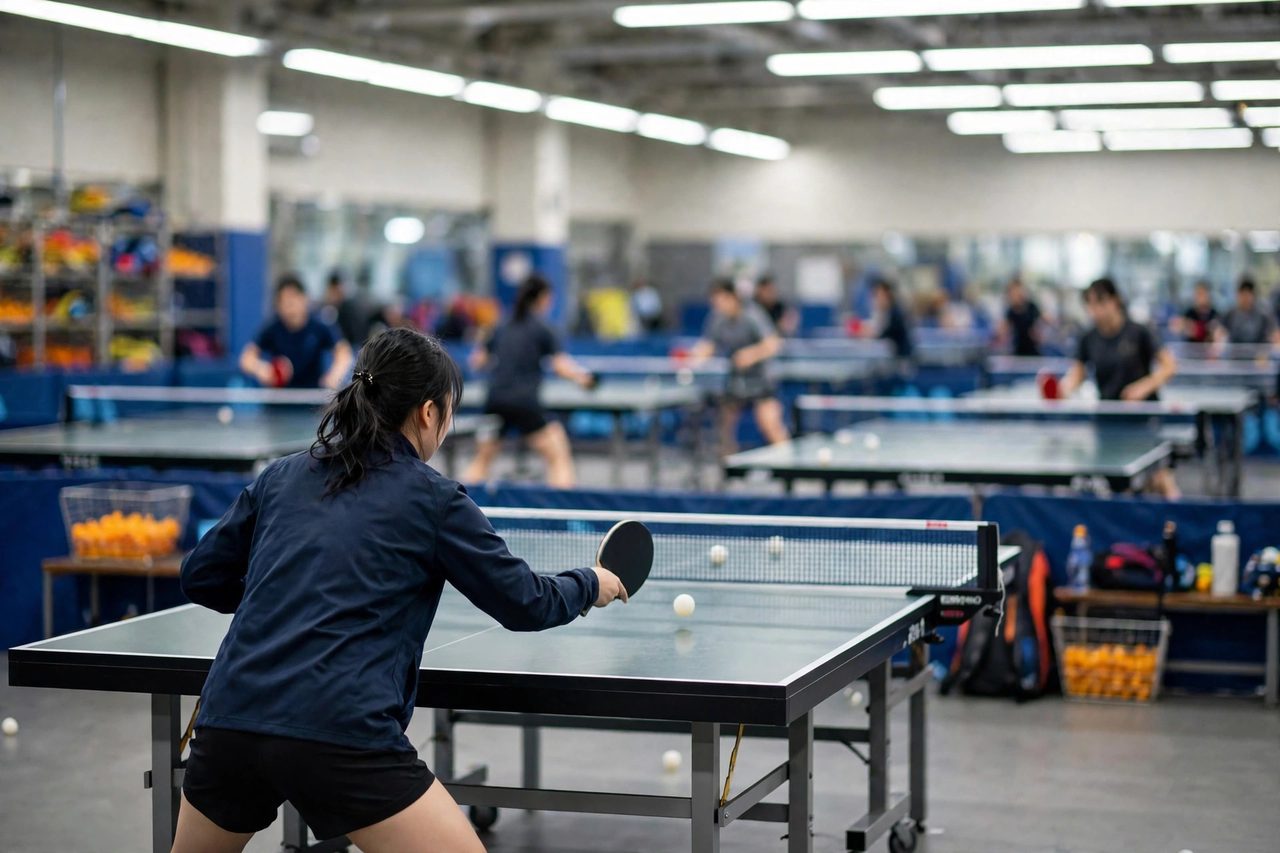
When people talk about table tennis, two countries dominate the conversation: China, which wins almost everything, and Japan, which produces stars and huge crowds. South Korea rarely gets mentioned first. That is strange, because South Korea has been one of the sport’s great powers for nearly forty years. It just goes about it more quietly.
Table tennis arrived in Korea in the early twentieth century, and it grew fast. It was cheap, it could be played indoors, and it fit into school life. By the 1980s, South Korea was already a force. At the Seoul Olympics in 1988, the first Games to include table tennis, South Korea won medals on home soil and announced itself as a serious table tennis nation.
The golden moment: Athens 2004
Every table tennis country has a hero. South Korea’s is Ryu Seung-min. At the Athens Olympics in 2004, Ryu won the men’s singles gold medal. Singles means one player against one player, and the Olympic singles title is the most prized prize in the sport outside the World Championships.
Ryu’s win mattered because of who he beat. China had dominated men’s table tennis for years, and beating a Chinese player in an Olympic final felt almost impossible. Ryu did it with an attacking penhold style. Penhold is a grip where you hold the handle like a pen, and it was already becoming rare at the top level. Ryu proved it could still win the biggest prize in the sport.
Ryu’s gold is still the high point of South Korean table tennis. It showed that a player from outside China could reach the very top, and it inspired a generation of Korean kids to pick up a racquet.
The system: schools, companies, and discipline
South Korea’s strength comes from its system. Table tennis is built into school sport, with talented kids spotted early and trained hard. The best players then join company teams. A company team is a professional team funded by a big business, where players train full-time and compete in the national league. This model gives players a stable career and a daily training environment, which is why South Korea keeps producing solid professionals even when it does not produce superstars.
The style of Korean table tennis reflects that system. Korean players are known for fitness, footwork and fighting spirit. They train long hours, they chase every ball, and they rarely give a point away cheaply. If Chinese players are known for flawless technique and Japanese players for creativity, Korean players are known for refusing to quit.
That spirit has produced a long line of strong teams. South Korea’s men’s and women’s teams have regularly reached the semi-finals and finals of World Championships team events, even when they could not get past China in the final. A team event is a competition where countries play each other, with several players contributing wins to the team total. Reaching the last four of a team World Championships, with China in the way, is a serious achievement.
The new generation: Shin Yubin
The current face of South Korean table tennis is Shin Yubin. Born in 2004, Shin was a child prodigy who joined the national team at just 14, the youngest Korean player ever selected. She plays right-handed with the shakehand grip, the most common grip in the modern game, where you hold the handle like shaking hands.
Shin’s breakthrough came at the Paris Olympics in 2024. She won two bronze medals: one in the mixed doubles with Lim Jong-hoon, and one in the team event. Mixed doubles is a doubles event with one man and one woman on each side. The mixed doubles bronze was South Korea’s first Olympic table tennis medal in 12 years, since the men’s team medal at London 2012. That 12-year gap tells you how hard it is to win an Olympic medal in this sport when China and Japan are in the way.
Shin is now one of the most popular young athletes in South Korea. She is known for her smile, her energy and her habit of celebrating with the crowd. She has become the kind of star who brings new fans to the sport, especially young girls who see a Korean woman competing with the best in the world.
Around her, a strong group is forming. Jang Woojin has been a mainstay of the men’s team for years. An Jaehyun, Lim Jonghoon and Oh Junsung all play regularly at WTT events, the professional world tour. At this week’s WTT Champions event in Montpellier, South Korea has players in both draws, fighting for ranking points against the world’s best.
Why Korea stays in the shadows
So why does South Korea not get more attention? Part of it is geography. The sport’s media attention focuses on China, where the biggest stars play, and on Japan, where the crowds are enormous. South Korea’s domestic league is strong but not widely broadcast outside the country. Its players are respected by everyone on tour, but they are not marketed the way Chinese or Japanese stars are.
Part of it is also that South Korea has not won another Olympic singles gold since Ryu in 2004. Team medals and doubles medals are real achievements, but singles gold is what makes headlines. Until another Korean player wins one, the country will keep its quiet reputation.
But quiet does not mean weak. South Korea has been in the world’s top group for four decades. It has an Olympic champion, a deep training system, a new star in Shin Yubin, and a team that can beat anyone except China on a good day. In a sport where most countries dream of a single medal, that is a powerhouse.
The next time you watch a big tournament, look past the favourites. The Korean player in the draw, the one chasing every ball and smiling after every point, might just be the one who ruins someone’s week.
Related articles

The Squash Ball: Why the Ball That Barely Bounces Makes Squash So Hard
A cold squash ball drops like a stone. Warm it up, and it comes alive. Here is the strange science behind the smallest, quietest ball in racquet sports — and the coloured dots that tell you which one to play with.
From Celluloid to Plastic: The Little Ball That Changed Table Tennis
The table tennis ball is smaller than a golf ball and weighs less than a coin — yet it has been changed twice in 25 years, and players still argue about it.
Ping Pong vs Table Tennis: One Sport, Two Names, One Big Argument
Ping pong and table tennis are the same sport, so why do we argue about the name? The answer starts with a trademark from 1901.