
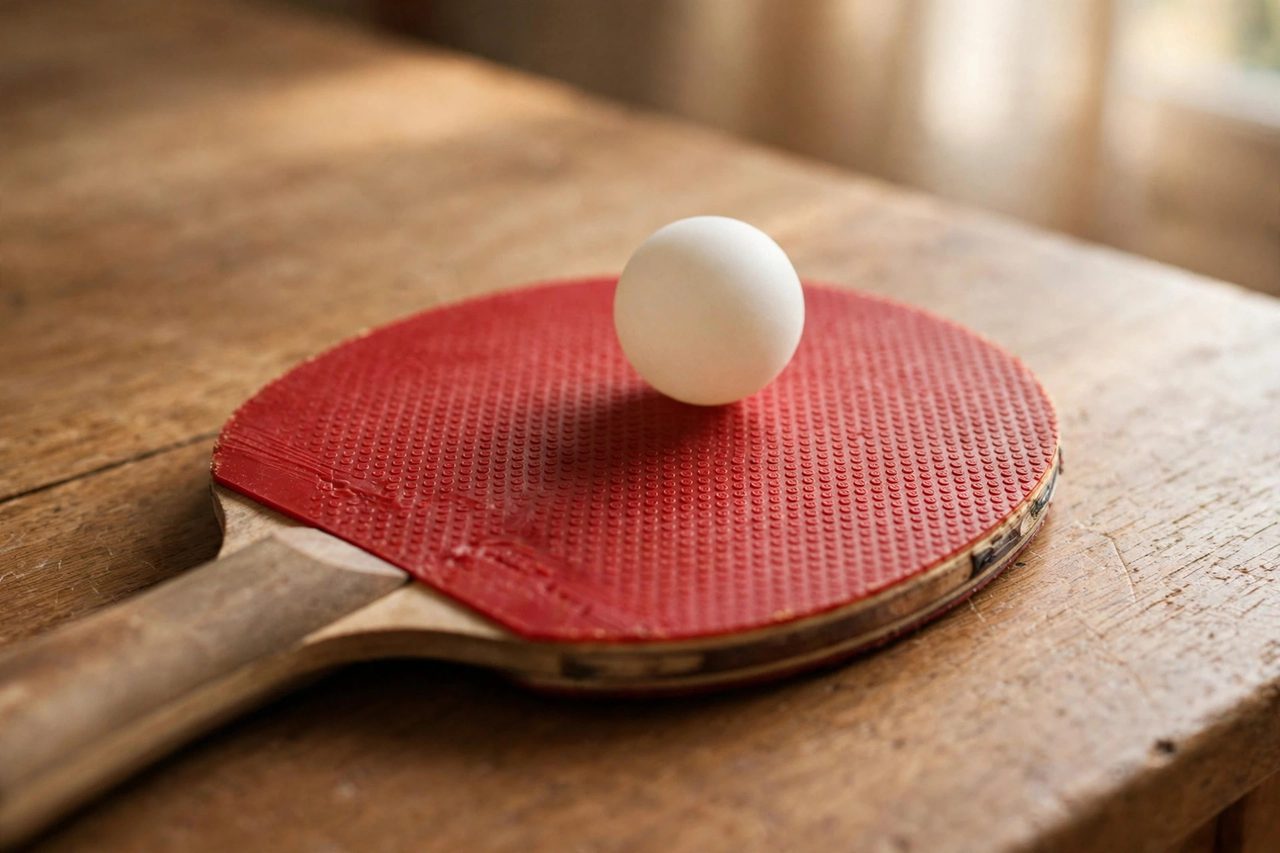
Some products have a short moment and fade away. The Butterfly Tenergy 05 is not one of them. It came out in 2008, and nearly two decades later it is still the rubber others get compared to. Pros from Timo Boll to Zhang Jike have played with it, and club players everywhere still swear by it. So what makes a rubber from 2008 still worth your money? Quite a lot — if you are the right kind of player for it.
What it is
A table tennis rubber has two parts. The topsheet is the thin outer skin that touches the ball. The sponge is the soft layer underneath it, and it decides how much bounce and speed you get.
The Tenergy 05 pairs a grippy, non-tacky topsheet with Butterfly’s Spring Sponge. Grippy means the surface grabs the ball without feeling sticky — unlike a tacky rubber, which feels slightly gluey. Spring Sponge is a bouncy sponge filled with tiny air bubbles that act like little springs, giving the ball extra energy. Butterfly calls the whole package High Tension technology.
It is an inverted rubber: the small pimples point inward, toward the sponge, leaving a smooth outer surface — the standard setup for attackers. It comes in black or red, in 1.7, 1.9 or 2.1 mm sponge thickness, and it is made in Japan.
Butterfly’s own ratings: sponge hardness 36 degrees, speed 13.0 and spin 11.5. In plain terms, the speed is at the very top of the range, and the spin is nearly there too.
How it plays: spin first, with a high, safe arc
The Tenergy 05 is famous for one shot above all: the loop. A loop is the big attacking forehand stroke in modern table tennis — you brush up the back of the ball so it spins forward fast, dips onto the table, and jumps away from your opponent. Topspin is the rotation that makes the ball curve and drop, and the Tenergy 05 creates more of it, more easily, than almost any rubber of its generation.
The ball flies in a high arc — it curves up over the net and drops sharply onto the other side, so even a mistimed loop often lands. Against backspin, spin that makes the ball float and drop, the 05 lifts the ball with confidence, so opening up against a heavy chop or push feels easier than with most fast rubbers.
The rubber also has a strong catapult effect: extra bounce from the sponge springing back, so it feels like the rubber is helping you. That is why counter-looping feels so natural with it. A counter-loop is looping back against your opponent’s loop, from mid-distance — you swing, and the ball comes off with pace and spin to spare.
Where it surprises people is the slower game. For such a fast rubber, it is calm on gentle touches: short pushes and serves stay low and tight, and the flip — a quick attacking shot over the table against a short serve — is quick and sharp.
The trade-off shows up when you play passively. A block is a defensive shot where you hold your blade up and let the opponent’s pace do the work. With the 05, a passive block can fly long, because the springy sponge keeps adding energy. If you like to win points by standing at the table and redirecting pace, a slower, calmer rubber will suit you better.
Which thickness should you pick?
The 2.1 mm sponge is the full-power version: maximum speed and spin, best for forehand attackers who swing hard. The 1.9 mm is the balanced choice — still fast, but easier to control, and a good fit for the backhand. The 1.7 mm is the control version: less speed, more touch, best for placement and the short game. If this is your first fast rubber, go 1.9 mm.
Who it is for
The Tenergy 05 is at its best for intermediate to advanced attackers. If you already loop with a full swing, play close to mid-distance, and want heavy spin with a safe, high arc, this is still one of the best rubbers you can buy. It works on both wings but shines brightest on the forehand, and pairs well with a medium-fast offensive blade — fast enough to help, but not so stiff that the setup becomes unforgiving.
It is less suited to beginners. The springy sponge needs good technique to unlock, and a beginner will get more fun, and probably more wins, from a softer, more forgiving rubber. It is also not the cheapest way to learn: at around $70–80 per sheet in the US, it costs about twice as much as many good club rubbers.
One honest note: the topsheet holds its grip well with basic care, but the springy feel fades over time, so most regular players replace it after a few months of heavy play. Wipe it clean after each session and keep a protective sheet on it — dust kills the grip.
The family, and the verdict
The 05 is the spinniest member of the Tenergy family. For a softer feel there is the Tenergy 05 FX, with the same topsheet and a softer sponge. For more punch and a lower arc there is the Tenergy 05 Hard, with a firmer 43-degree sponge. Butterfly’s newer Dignics range, including the Dignics 09C, pushes spin further still — at a higher price, with a harder feel.
So is a rubber from 2008 still worth buying in 2026? If you are a committed attacker who wants the heaviest, safest spin in a rubber that forgives your timing — yes. Newer rubbers have caught up in parts, but almost none do the whole job this well, and none have this track record. It will not fix a broken loop. But if your loop is already there, it will make it heavier, safer and scarier — and after eighteen years, that is still exactly what a great attacking rubber should do.
Related articles
Tecnifibre Slash 125 Review: Light, Fast and Built to Attack
The Tecnifibre Slash 125 is the power frame of the Slash range: 125 grams, a big 485 cm² head, a bumperless X-TOP design and the open-core build made with Mostafa Asal. We put it to the test.
Butterfly Dignics 09C Review: The Spin Monster That Rewards Big Swings
Tacky topsheet, hard 44-degree sponge, huge spin: the Butterfly Dignics 09C is a premium forehand rubber for players who loop hard. What it does well, who it suits, and who should skip it.
Butterfly Timo Boll ALC Review: The Blade Behind a Legend's Forehand
The Butterfly Timo Boll ALC is a 5-ply wood, 2-ply Arylate-Carbon blade of about 86 grams. It gives attacking players speed, spin and control — but it asks for good technique in return.