
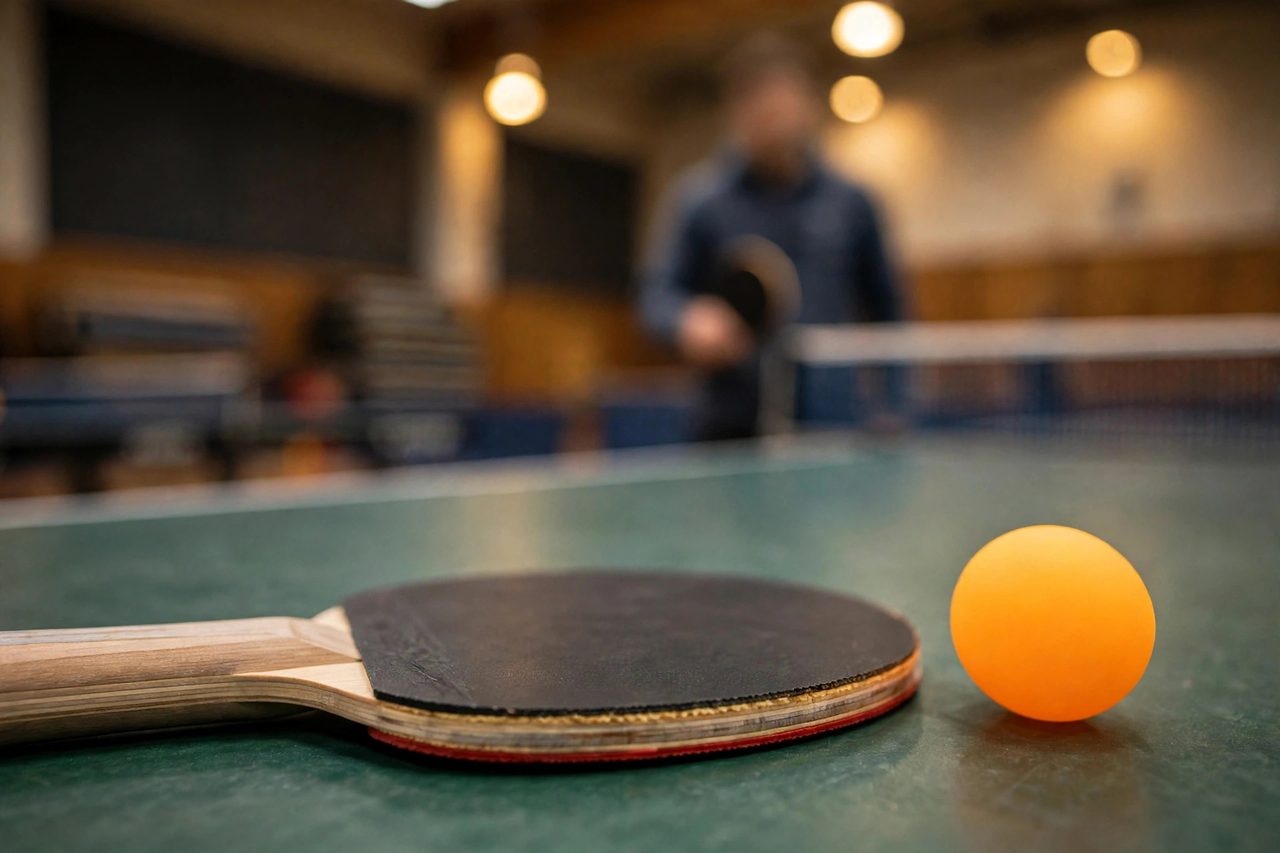
Some table tennis blades become famous because a star uses them. The Butterfly Timo Boll ALC became famous because it stayed famous. It was designed with Timo Boll, Germany’s greatest ever player, and it has been one of the most popular attacking blades in the world for well over a decade. There is a reason for that. It does a lot of things well, and almost nothing badly.
First, a quick explainer. A blade is the wooden part of a table tennis racquet, without the rubbers. Players glue a rubber on each side: usually one for the forehand and one for the backhand. The blade decides much of how the racquet feels. A fast blade gives you more speed. A slower blade gives you more control. The Timo Boll ALC sits in the attacking middle: fast, but not wild.
The specs
The headline numbers are simple. The Timo Boll ALC is a 5+2 blade. That means it has five layers of wood and two layers of Arylate-Carbon. Arylate-Carbon is a man-made fibre layer. It is softer than pure carbon, so it keeps some feel, but it still adds speed and makes the hitting area bigger. The hitting area, often called the sweet spot, is the part of the racquet where the ball comes off best. A bigger sweet spot means more of your shots feel clean, even when you do not hit the ball perfectly.
The outer wood layer is limba, a soft wood that helps the ball stay on the racquet a fraction longer. That longer contact time is called dwell time, and it helps you create spin. Spin is what makes the ball curve and dip in the air. The core of the blade is kiri, a light wood that keeps the weight down.
The blade weighs around 86 grams, measures about 5.8 millimetres thick, and has a head size of 157 by 150 millimetres. It comes in three handle shapes: flared, straight and anatomic. A flared handle gets wider toward the bottom, so it sits securely in your hand. A straight handle is the same width all the way down. An anatomic handle is shaped to fit the hand. Most players pick the flared version. Butterfly rates the blade as OFF, which is its class for offensive blades. OFF means it is built for attack, not defence.
On the table: the forehand
This blade is at its best when you attack with your forehand. A forehand topspin, often called a loop, is the big attacking shot in modern table tennis. You brush up the back of the ball so it spins forward fast, dips down onto the table, and then jumps away from your opponent. The Timo Boll ALC is made for that shot.
The limba outer layer gives you the soft touch to brush the ball, and the Arylate-Carbon layers give you the extra speed to finish the point. The result is a loop that feels controlled rather than frantic. You can swing hard and still place the ball where you want it. That balance is the blade’s whole selling point. Pure carbon blades are faster, but they can feel harsh and hard to control. All-wood blades feel lovely, but they can lack punch against strong opponents. The Timo Boll ALC sits between those two worlds.
The backhand is good too, especially for blocking and counter-attacking. Blocking is when you hold your racquet still and let your opponent’s speed do the work, sending the ball back with a short, firm touch. Counter-attacking is when you attack your opponent’s attack instead of just blocking it. The blade is stable enough for both, and the larger sweet spot helps when a fast ball arrives at an awkward angle.
The short game and the trade-offs
No blade is perfect, and this one has two things to know before you buy it. The first is the short game. The short game is the soft, close-to-the-net part of table tennis: short serves, gentle pushes, and delicate flicks. A fast blade makes the short game harder, because the ball wants to fly off the racquet. The Timo Boll ALC is forgiving for its speed class, but it still rewards players who have soft hands. If your short game is shaky, this blade will not hide it.
The second trade-off is that it asks for decent technique. Beginners who are still learning the basic strokes will get more from a slower, all-wood blade. The Timo Boll ALC is best for intermediate and advanced players who already loop with confidence and want a blade that keeps up with them as they get faster.
There is also the price. Butterfly blades sit at the top of the market, and this one is no exception. You are paying for Japanese manufacturing quality and for a design that has been refined over many years. It is an investment, not a starter purchase.
Who should buy it
Buy the Timo Boll ALC if you are an attacking player who loops from both wings, wants a blade that balances speed with control, and already has solid technique. It suits two-winged loopers, which means players who attack with both forehand and backhand. It also suits players moving up from a slower blade who want more speed without jumping to a wild, ultra-fast carbon blade.
Skip it if you are a beginner, a defensive player, or someone who mainly blocks and pushes. Defensive players, who win points by returning everything and waiting for mistakes, will find it too fast. Beginners will learn faster on a slower blade.
The verdict
The Timo Boll ALC has lasted because it gets the balance right. It is fast enough for serious attacking play, soft enough to feel the ball, and forgiving enough that good shots feel great and decent shots still land. It will not fix your technique, and it will not turn a defensive player into an attacker. But if your game is already built on the forehand loop, this is one of the safest upgrades in the sport. There is a reason it has been a bestseller for years. It earns it, one topspin at a time.
Related articles
Butterfly Tenergy 05 Review: The Spin Classic That Still Sets the Standard
Launched in 2008 and still the most trusted rubber in table tennis: the Butterfly Tenergy 05 pairs a grippy topsheet with Spring Sponge for huge spin and a high, safe arc. What it does well, who it suits, and who should skip it.
Tecnifibre Slash 125 Review: Light, Fast and Built to Attack
The Tecnifibre Slash 125 is the power frame of the Slash range: 125 grams, a big 485 cm² head, a bumperless X-TOP design and the open-core build made with Mostafa Asal. We put it to the test.
Butterfly Dignics 09C Review: The Spin Monster That Rewards Big Swings
Tacky topsheet, hard 44-degree sponge, huge spin: the Butterfly Dignics 09C is a premium forehand rubber for players who loop hard. What it does well, who it suits, and who should skip it.